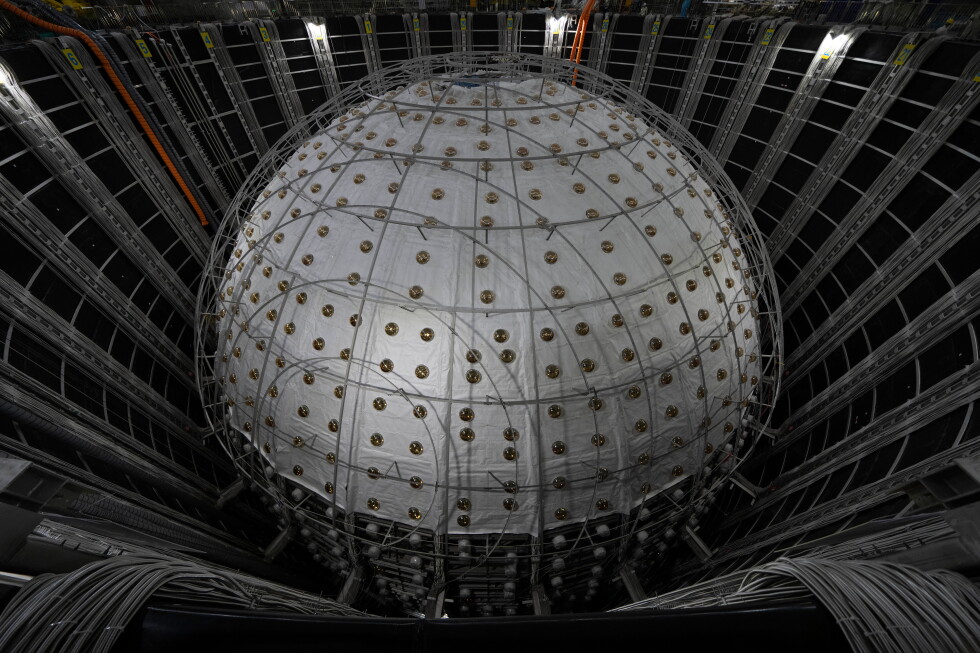
NEW YORK — One of the most ambitious particle physics experiments of the decade has delivered its first groundbreaking data, bringing scientists closer to unraveling one of the biggest unsolved mysteries of the universe: the nature of neutrinos, the nearly massless ‘ghost particles’ that permeate every corner of space. On Wednesday, the international collaboration behind China’s Jiangmen Underground Neutrino Observatory (JUNO) published its first major findings in the journal *Nature*, marking a major milestone in global particle physics research.
Located 700 meters (2,297 feet) underground to block out interfering cosmic radiation, the massive spherical JUNO detector began its official data collection phase in August this year. The observatory was built to study neutrinos — ultra-tiny subatomic particles that originated in the Big Bang, travel close to the speed of light, and pass trillions strong through the human body every second without any measurable harm. For decades, neutrinos have baffled researchers: their near-zero mass makes them extremely difficult to detect, despite their ubiquity in the universe.
Instead of directly observing ancient cosmic neutrinos, JUNO focuses on studying antineutrinos — the antimatter counterparts of neutrinos — produced by fission reactions in two nearby operating nuclear power plants. When antineutrinos collide with particles inside the detector, the interaction generates a faint flash of light that researchers can capture and analyze to map the particles’ properties.
From just two months of initial data collection, the JUNO team has already produced some of the most precise measurements ever recorded of a key neutrino behavior: the phenomenon of neutrino oscillation, in which the particles shift between three distinct ‘flavors’ — electron, muon, and tau — as they travel through space. These early measurements confirm that the observatory is functioning at the sensitivity its designers projected, even earlier than many project members expected.
While the initial results have not yet settled the central question that drove the construction of JUNO — determining the exact mass ordering of the three neutrino flavors — researchers say the data proves the detector can deliver on its core promise. Physicists currently know that two of the three flavors have similar masses, while the third differs significantly, but they have not confirmed whether the outlier is lighter or heavier than the other two. Resolving this mass ordering question will reshape fundamental understandings of cosmology and the formation of the early universe.
“The initial results already demonstrate that JUNO will be able to probe the subtle differences that separate the neutrino flavors and their mass hierarchies,” explained Liangjian Wen, study co-author and member of the JUNO international collaboration. Outside physicists not involved in the research also expressed enthusiasm about the milestone. Kate Scholberg, a particle physicist at Duke University, noted that the first data release builds major excitement for future discoveries from the observatory.
JUNO’s findings will eventually be cross-checked by two other cutting-edge neutrino experiments currently under development: Japan’s Hyper-Kamiokande and the United States’ Deep Underground Neutrino Experiment (DUNE). Both facilities are scheduled to begin data collection within the next 10 years, using different experimental approaches to verify JUNO’s conclusions and advance global research into neutrino properties.
This reporting, produced by the Associated Press Health and Science Department, receives support from the Howard Hughes Medical Institute’s Department of Science Education and the Robert Wood Johnson Foundation, with the AP retaining full editorial control over all content.