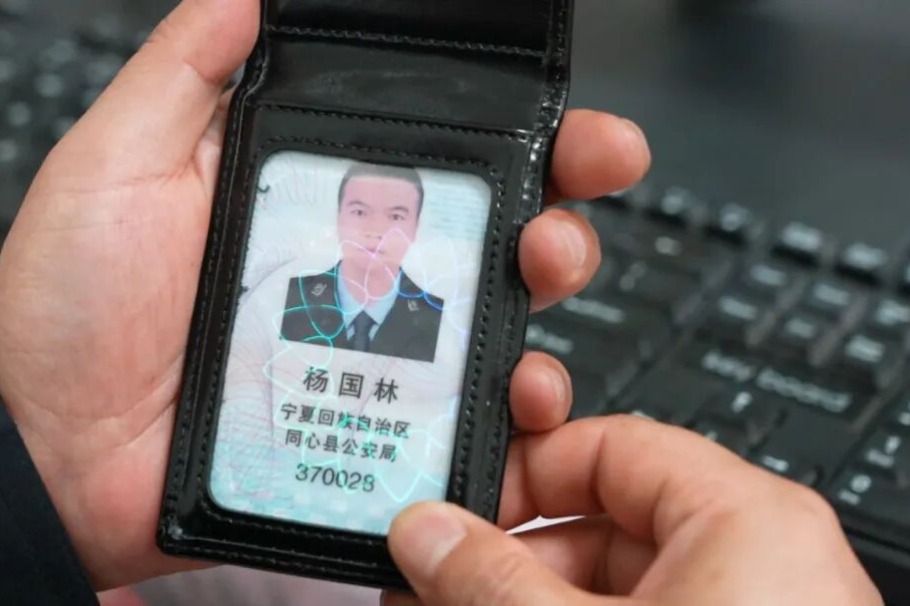
On the evening of October 31, 2025, a routine on-call shift at Yuwang Police Station in Ningxia’s Tongxin County turned into a fatal test of courage for 34-year-old duty officer Yang Guolin. The emergency call that came in that night carried an urgent plea: a tanker driver had collapsed inside the vehicle’s tank while cleaning it, lying unconscious at the bottom with no sign of movement. With the nearest professional rescue team more than 70 kilometers away — a 90-minute drive that the victim could not wait out — Yang and his colleague Ma Chao rushed to the scene immediately.
When the two officers arrived, panic had already taken hold of the crowd gathered at the site. Climbing onto the top of the tank, Yang shone his flashlight through the narrow hatch, confirming the driver’s motionless form at the bottom. The air inside the sealed tank was thick with toxic fumes, and no professional breathing apparatus was available on site. Refusing to wait for backup, Yang grabbed the only protective gear that could be scavenged from bystanders: an N95 mask and a damp cloth, and lowered himself into the hazardous space.
Inside the tank, suffocating fumes quickly overwhelmed Yang. After failing to rouse the unconscious driver, he pulled himself back to the hatch to catch his breath and call for a rope. When Ma Chao saw Yang’s lips turning purple — a clear warning sign of toxic poisoning — he begged Yang to pull himself out immediately. Yang’s response was short and unshakable: “If I come up, what happens to the driver?” He turned back into the tank to finish the rescue.
What would have been a straightforward operation with proper equipment became a brutal battle against Yang’s own failing body. His fingers stiffened from toxic exposure, every movement drained the last of his strength, but he still managed to secure the rope around the driver’s torso and push the man up toward the hatch. When the driver began to slip back, Yang made one final, desperate lift to push him to safety.
The driver survived. Yang collapsed inside the tank, less than two meters from the hatch he never reached. Though rescuers pulled both men out and rushed them to the hospital, Yang was pronounced dead shortly after arrival.
Yang’s life was defined by quiet commitment to serving his community long before that fateful night. Born in 1991 to a rural family in Tongxin, Yang became the first university graduate in his family, graduating from Beijing City University in 2016. At a time when most young graduates from small towns chased opportunities in wealthy metropolises, Yang made the deliberate choice to return to his hometown. “We’re from Tongxin,” he often said. “We ought to do something for our hometown.”
In 2018, he deepened that commitment by volunteering for a teaching post in Artux, Xinjiang Uygur Autonomous Region. Taking over a fifth-grade Chinese class that ranked dead last in its year, he promised to lift their scores within a single semester. He spent long days and late nights preparing targeted lessons and tutoring struggling students, and by the end of the term, the class had climbed from last place to first. The experience reinforced his core belief: with full commitment, no task was impossible.
Becoming a police officer had been Yang’s lifelong dream, and he pursued it with unwavering persistence for six years. Year after year, he took the national police entrance exam, even when his wife Li Ling gently urged him to give up his stubborn quest. “This is my life’s dream,” he would tell her. “No matter how hard it is, I want to keep trying.” In the summer of 2022, his persistence paid off: he finally put on the uniform he had chased for half a decade, and volunteered for the Yuwang Police Station posting — a remote station 78 kilometers from the county seat, widely known as one of the toughest assignments in the region.
Starting out handling office paperwork, Yang quickly organized years of disorganized files and brought order to chaotic record-keeping. Unsatisfied with desk work, he requested a transfer to the case handling team, promising to master all core procedures within a month. From then on, he worked shifts in the field by day and studied legal texts and policing protocols line by line at night. It did not take long for him to earn a spot on the team.
What made Yang beloved by local residents was his refusal to dismiss any problem as “too small” to matter. On a stormy autumn night, when a group of local villagers were owed more than 340,000 yuan in plowing wages and the muddy roads had become impassable to vehicles, Yang trekked more than one kilometer through rain and sludge to reach the site. Soaked to the bone, he mediated the dispute immediately, and did not leave until the employer paid the full owed amount on the spot.
On another occasion, an elderly shopkeeper was left distraught after a customer underpaid him by 100 yuan — money the elderly man relied on for his livelihood. Yang reviewed the shop’s surveillance footage, tracked down the customer, and drove 40 kilometers that same night to recover the full amount. When the old man later brought homegrown vegetables to thank him, Yang refused the gift, saying the 100 yuan was the old man’s hard-earned money and he was only glad to return what was owed.
In the summer of 2024, a string of shop burglaries left local merchants on edge. Yang spent days working the case, connecting incident patterns, analyzing clues, and eventually identified and arrested the culprit. After that, local shopkeepers often said: with Officer Yang around, we feel safe.
Yang drew inspiration from the station’s long tradition of heroic service. Early in his career, after learning the story of Hai Xiaoping, a young officer who died of overwork and was named a second-class national hero model, Yang wrote in his notebook that he hoped to emulate Hai’s courage in the face of hardship and danger. That promise was fulfilled in his final act.
After Yang collapsed, his colleague Ma Chao jumped into the tank to hold him, continuing to shout for help even after he was pulled out, exhausted and half-conscious, calling Yang’s name until he lost consciousness.
Yang leaves behind his wife and an infant son. His last text exchange with his wife ended just 30 minutes before the emergency rescue call came. When he was laid to rest, dozens of villagers came spontaneously to pay their respects, including an elderly local man whom Yang had supported quietly for years, listing himself as the man’s emergency contact and visiting regularly with daily supplies. The old man had repeatedly invited Yang to stay for a meal, and Yang always said he was too busy, that he would come next time. There would be no next time.
Yang served as a full-fledged police officer for just three years. In that short time, he handled more than 100 cases, earned the unwavering trust of both villagers and colleagues, and gave his last breath to save a stranger’s life. While many careers are measured by rank or length of service, Yang Guolin’s legacy will be forever tied to a damp cloth, a rope held by stiffening fingers, and a final choice to never leave someone behind.