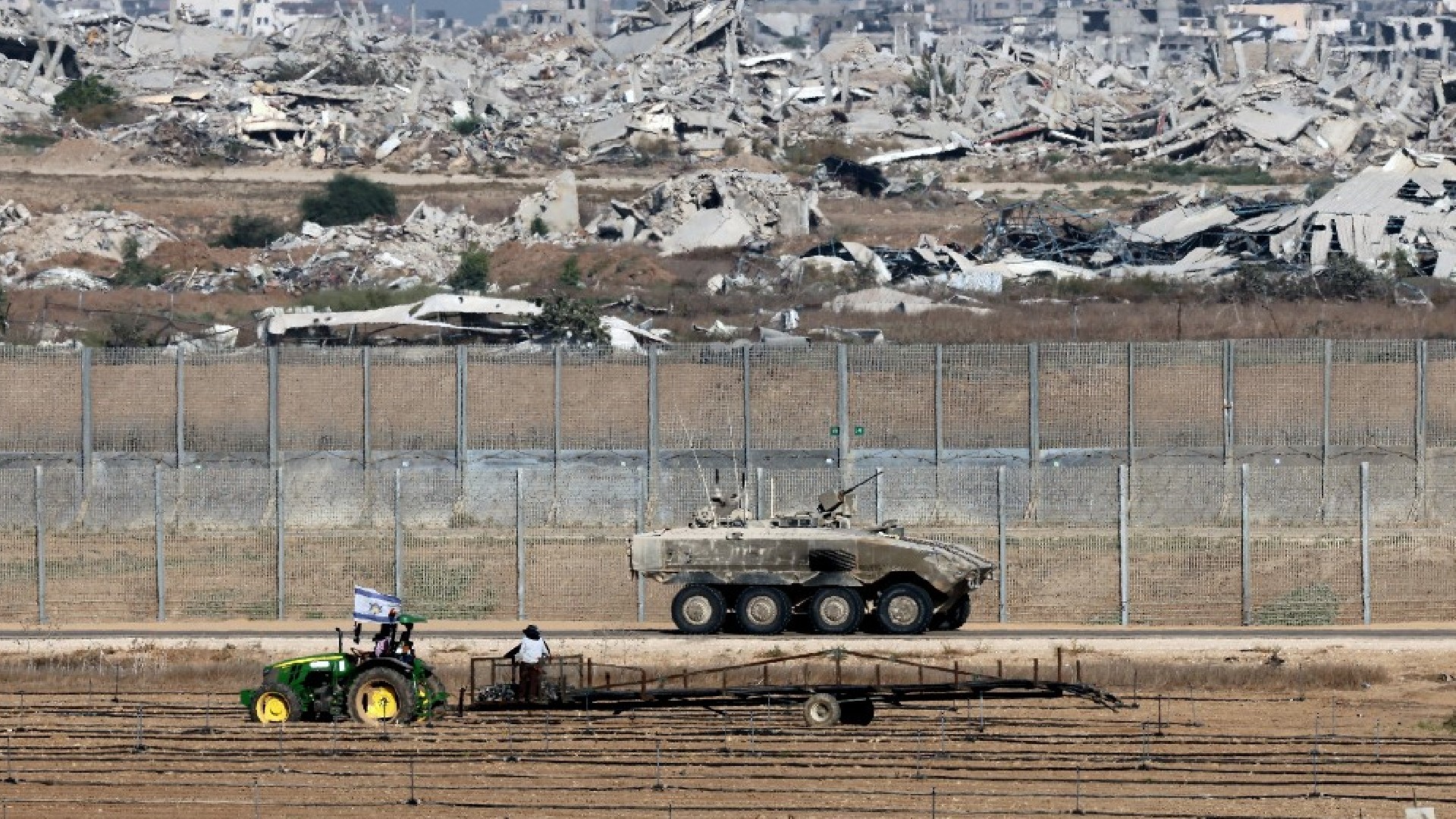
Naim Abu Amra, a Palestinian farmer from Deir al-Balah in central Gaza, once cultivated a thriving 11-dunam (one hectare) plot of land. His greenhouses, powered by solar panels and a small diesel pump, yielded tomatoes, cucumbers, peppers, and courgettes, sustaining his family of eight and providing seasonal employment. However, the onset of Israel’s military campaign in October 2023 turned his life upside down. The area was declared a ‘no-go zone,’ and his greenhouses were obliterated, irrigation systems destroyed, and wells filled with debris. ‘Military bulldozers leveled the land to bare soil; even the plastic and metal structures melted under the bombing,’ Abu Amra recounted to Middle East Eye. His once-fertile fields are now littered with rubble and unexploded ordnance, rendering them unusable. Despite the devastation, Abu Amra and his sons have begun clearing debris by hand, planting small patches of okra and molokhia using collected rainwater. ‘The war didn’t just take our crops. It took our future,’ he lamented. The destruction of Gaza’s agricultural sector is staggering. A joint assessment by the Food and Agriculture Organization (FAO) and the United Nations Satellite Centre (UNOSAT) revealed that over 95% of Gaza’s agricultural land is now inaccessible, with 80% of cropland damaged and 77.8% of it unusable. The sector, which once contributed 11% to Gaza’s GDP and supported 560,000 livelihoods, now accounts for less than 2%. Bahaa Zaqout of the Palestinian Agricultural Development Association (PARC) described the destruction as ‘deliberate and carefully planned.’ Israel’s blockade has long restricted agricultural inputs, but since October 2023, the policy has intensified, aiming to eradicate the sector entirely. The World Bank estimates that restoring Gaza’s agriculture will cost $8.4 billion, with one of the biggest challenges being the clearance of 61 million tonnes of debris, 15% of which contains toxic substances like asbestos. Israel has barred the entry of heavy equipment needed for cleanup, further complicating recovery efforts. Mariam Al-Jaajaa of the Arab Group for the Protection of Nature (APN) highlighted the weaponization of seeds, which Israel deems ‘dual use’ and blocks from entering Gaza. Despite these obstacles, APN has supported over 700 farmers in cultivating 13,000 dunams of land, producing seven million kilograms of vegetables. However, the cost of cultivation has skyrocketed from $5,000 to $25,000 due to the siege. Jaajaa criticized international NGOs for focusing on food aid rather than supporting agricultural recovery, emphasizing the political implications of Palestinians regaining control over their land. ‘You can’t have a sustainable resolution without having justice,’ she asserted. The road to recovery is long and fraught with challenges, but for farmers like Abu Amra, restoring their land is not just about livelihoods—it’s about reclaiming their future.