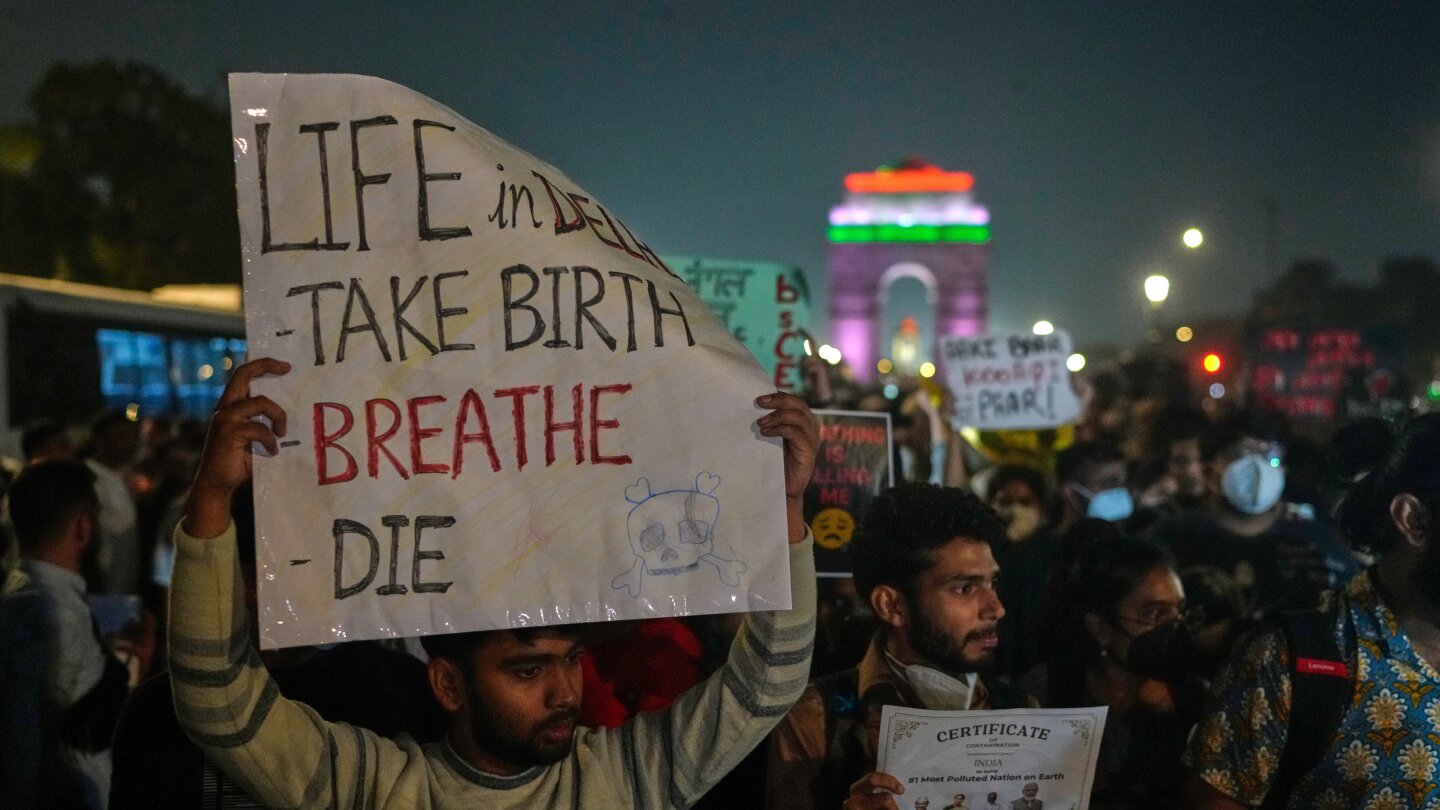
New Delhi, India’s capital, was shrouded in a dense layer of smog on Monday, with air pollution levels reaching hazardous heights and exacerbating an ongoing public health crisis. The air quality index (AQI) soared to 344, a level classified as ‘severe’ by the World Health Organization (WHO), posing significant risks to residents’ health. The acrid smell of pollution permeated the city, prompting widespread concern and frustration among its inhabitants. On Sunday evening, hundreds of protesters, including parents and environmental activists, gathered at India Gate in a rare demonstration, demanding immediate government action. Many participants wore masks and carried placards, with one reading, ‘I miss breathing.’ Meghna, a protester who only provided her first name, expressed her distress, stating, ‘I am here just as a citizen who cares and who is worried about the state of situation that we are in with respect to the lack of clean air to breathe.’ However, police intervened, confiscating banners and placards and dispersing the crowd, citing a lack of permission for the protest. The worsening air quality has led to a surge in health complaints, including headaches and persistent coughs, fueling public anger toward politicians accused of inaction and blame-shifting. New Delhi, home to over 30 million people, consistently ranks among the world’s most polluted cities, with India hosting six of the top 10 globally. The city’s air quality deteriorates further during winter due to crop residue burning in neighboring states, combined with vehicle and industrial emissions. Cool, dry, and windless conditions trap toxic particles, sometimes pushing pollution levels to 20 times the WHO’s safe limit. While authorities have implemented temporary measures such as construction bans, diesel generator restrictions, and cloud-seeding experiments, critics argue that only long-term emission reduction strategies can provide lasting relief.