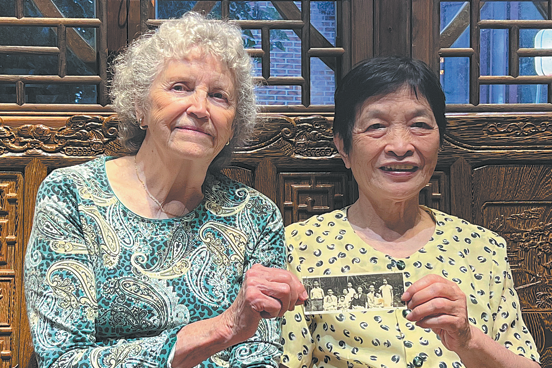
In the mountainous retreat of Kuliang, where foreign residents once sought refuge from Fuzhou’s subtropical heat, an extraordinary cross-cultural friendship has withstood eight decades of separation and geopolitical shifts. The story begins in November 1941 when two families—one Chinese, one American—welcomed daughters on the same day at Fuzhou’s Anglo-Chinese College. The coincidence prompted the families to name both girls after the institution’s Chinese name, Yinghua Middle School, creating an immediate bond between Li Yiying and Gail Harris (Chinese name Bi Lehua).
Their childhood unfolded against the backdrop of Kuliang’s international community, which flourished from the late 19th century as a summer sanctuary for foreigners from more than 20 nations. The girls spent idyllic summers exploring the hills, fishing in creeks, and sharing sweets—forming what Harris describes as “a twin-like connection” despite their different cultural backgrounds.
This childhood chapter abruptly closed in 1948 when Harris’s family returned to the United States. “We were devastated when we left China when I was 7,” Harris recalled. “I never imagined I would return.” For decades, their connection survived only through fading photographs and distant memories until a miraculous reunion in 2014 brought the sisters-by-bond back together in Fuzhou.
The emotional reconnection sparked broader interest in Kuliang’s multicultural heritage. Elyn MacInnis, descendant of an American family with deep Kuliang roots, has spearheaded efforts to revive these cross-cultural connections through the Kuliang Friends group. “The Kuliang story demonstrates that friendship across cultures is both fragile and powerful,” MacInnis noted. “It requires time, listening, and trust-building—qualities that characterized the original community where families lived together with mutual humility and respect.”
MacInnis emphasizes that preserving Kuliang’s legacy requires both honoring historical roots and cultivating new growth through youth engagement. She points to China’s initiative to invite 50,000 young Americans over five years as particularly significant, noting that even brief cultural exchanges can create lifelong impacts. “These experiences of shared daily life and trust-building may affect participants for the rest of their lives,” she observed, adding that meaningful relationships “may not take as long as we think to form.”
Meanwhile, the rekindled bond between Li and Harris continues to flourish across generations. The childhood friends have reunited four times in Fuzhou since 2014, retracing their steps through Kuliang and introducing younger family members to their trans-Pacific heritage. Their enduring connection stands as a testament to people-to-people diplomacy and the enduring power of cross-cultural friendship.