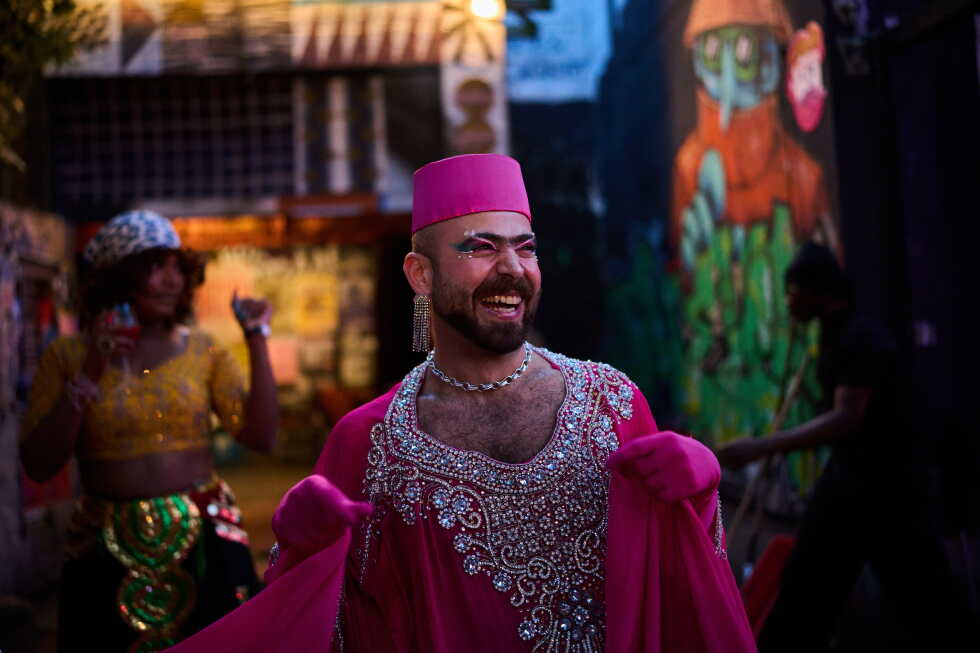
BERLIN — Just hours after a deadly extremist terror attack targeting Berlin’s annual Pride celebrations left one person dead and nearly 30 others injured, the city’s LGBTQ+ community and its allies refused to let hate steal their space, with a collective performance of resilience kicking off as scheduled on Sunday night at Museum Island.
Haidar Darwish, a 30-year-old Syrian belly dancer and performance artist who fled his home country for Germany in 2016, opened the show clad in a dramatic hoop skirt and a bold red fez, opening with a call for a quiet moment of remembrance before declaring that artistic expression and community solidarity would not be canceled by violence. “Yesterday there was an attack and a hate crime on our community in Berlin during the Pride Parade,” Darwish told the gathered crowd, his voice thick with emotion as he fought to retain his composure. “It’s heavy on our community but we are pushing through, and we are here specifically today, myself and my artists, to show up and be visible.”
Authorities confirmed on Sunday that Saturday’s attack, which involved a suspect ramming a van into crowds near the Pride festival and carrying out a stabbing spree, was classified as an extremist terrorist act. The suspect, identified as Abdul Ballout, a 21-year-old German citizen born in the country to Lebanese family, was shot and killed by police Sunday evening after he charged toward responding officers wielding a bladed weapon. The case has already sparked urgent official scrutiny: multiple public officials are now questioning how Ballout was able to move freely across Germany despite a prior conviction tied to his documented connections to the Islamic State extremist group.
Darwish took the stage as a core member of Queens Against Borders, a Berlin-based performance collective built to foster solidarity among LGBTQ+ refugees, migrants, and immigrants. He was joined on Sunday by fellow multidisciplinary queer artists: Egyptian belly dancer Aleya and Nigerian drag performer Countess Sasha Seduction, all of whom opted to proceed with the planned performance rather than cancel in the wake of the attack.
After his opening remarks, Darwish pushed through the collective grief of the community to begin his performance, starting with a slow, meditative spin in the style of traditional Anatolian dervishes. His voluminous red skirt billowed into a graceful cone as traditional Arabic melodies echoed through the venue. As the music rose in volume and tempo, Darwish shed his outer skirt, and launched into dynamic, rhythmic belly dance moves to roaring cheers from the audience.
Speaking to the Associated Press after the performance, Darwish, who performs under the stage name “The Darvish,” emphasized that the decision to perform the night after the attack carried intentional meaning beyond the queer community, reaching out to Berlin’s diverse general population and the many international tourists visiting the city. He acknowledged the exhaustion that comes with constant resistance: “we are tired to constantly be put in a position where we have to fight endlessly.” But he added that the choice to step on stage was a deliberate rejection of despair. The troupe could have easily chosen to stay home in mourning, he noted, but instead opted to channel shared pain into collective joy.
By the end of the night, that choice resonated: Darwish and the other performers danced until the entire audience rose from their seats, joining the dance floor and transforming what was expected to be a somber night of grief into a powerful demonstration of solidarity and joy in the face of hate.