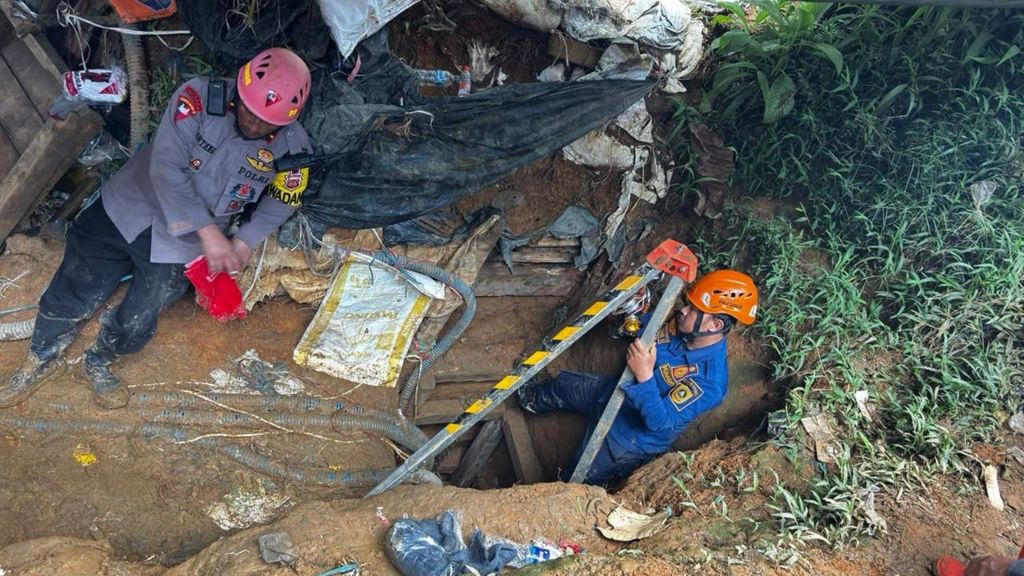
For three agonizing days, 17-year-old Rani has clung to hope since her 50-year-old father Rais left for what he thought was a routine work shift earlier this week, only to receive devastating news hours later that he was trapped deep underground in a flooded unregulated gold mine in Indonesia’s West Java province.
The disaster unfolded late Monday evening, when 26 miners were excavating in a 100-metre deep open-pit mine site. Torrential seasonal rainfall caused a nearby river to burst its banks, sending rushing floodwater surging into the mine’s two connected access shafts, cutting off all escape routes for the workers below. By Thursday, official search teams from Indonesia’s National Search and Rescue Agency (Basarnas) confirmed that 13 recovered bodies had been pulled from the waterlogged tunnels, with at least 13 additional workers still unaccounted for, feared dead.
Ground rescue operations remain fraught with extreme peril: teams are navigating slippery, pitch-black, narrow shafts that continue to fill with incoming groundwater, using specialized rope access systems to reach the deepest sections of the site. Waiting at the surface, fully staffed ambulances and emergency medical teams stand on standby to treat any potential survivors or transport newly recovered remains. Desiana Kartika Bahari, head of the Jakarta Search and Rescue Office, outlined the coordinated operational challenges in an official Wednesday statement: “We are synchronizing efforts across all deployed rescue teams to constantly monitor fluctuating water levels and map safe access routes into the mine. The extreme depth, confined entry points and near-zero visibility are all critical factors shaping our search protocols to ensure our personnel can carry out their work without additional casualties.”
This latest tragedy is far from an isolated incident, but rather the latest deadly symptom of a sprawling, long-standing illegal small-scale gold mining crisis that has taken root across Indonesia’s mineral-rich archipelago, despite a formal national ban on unlicensed operations. Over the past decade, the unregulated sector has exploded in size, directly correlated with global surges in gold prices that hit an unprecedented all-time high in early 2026, triggering a nationwide gold rush that pushed unlicensed operators to rapidly expand dig sites even in areas designated for formal, permitted mining. The flooded West Java mine sits on a concession legally held by state-owned mining firm Aneka Tambang (Antam), which has publicly clarified that the unauthorised dig site was operating entirely outside of its oversight and without any official permission from the company.
Law enforcement data hints at the scale of the unregulated activity: West Java Regional Police announced Wednesday that they uncovered 24 separate illegal mining operations across the province in just the two-month window between October and November. But independent mining policy experts warn official figures dramatically undercount the true size of the problem. Bisman Bakhtiar, Executive Director of the Center for Energy and Mining Law Studies, noted to local and international media earlier this year that the documented number of illegal sites represents only a tiny fraction of total operations, as enforcement efforts have consistently failed to make a meaningful dent. “The official numbers only reflect what authorities have managed to seize,” Bakhtiar explained. “That means the real total is far higher. This ecosystem has been allowed to grow for decades, and it remains massive today.”
Multiple anti-corruption officials have confirmed that the illegal mining sector is sustained by systemic protection networks. Laode M Syarif, former deputy chairman of Indonesia’s Corruption Eradication Committee, stated that unlicensed dig sites are nearly impossible to stamp out as long as they enjoy backing from corrupt figures within the police, military, and local and provincial government leadership. “As long as these high-level backers are not held fully accountable, illegal mining will never disappear,” he emphasized.
For thousands of low-income Indonesian workers, however, these unregulated mines represent a rare economic lifeline when few other formal employment opportunities exist, even as the work carries catastrophic risk. Without any formal safety oversight or proper structural engineering, unlicensed mines see frequent deadly accidents ranging from sudden landslides, flood events, and toxic gas exposure that claim dozens of lives every year. Earlier this year, 11 illegal miners died from a carbon monoxide leak in a dig site in the exact same West Java region as this week’s flood disaster; last May, a 30-metre cliff collapse triggered by heavy rain killed nine workers at an unlicensed West Sumatra gold mine.
The hidden, unregistered nature of the sector means the true national casualty toll from illegal mining accidents is systematically underreported. Even in the ongoing West Java flood incident, M Adam Hamdani, head of emergency and logistics at the Bogor Regency Regional Disaster Management Agency, admitted that the exact number of miners trapped remains unconfirmed, with conflicting local accounts ranging from 20 to 29 people on site when the flood hit. “No one officially registered the workers, and no site operators are willing to come forward to give an accurate headcount,” Hamdani told local Indonesian news outlet Detik.
The Indonesian Ombudsman issued an official public statement Thursday calling for a full, sweeping investigation into the West Java disaster, and urged policymakers to use the tragedy as a turning point to dismantle the entire illegal mining ecosystem rather than only carrying out superficial, post-accident crackdowns on individual dig sites. “We cannot keep only arresting the low-level miners working in the tunnels while the wealthy operators who fund the sites, supply equipment, and smuggle and sell the mined gold remain completely unpunished,” said Abdul Ghoffar, a member of the Indonesian Ombudsman. “Law enforcement must target the full support networks that keep this deadly illegal activity running.”
As rescue teams push past the 72-hour mark since the flood, the window to locate any potential survivors is rapidly closing. For Rani and dozens of other family members waiting at the mine site, each passing hour brings more uncertainty, as they hold out for any sign that their trapped loved ones are still alive. “I just hope they find my father soon, safe,” Rani shared, her voice trembling as she waited outside the cordoned-off mine site.
Deadly mine disaster highlights illegal hunt for gold