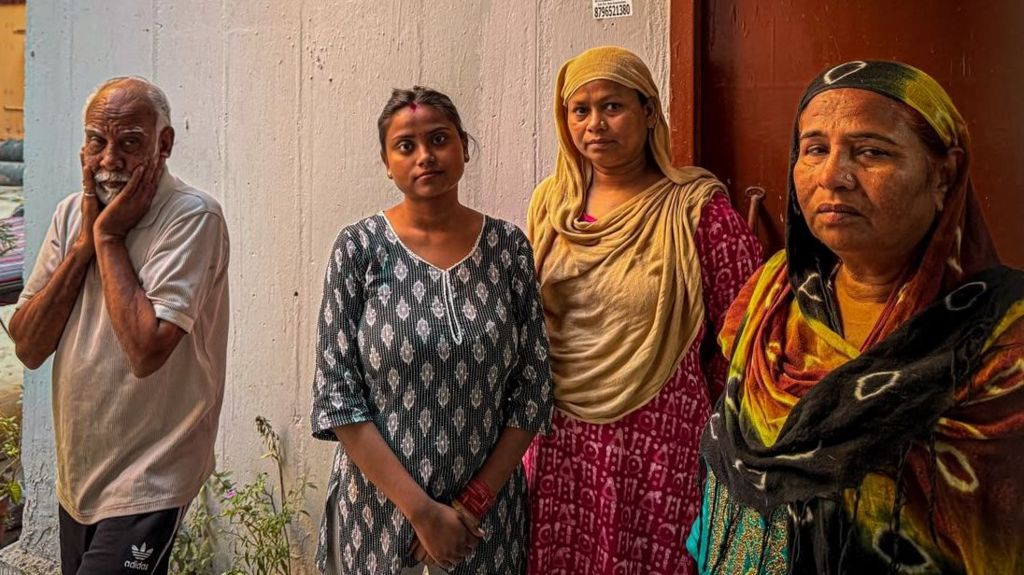
Nestled in one of Delhi’s most heavily secured, upscale central neighborhoods, steps away from the Indian Prime Minister’s official residence, the centuries-old Race Course Mosque stands surrounded by mounds of crumpled rubble, a lone surviving structure amid the flattened remains of tightly knit residential settlements that housed generations of low-wage working families. For decades, hundreds of households of drivers, cleaners, gardeners, and domestic staff occupied the small, modest homes tucked between high-security military compounds, elite private clubs, and sprawling luxury bungalows in the Race Course enclave, building interwoven lives, livelihoods, and community ties that stretched back multiple generations. That way of life was abruptly upended on October 7, when municipal authorities carried out mass demolition drives across three adjacent settlements, claiming the structures were illegally erected on government-owned land, and citing public security risks stemming from the residential clusters’ close proximity to sensitive military installations. In total, 717 families were forcibly relocated to the Savda Ghevra residential colony, a remote development situated roughly 31 miles away on Delhi’s far northern outskirts, bordering the state of Haryana. Prior to the demolition, residents had filed a petition with the Delhi High Court challenging the eviction order, arguing that a move to such a distant location would irreparably disrupt their access to existing jobs, local schools, and longstanding community support networks. The court ultimately ruled in favor of the government in August, accepting official security justifications for the clearance and noting that alternate housing units had been allocated to displaced families. Only two religious sites were spared the bulldozers: the Race Course Mosque and a nearby Hindu temple. But within hours of the demolition, both structures had their municipal water and electricity supplies severed, and access to the surrounding compound was heavily restricted. Most worshippers are turned away at the security perimeter, with only a small handful occasionally granted entry after lengthy negotiations with posted guards. A bitter legal dispute now looms over the mosque itself: government officials assert full ownership of the land the mosque occupies, while the Delhi Waqf Board argues the site was formally registered as waqf property under Islamic charitable law in 1977, designated a protected heritage structure, and dates back between 125 to nearly 300 years. The Waqf Board has submitted formal appeals to administrative authorities demanding the immediate restoration of utility services, while a local worshipper has filed a separate High Court petition challenging the ban on regular congregational prayers and raising fears that the mosque could face demolition in the near future. On October 29, the central government informed the Delhi High Court that it would take no punitive or demolition action against the mosque for a four-week window while reviewing the Waqf Board’s formal objections, but pushed back against demands to restore full public access for prayers, claiming safety risks remained amid ongoing nearby demolition work — a position fiercely contested by the petitioners’ legal representative. The court declined to issue immediate intervention orders, and has scheduled the next hearing for December 16. For the hundreds of displaced families who once built their lives around the mosque, the uncertainty over the site’s future is secondary to the cascading hardships of their forced relocation. Mohammad Wasim, a 50-year-old professional driver who once lived steps from the mosque, still makes the long journey back whenever he can to pray, often facing rejection at the gates from patrolling guards. On a recent weekday afternoon, he was one of only four or five worshippers inside the mosque, where a loud portable generator chugged away to provide the only source of power after municipal services were cut. “Our entire lives and our hearts are tied to this ground,” Wasim explained, gesturing to the rubble where his family home once stood, the site of both his father’s wedding and his own daughter’s decades later. “We grew up playing here. How can we ever just walk away?” The transition to Savda Ghevra has been devastating for nearly all the relocated households, who have lost easy access to the stable informal livelihoods that sustained them for generations. Rekha, a widowed domestic worker who spent decades washing dishes for nearby wealthy households and performing voluntary seva service at the local Hindu temple, now finds herself stranded in a third-floor apartment that she struggles to climb due to a metal rod implanted in her leg after a major surgery. She has lost all her former clients, and her 19-year-old son has been unable to secure steady work in the new neighborhood. “They gave us a house, but they stole our actual home,” she said. Urban policy researcher Mukta Naik, who has studied displacement patterns across Delhi for years, noted that the Race Course evictions fit a long-running pattern of working-class communities being systematically pushed to the city’s peripheries, largely because they lack formal land ownership documentation for sites they have occupied for generations. “This kind of distant relocation completely severs their ties to jobs and the informal mutual support networks they have relied on for decades,” Naik told the BBC. “It leads to massive drops in income and livelihood loss, and as families scatter to find whatever work they can, those critical community safety nets are almost impossible to rebuild. They end up having to fend entirely for themselves.” Savda Ghevra was first established in 2006 on former agricultural land to house previous waves of displaced Delhi families, and its first residents arrived to find nothing but empty bare plots, with no paved roads, running water, or electricity. Over 17 years, residents gradually built the neighborhood from scratch, opening small shops and organizing collective campaigns to secure basic public services, and by the early 2020s it was home to an estimated 50,000 people. Now, the newly arrived Race Course families are being forced to repeat that grueling process from scratch, trading the tree-lined central Delhi avenues they knew for rows of identical concrete apartment blocks abutting open empty farmland. Many families now spend hours each day on multi-leg commutes across the city to maintain access to their old jobs and their children’s former schools. Babloo, a former club employee from Race Course, wakes up at 5 a.m. every day to escort his children on a three-train metro ride to their old central Delhi school, waiting six hours at a local tea stall for classes to end before making the long trip back to Savda Ghevra, arriving home at roughly 4 p.m. He has since taken a new job in Meerut, a town nearly 43 miles northeast of Delhi, after being unable to find comparable work closer to his new residential colony. Officials have stated that no suitable alternate housing plots were available closer to the Race Course site, and argued in court that Savda Ghevra already has operational schools, local clinics, and public transport links that can support incoming families. But those formal amenities do little to address the specific, unmet needs of many displaced residents. Naeem Khan, a 63-year-old grandfather, says his two grandsons who live with him, both of whom have speech and hearing disabilities, have no access to the specialized therapy and special education services they relied on in central Delhi. His family of seven has been forced to split across multiple homes, with two of his adult sons relocating elsewhere due to lack of space in his single allocated one-room unit. “We have been thrown 20 years backward overnight,” he said. The relocation has had a disproportionately severe impact on women, Naik explained, as existing childcare responsibilities, high public transport costs, and late-night safety risks make long cross-city commutes to informal domestic work far more burdensome for women than for men. Where the upscale Race Course neighborhood offered steady, small earning opportunities for women — washing dishes, tending private gardens, collecting discarded plastic bottles to resell — the low-income Savda Ghevra colony has no such client base. Akhtari, an elderly widow who previously earned roughly $1.05 a day collecting empty mineral water bottles and drying leftover flatbreads to sell as cattle feed, now has no source of income at all. “Everyone who lives here is poor, broken, and struggling just to get by themselves,” she said. “No one has extra money to pay someone else to do housework.” She no longer has the nearby support system of neighbors and the mosque’s imam who would previously bring her flour or check in on her if she did not step outside for a day. She now lives in constant fear of falling seriously ill, with no one nearby to notice if she is in distress. “If I collapse and die inside my apartment, no one will even know,” she said. “I just hope someone eventually breaks down the door to find me.” Multiple administrative bodies including the Delhi government’s housing agency, the local municipal council, and the central government’s land management office have not responded to repeated requests for official comment on the displacement and mosque dispute.