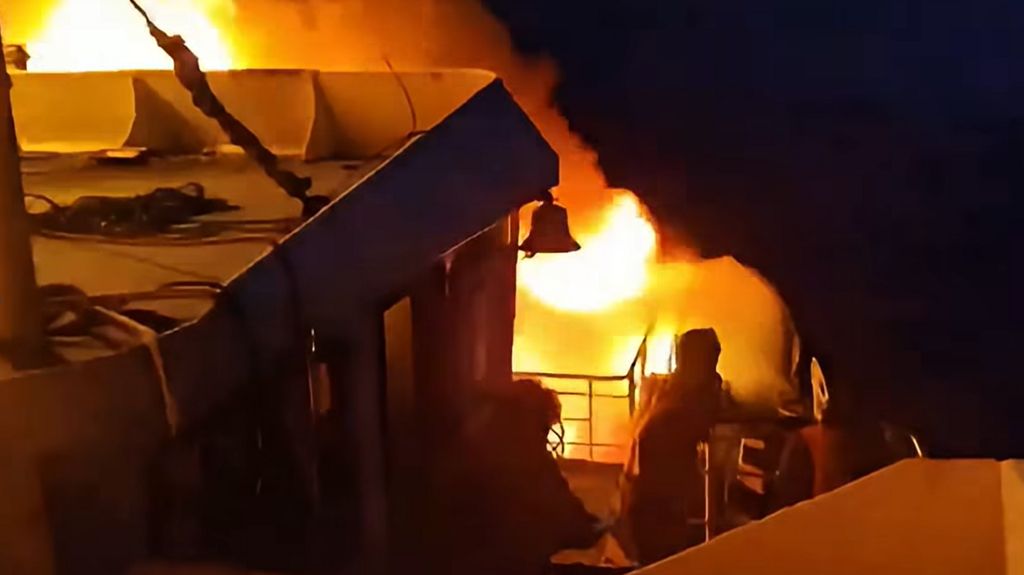
A devastating fire aboard a passenger ferry off the coast of the Philippines has left at least five people dead and 86 others unaccounted for, in what is shaping up to be one of the country’s worst maritime disasters in recent years, according to the Philippine Coast Guard.
The MV June Aster, carrying 117 passengers and 17 crew members, departed Manila bound for Coron, a popular tourist destination in the western province of Palawan. The blaze ignited at 18:00 local time (10:00 GMT) on Wednesday, when the vessel was just an hour away from its final port of call, roughly four nautical miles off the coastal barangay of Turda. As of 11:00 Thursday, the fire was still burning, hampered by uncooperative conditions that have complicated rescue and extinguishing efforts.
“Strong currents and poor weather are creating major obstacles for our response teams,” a Philippine Coast Guard spokesperson told the BBC. The fire has already pushed the ferry far off its original distress position: it has drifted more than seven nautical miles further out to sea, expanding the search area and slowing rescue operations.
Video footage released by the coastguard Wednesday night shows the entire vessel engulfed in thick orange flames, as rescuers pull survivors from the dark surrounding water into small rescue craft. Forty-three people have been pulled from the sea so far and transferred to a local evacuation center in Turda, but details on the extent of their injuries have not yet been released. Investigators have not yet been able to interview the survivors to determine the origin of the blaze, which remains under official investigation.
For families of the missing, the hours since the disaster have been filled with agonizing uncertainty. Anelyn Magbanua, whose husband Marlon was on the ferry returning from visiting the couple’s two school-age children in Manila, told reporters she was woken by a relative with news of the fire just hours after she had waited for him to arrive at the Coron port.
“I couldn’t put what I’m feeling into words. I’ve been crying and praying since last night,” Magbanua said. She traveled to a local hospital in Coron to check for her husband among survivors, but he has not been located. “My two-year-old son and I are waiting outside the hospital right now. We have nothing but each other.”
Elsewhere, Rai Garcia’s family is still waiting for word on three missing family friends: Mae Lorraine Galera-Navoa, her husband Elyzer Navoa, and their three-year-old daughter Hiraya Joy. The trio had traveled to Luzon to attend Mae’s father’s funeral, and were returning to their home in Palawan’s El Nido when the fire broke out.
“We haven’t gotten any updates yet, so we’ve been commenting on local news threads just to get any information,” Garcia said. “We still hold out hope and pray for their safety.” Garcia’s family created an appeal poster using a photo Mae had shared with relatives from the ferry, and dozens of other anxious family members have left pleas for information on the Philippine Coast Guard’s official Facebook page, one reading simply: “Please can you find my sibling.”
Maritime incidents are an all-too-common occurrence in the Philippines, a nation made up of more than 7,100 islands where inter-island ferries serve as the primary affordable mode of transport for both people and goods connecting remote communities that do not have air access. The country’s geographic location leaves it exposed to an average of 20 typhoons annually, with monsoon rains and severe storms regularly creating dangerous sea conditions. Past accidents have also been linked to inadequate vessel maintenance and inconsistent enforcement of maritime safety regulations.
Just three years prior, in 2023, a ferry fire off the southwestern coast of the Philippines killed 31 people. That incident involved the MV Lady Mary Joy 3, which was traveling from Zamboanga City to Basilan Island in Mindanao. With 86 people still missing, the MV June Aster disaster is on track to become one of the deadliest maritime accidents the Philippines has seen in decades. A first responder who spoke to the BBC, one of the first on scene to transport casualties to local hospitals, called the disaster unprecedented for the Coron area, describing it as “really heartbreaking.”