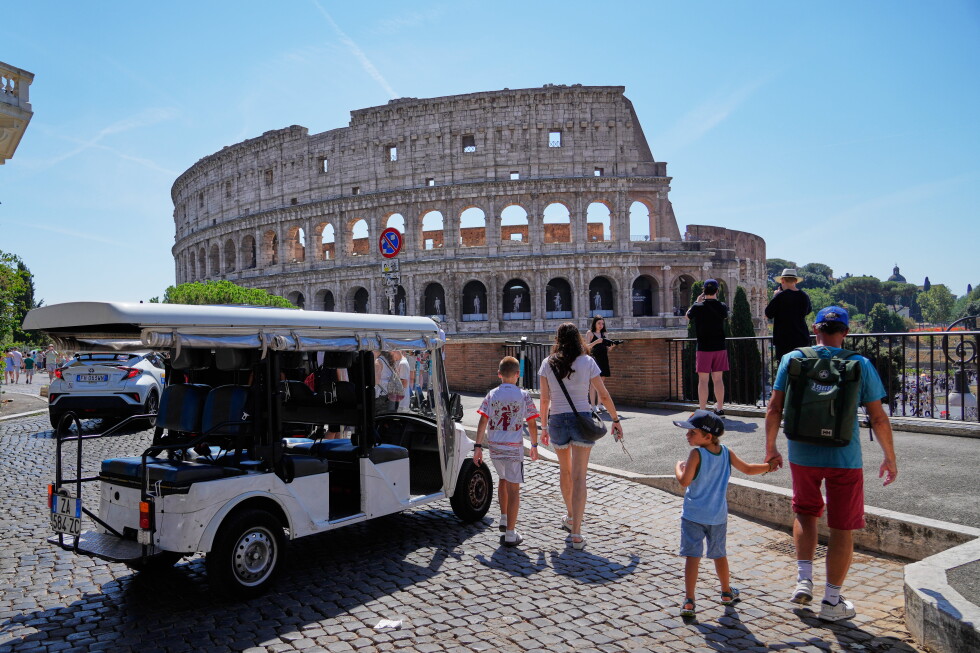
ROME — Beneath the centuries-old grandeur of Rome’s iconic monuments and ancient ruins, a very modern travel phenomenon is stirring heated conflict: the tourist golf cart. What started as a novel way for visitors to zip through the Eternal City’s historic core has exploded in popularity, spurring city officials to launch a sweeping crackdown on the hundreds of unregulated vehicles currently outpacing local traffic laws.
Critics of the golf cart boom paint a bleak picture of vehicles running amok through narrow cobblestone streets, parking illegally in restricted zones, worsening already crippling congestion and exacerbating Rome’s long-running overtourism crisis. Local outlets have used inflammatory language to frame the trend, describing it as an “invasion” and claiming the historic center is being “held hostage by golf carts.”
But proponents of golf cart tours push back, arguing the small, electric vehicles are far quieter than large tourist vans and buses, take up less limited street space, and produce zero exhaust fumes that erode and stain the city’s irreplaceable historic landmarks. Tensions between golf cart operators and other road users have boiled over repeatedly, even drawing in frustrated local drivers. During an August ride-along conducted by The Associated Press, a confrontation erupted between an eight-seater van driver and a golf cart operator, with both shouting insults and gesturing angrily as they jostled for position on the narrow street — a clash that has become increasingly common.
Today, golf carts speed past outdoor cafes where visitors dine on spaghetti carbonara at checkered tablecloths, weave past souvenir stalls selling everything from hot priest calendars to branded “Ciao Bella!” tote bags. Most tours are tightly scheduled blitzes of Rome’s most popular hot spots, giving visitors just enough time to stop for a cappuccino or gelato between stops — until the vehicles run afoul of city authorities.
For tourists, the tours offer a convenient way to see Rome’s top attractions in just a few hours, leaving the rest of a short trip open for casual exploration. Ruth Sanderson, a 50-year-old traveler from Manchester, England, booked a golf cart tour as a birthday surprise for her husband during their first visit to Rome. Even on that tour, however, the operator parked illegally multiple times, including in a zone reserved exclusively for car-sharing vehicles near the Spanish Steps. “We don’t have designated parking spots for golf carts, so we park wherever we can, as legally as possible,” guide Martin Halili, who owns Wheel Tours, explained to the couple.
Long before golf carts rose in popularity, Rome’s historic center has struggled with chronic parking and congestion. A 2023 field survey conducted by the city found the historic core has only 4,300 public on-street parking spots — roughly one-quarter the number of cars owned by local residents alone. On an average day, an additional 50,000 vehicles enter the restricted area, leaving every spare cranny of curb space claimed by illegally parked cars, vans, Vespas, motorcycles and double-parked delivery trucks. For local residents already fed up with unending traffic, golf carts were the final straw.
Luigi la Licata, head of the Monti neighborhood association, told the AP that decades of over-authorization for multiple vehicle classes have already choked local streets, and unregulated golf carts are the most visible and recent addition to the chaos. “The golf cart is the most obvious one — and the latest — but there are many others,” he said.
Data from TripAdvisor confirms how rapidly the trend has grown: golf cart tour bookings this summer jumped 147% compared to 2024. Viator, TripAdvisor’s tour booking subsidiary, is the single largest source of bookings for these tours. Current estimates put the total number of tourist golf carts in Rome at roughly 500. One-fifth of those operators belong to Metur, an industry association founded last December to build dialogue with local residents and city officials.
Metur president Pascal van Duijnhoven acknowledges that overtourism is a serious challenge for Rome, and that the industry is not blameless. “Overtourism is a real problem, and we’re not denying it. And maybe we’re also part of it in a way. But if we’re part of it, then at least be part of it in a smart way,” van Duijnhoven said. “We believe, especially for Rome, that it’s a solution. And we really hope that people start looking at it like this. But we need a hand. We need some help from the authorities.”
Regulating the booming industry has proven far from straightforward for city leaders. Eugenio Patanè, Rome’s deputy mayor for sustainable mobility and transport, has been working to overhaul traffic rules citywide to cut congestion, not just for golf carts. In July, the city implemented a new rule requiring electric vehicles to pay to enter the historic center, aligning them with the existing fees for gasoline-powered cars — a policy shift that prioritizes cutting congestion over solely reducing emissions. Since the policy took effect, the number of authorized vehicles entering the center has dropped by roughly one-quarter to 350,000, and Patanè has set a goal of cutting daily entries in half long-term.
But reining in golf carts has hit multiple roadblocks. First, inconsistent technical classifications mean some carts fall under existing traffic regulations, while others are able to operate with no restrictions. Second, oversight of passenger transport and tourism licensing is currently controlled at the regional level, not by the city of Rome. Patanè has requested that the Lazio region transfer regulatory authority to the city, a move he expects to be finalized this month. Once the city gains control, Patanè plans to introduce new rules that will set fixed approved tour routes, cap the total number of golf carts allowed to operate, and create a licensing system to select authorized operators.
“Cities where this golf cart phenomenon is expanding truly have very few weapons,” Patanè said. “We will be able to regulate this phenomenon that has now become rampant and, in some cases, even worrisome.”
As the city waits for regulatory power to transfer, a reckoning is already underway for operators. Enforcement actions have already increased sharply, with operators facing inconsistent but often severe penalties. Van Duijnhoven told the AP that authorities stopped vehicles owned by Metur members 14 times in the second half of August alone, with document reviews lasting up to an hour. Unlicensed operators can face penalties including having their vehicles impounded for more than a month, or fines as high as 4,000 euros ($4,600) for unlicensed tour guiding.
During an AP visit to the area just one block from the Pantheon, reporters observed an Italian financial police officer stopping a golf cart carrying a family from Florida, spending a half-hour inspecting documents, copying down visitor ID information. Three nearby private hire vans, also parked illegally, received no enforcement action at all. Operators argue that existing private hire and taxi drivers, who see golf carts as a threat to their business, are behind the push for harsh enforcement.
Halili, the guide who led the Sanderson family’s tour, says established transport lobbies have “waged a war” against golf cart operators, filing repeated complaints and appeals to block their operations. “They have it in for golf carts,” he said.