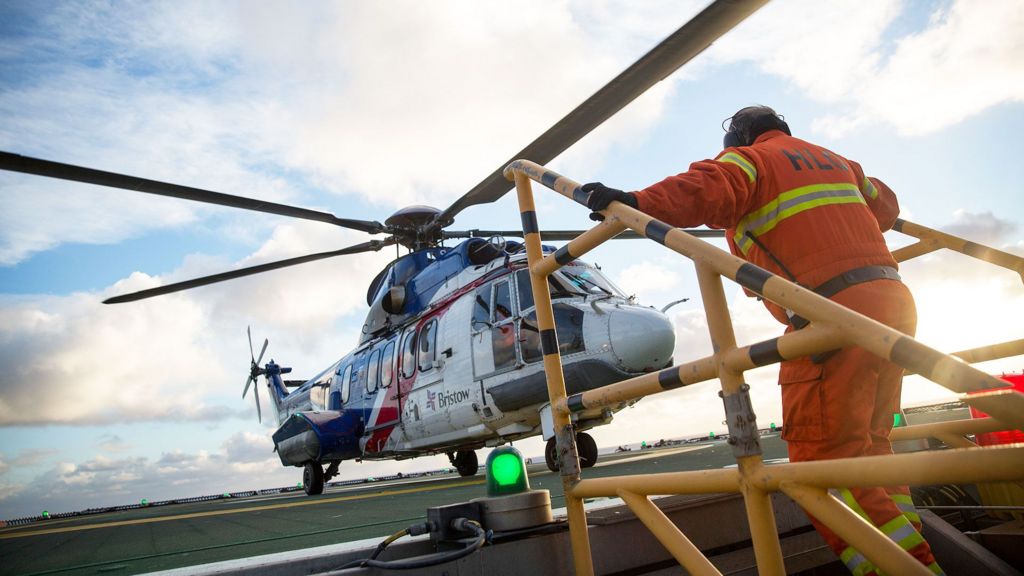
With just two months remaining before life jacket new weight restrictions for offshore helicopter travel take full effect, hundreds of North Sea energy workers still fail to meet the new safety threshold, BBC Scotland has confirmed. The updated regulations, set to come into force on November 1, will require all offshore workers to weigh no more than 124.7kg (19st 7lb) when fully dressed in work clothing and footwear — a restriction designed to ensure that emergency winch rescues can be carried out safely during critical offshore incidents.
The weight cap was first announced by industry representative body Offshore Energies UK (OEUK) in 2023, when initial assessments found more than 2,200 active workers exceeded the proposed limit. The most recent data, collected from more than 35,000 offshore worker records between April and August 2026, shows that while hundreds of workers have successfully reduced their weight to meet the threshold, between 500 and 800 workers remain above the cap, equal to approximately 3.4% of the total offshore workforce. That marks a notable drop from the 2022 estimate of 4.7%, but progress still leaves hundreds of workers at risk of being locked out of their jobs when the rule becomes mandatory.
The policy was developed after a years-long industry review, prompted by a formal warning from the Maritime and Coastguard Agency (MCA) that the standard winch systems fitted to UK Coastguard rescue helicopters have a hard total maximum capacity of 249kg (39st). This total capacity must account for not just the stranded worker, but also the 90.3kg (14st) rescue technician, a 29kg (4st 7lb) emergency stretcher, and 3kg (7lb) of rescue equipment. When broken down, this leaves just 124.7kg as the maximum safe clothed weight for a rescued worker. OEUK data also shows the average weight of North Sea offshore workers has risen by 10kg (1st 7lb) since 2008, creating a growing safety gap that the new rule aims to address.
This is not the first size-based safety regulation for offshore helicopter travel: several years ago, shoulder width restrictions were introduced, requiring workers with shoulder measurements of 56cm (22in) or more to be seated adjacent to an extra-large helicopter exit to facilitate emergency evacuation. The new weight rule expands these existing safety protocols to address life jacket rescue risks.
For workers unable to meet the deadline, the policy carries tangible employment consequences. Anyone over the weight limit will not be issued the mandatory medical fitness certification required to work offshore, meaning they will be barred from boarding transport helicopters at heliports starting November 1. Some workers have already opted to leave the industry entirely rather than pursue weight loss, according to occupational health professionals working with the workforce.
Aberdeen-based occupational health physician Dr Niyi Adeleke, who conducts fitness assessments for offshore workers, told BBC Scotland the regulation has been a major source of stress across the sector since it was announced. “The reaction has been varied, some people are really stressed, asking ‘what can I do?’” he said. Many workers have pursued aggressive weight loss strategies, including turning to weight loss injections and extended fasting, though Dr Adeleke noted that extreme fasting is rarely sustainable long-term. He added that while a small number of workers have chosen to leave the sector entirely or transfer to onshore or international roles, the vast majority are actively working to meet the new limit. “There are solutions which are sustainable, there is help, and please do not lose hope,” he said.
Employment law experts note that employers have a responsibility to explore alternative roles before dismissing workers who cannot meet the weight cap. Will Rollinson, an employment specialist with Scottish law firm Brodies, said employers are required to evaluate what steps a worker has taken to lose weight, what barriers are preventing progress, and whether onshore roles can be offered to displaced workers.”Some operators would have much more scope for offering alternative roles,” Rollinson explained. “Ultimately though, if an employee whose role is offshore is unable to get below the safe weight limit, and an employer has followed a full proper process, it may be that job termination is a possibility.” He added that the remaining two-month window gives both employers and workers time to find solutions that avoid layoffs.
OEUK health, safety and security manager Graham Skinner said the falling number of workers above the limit shows the efforts of the workforce are paying off. “It’s significantly less than when we started and that’s a great sign,” he said. “But we recognise there’s going to be some hard work to be done to continue to reduce that number in time. On 1 November, if a worker turns up at the heliport over 124kg, they will not be able to go to work.”
Skinner emphasized that the rule was rooted in core safety priorities for the entire offshore workforce. “We identified that there’s a significant risk due to workers’ weight. That affects all aspects of their offshore work from getting on the helicopter and travelling offshore to working around confined space, working at height, but also in terms of how we might rescue them using the winch on helicopters,” he said. “When we looked at all of the risks, we felt it was important to make sure that we didn’t have workers who we wouldn’t be able to rescue if the worst thing happened to them.”
For workers who have not yet started making changes, Skinner’s message is clear: the deadline is non-negotiable, but progress is still possible in the remaining eight weeks. “I think the message here is for people who haven’t started yet, who think this isn’t going to happen or it’s going to go away, you really have to start now because with eight weeks to go it will still be possible,” he said. “It will be hard, but we’d like to have you as part of our workforce.”