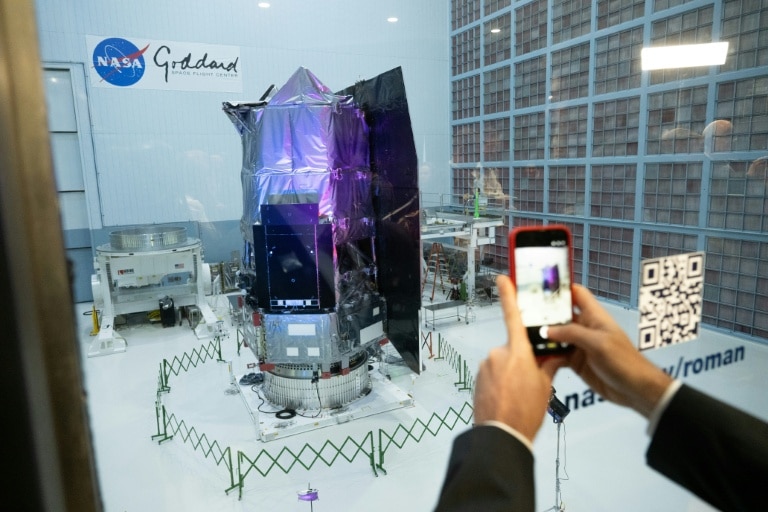
In a landmark moment for space exploration, NASA launched its next-generation flagship observatory, the Nancy Grace Roman Space Telescope, on Sunday from the Kennedy Space Center in Florida. Lifting off aboard a SpaceX Falcon Heavy rocket at 7:26 a.m. local time (1126 GMT), the 12-meter-tall telescope begins a multi-year mission to construct the most comprehensive map of the cosmos ever created and tackle long-standing unsolved questions in fundamental physics.
The $4 billion project, more than a decade in development, honors Nancy Grace Roman, a pioneering American astronomer widely known as the “Mother of Hubble” for her foundational work on NASA’s iconic Hubble Space Telescope. Speaking at a pre-launch ceremony at NASA’s Houston headquarters Friday, former President Donald Trump emphasized the telescope’s transformative potential, noting it will open new windows into understanding the universe’s deepest secrets.
Unlike existing space observatories, Roman boasts a revolutionary field of view more than 100 times larger than Hubble’s, and far wider than that of the James Webb Space Telescope. Positioned at a vantage point 1.5 million kilometers from Earth — a journey that will take roughly 100 days to complete — the telescope will work in tandem with other leading observatories, including Webb, to advance multiple branches of astronomical research.
Among its core science goals, Roman is tasked with discovering thousands of exoplanets outside our solar system and cataloging tens of thousands of supernovae, the violent death throes of massive stars. “It will be the biggest catalog of astronomical objects anybody’s ever produced, and it will help us understand how common solar systems like our own are,” Dave Content, Roman’s technical manager, told Agence France-Presse.
The mission’s highest-profile objective is unpacking the nature of dark matter and dark energy, two invisible phenomena that together account for roughly 95 percent of the entire universe. While dark matter is hypothesized to act as an invisible gravitational glue holding galaxies together, dark energy is the repulsive force driving the accelerating expansion of the universe. Equipped with advanced infrared capabilities, Roman can detect light that originated from celestial objects billions of years ago, effectively allowing astronomers to peer back into the universe’s earliest history and trace the evolution of these mysterious forces.
Roman’s data will also complement ongoing work by the Vera C. Rubin Observatory in Chile and the European Space Agency’s Euclid probe, and scientists say the mission could upend long-held models of cosmic evolution. Senior project scientist Julie McEnery noted that recent astronomical observations have cast doubt on the standard cosmological model that underpins modern understanding of the universe’s early expansion. “Recent observations hint that our standard model of the universe is incorrect,” she told reporters Saturday ahead of launch. “Roman will definitively say, ‘Yeah, the model works, or it doesn’t.’ And if it doesn’t, it’s going to provide us with the precision and quality of data that will allow us to start to distinguish between those options.”
All data collected by Roman will be made publicly available to scientists and casual enthusiasts worldwide, though the scale of data collection presents unique logistical challenges. The telescope will generate roughly 1.3 terabytes of new data every day, a volume too large for most personal computing devices to store or process. For McEnery, however, the massive dataset is part of the mission’s greatest promise. “I very much hope, and in fact expect, that the most exciting science from Roman will be a surprise, something we couldn’t predict, and that will set the stage for the next deeper set of questions for future missions to address,” she said.