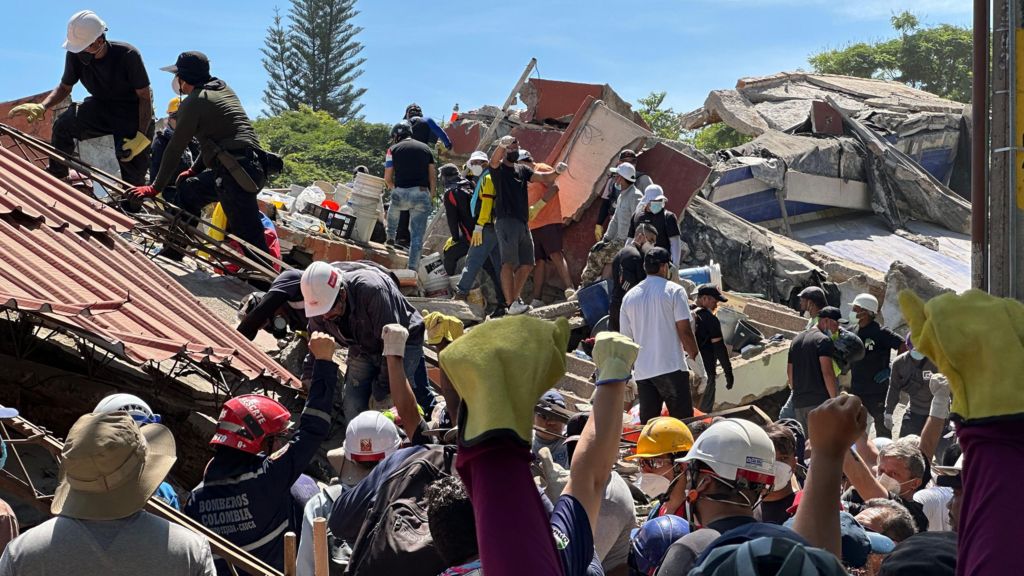
On August 10, a devastating magnitude 7.4 earthquake ripped through southwestern Colombia, leaving a trail of destruction and death that stands as the worst seismic disaster the country has faced this century, according to the nation’s National Geological Service. Among the hardest-hit areas is Cali, Colombia’s third-largest city home to more than two million residents, where the four-story Torres del Limonar apartment building in the southern Capri neighborhood crumbled to the ground, becoming a grim symbol of the tragedy that has unfolded across the region.
By the count of Cali Mayor Alejandro Éder, the earthquake has killed at least 95 people across the city, with an estimated 25 people still trapped beneath the rubble of collapsed structures as of Monday night. Torres del Limonar is one of more than 50 buildings that collapsed in the quake, and while neighboring properties escaped the same fate, suffering only minor cracks, the site itself is now a jagged mountain of shattered concrete, where half-buried mattresses, broken furniture and personal belongings poke through the debris under the unforgiving scorching tropical sun.
For Efraín Gallego, every passing minute brings a agonizing mix of renewed hope and crushing disappointment. His 80-year-old brother and brother’s wife were both buried when the building gave way, and despite the emotion that cracks his voice and leaves him pausing to swallow hard and regain his composure as he speaks, he refuses to give up on finding his brother alive. “You feel such deep anguish,” Gallego told BBC News Mundo at the collapse site. “Every time there is an alert about someone being alive, hope is reborn that we will find him.”
More than 100 people have gathered at the site, waiting for updates on missing loved ones. Many are too shaken to speak, visibly drained by grief and uncertainty. Some sleep exhausted on the sidewalk or on couches pulled into the street, while others huddle together in shade to lean on one another for support as hours stretch on and anxiety mounts.
A multi-team response of professional rescuers, military personnel, firefighters, paramedics, humanitarian workers and hundreds of civilian volunteers has been working around the clock to clear debris and reach potential survivors. To cut through the noise of excavators, hammers and saws, workers regularly pause operations and raise their hands in a universal signal for complete silence, calling out into the rubble: “Silence! We are firefighters. If you can hear us, shout or make any noise.” Each pause brings a held breath for waiting family members, but more often than not, no sound comes from below.
While official counts remain fluid amid the chaotic response, rescuers confirm they have pulled at least 10 survivors from the rubble of Torres del Limonar since the collapse, with local media reporting six survivors extracted in the hours after the disaster, including an infant just a few months old. As of Tuesday morning, rescue team member James Velasco told reporters that at least two trapped people had been detected alive, with crews digging narrow access tunnels to reach them. One survivor is currently trapped with a leg pinned under debris, Velasco added.
For veteran rescuers like Velasco, there remains cautious reason to hold out hope. “In the past I have participated in operations where we have pulled out survivors after seven days trapped,” he said. “Those who are meant to survive, survive. Nothing is written.”
A large part of the on-site response has been driven by ordinary Cali residents who have stepped up as volunteers, a collaboration Gallego was quick to highlight amid his own anguish. “We must mention all the people who have come to help with water, supplies, tools, equipment; there is a lot of collaboration. Volunteers are plentiful,” he said.
Nineteen-year-old Alejandro Mahecha is one of those volunteers. After surviving the quake unharmed with his family and working through the initial shock, he headed to the Torres del Limonar site at first light to pitch in. “The earthquake affected my city and the homes of people I know. I came to this site because there has been a lot of talk about this building and the need for help here,” Mahecha explained. Working alongside friends, he helps clear debris, haul fresh water to exhausted rescue teams and clear streets to speed up evacuation efforts.
To speed up rescue operations, Mayor Éder has implemented a nighttime curfew around disaster sites, allowing crews to work uninterrupted. As of Tuesday morning, search and extraction efforts were continuing non-stop, even as waiting families confront the growing weight of uncertainty.