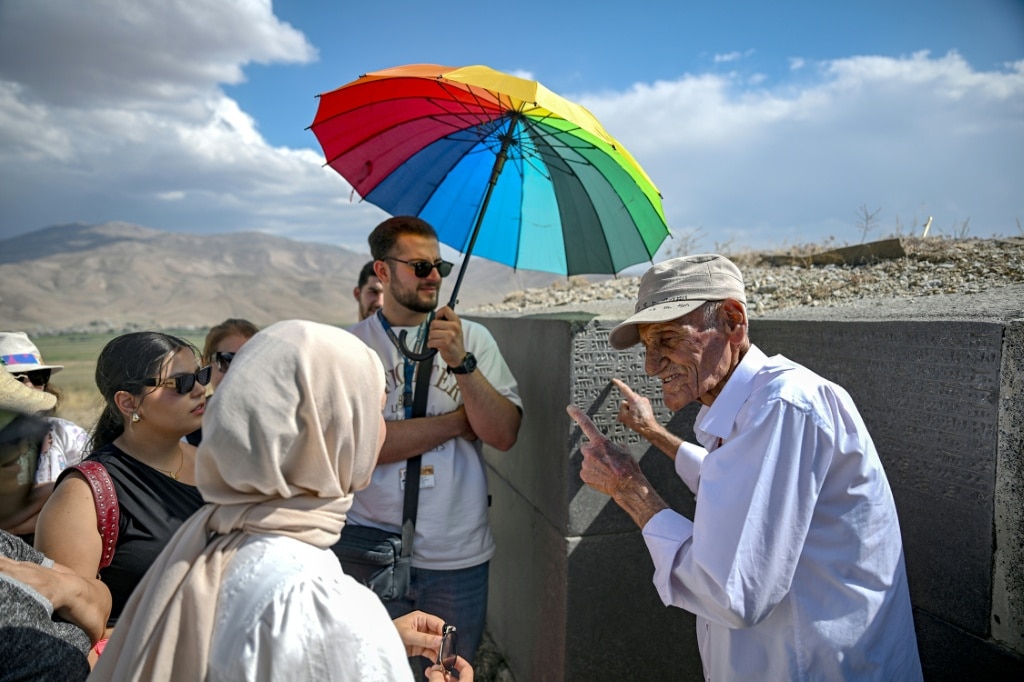
Nestled among the sun-scorched ruins of the Cavustepe fortress in eastern Turkey, 86-year-old Mehmet Kusman has built a life mission few would dare take on: keeping the long-lost language of the ancient Urartu kingdom alive, despite never completing formal education.
Running his fingers over cuneiform inscriptions carved into solid black basalt, Kusman deciphers lines written nearly 3,000 years ago: *”Before me there was nothing. But by the power of the god Haldi I founded this city.”* For six decades, he has devoted himself to this forgotten Iron Age civilization, its forgotten deities, and its lost written language.
Kusman’s connection to Urartu began in the 1960s, shortly after he finished military service. Hired as an unskilled laborer for the initial archaeological excavations at Cavustepe, he stumbled across his first ancient stone stele and was immediately captivated by the elegant, unfamiliar script. When the excavation’s lead archaeologist warned him the cuneiform writing system adapted from Assyrian was far too complex for an untrained man to learn, the brush-off only fueled his determination. *”His telling me ‘No’ hurt me,”* Kusman recalled to AFP. *”I became relentless, thinking: ‘In my lifetime, I will learn it.’”*
With no academic training or formal linguistic guidance, Kusman set out to teach himself the language. He spent years traveling across the historic territory of Urartu, which once spanned parts of modern eastern Turkey, Iran, and Armenia, copying every inscription he found at excavation sites. In just three years, he had memorized the full Urartu cuneiform alphabet, though mastering the limited surviving vocabulary took far longer: it took 22 years for him to commit 650 known Urartu words to memory.
Today, the silver-haired guardian is a local legend, who refers to himself as one of only seven people in Turkey who can work with the Urartu language. Academics across Turkey have mixed assessments of his claims, but nearly all praise his unwavering passion for bringing Urartu to public attention.
To contextualize Urartu’s place in history, Istanbul University ancient history professor Erkan Konyar explains the kingdom was one of the most dominant powers in the ancient Near East between the 9th and 7th centuries BCE. Emerging after the early Mesopotamian kingdoms of Sumer, Babylon, and Assyria, Urartu unified scattered mountain tribal communities under a centralized government, building sophisticated fortresses, cities, irrigation systems, and large-scale food storage infrastructure. Konyar, a leading specialist on Urartu’s original capital Tuspa, notes that even after retiring from his official role at Cavustepe in 2005, Kusman has never left the site.
“For 60 years, he has lived amid the excavations and introduced thousands of visitors to the history of Urartu,” Konyar said. Still, he pushes back on Kusman’s claim to speak the language: the full pronunciation of Urartu has been lost to history, and only around 100 words have their meanings confirmed with certainty. Unlike modern living languages, Urartu was only used for official inscriptions, not everyday conversation, even during the kingdom’s peak. Mehemet Isikli, head of the Department of Near Eastern Archaeology at Ataturk University, echoed this clarification, noting Kusman’s work is public outreach, not formal academic research.
“I admire him,” Isikli said. “He has worked hard and brought Urartian culture to light. Mehmet Kusman provides a sort of publicity for Urartu, but it has nothing to do with academic work: he knows only a few alphabetical signs, or a few letters, and some very, very general information about them.”
Undeterred by academic skepticism, Kusman remains proud of his work guarding the Cavustepe site and welcoming guests from his small stone hut at the excavation entrance. Calling himself a literal descendant of the Urartu people, he says his life’s work proves the civilization has not been entirely lost to time. His passion has even taken him across the globe: he has lectured five times in the United States, as well as in Germany, the Netherlands, and Belgium, and is now planning a trip to Japan to share his love for Urartu with new audiences.
As ongoing excavations like the one at the Ayanis fortress, 22 miles north of Lake Van, continue to uncover new clues about how the Urartu kingdom collapsed (recent research points to a massive earthquake as a key contributing factor), Kusman remains the public face of the civilization for visitors and casual enthusiasts. Standing to greet a new group of tourists at Cavustepe, he declared, *”They disappeared, but look, they are not all dead.”*