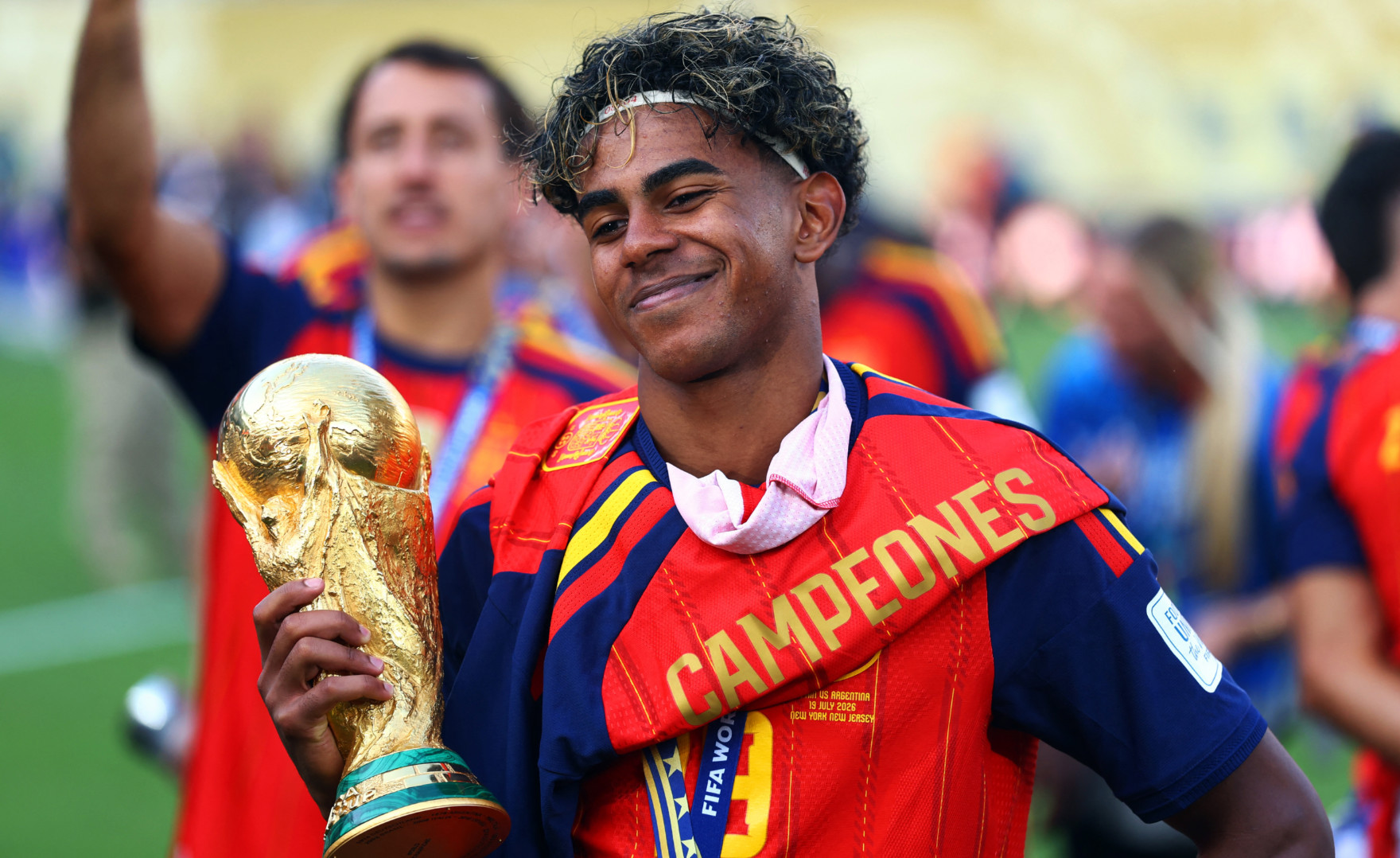
In the immediate aftermath of Spain’s 2026 World Cup final win over Argentina, one image cut through the chaos of post-match celebrations and on-pitch scuffles to capture global attention: 19-year-old Lamine Yamal, the youngest starter to win a World Cup final since Pele and Kylian Mbappé, dropped to his knees in prayer, the iconic red of Spain’s national team draped over his shoulders. What began as a quiet, personal moment of gratitude for a historic sporting achievement quickly exploded into the center of a decades-long conversation in Spain over what it means to be Spanish, and who gets to claim that identity.
Yamal’s background places him directly at the intersection of Spain’s complex multicultural present. Born in the working-class neighborhood of Rocaforda in Mataró to a Moroccan father and an Equatorial Guinean mother, the young Barcelona star has never hidden his Muslim faith. He has spoken openly about reciting a traditional dua taught by his grandmother before every match and fasting during Ramadan while training at Barcelona’s Camp Nou stadium. Earlier in the World Cup, after scoring against Saudi Arabia in the group stage, he performed sujud – a common prostration of gratitude practiced by Muslim athletes around the world. That gesture alone sparked immediate backlash: while many fans celebrated Yamal’s open embrace of his identity, others argued his public prayer had no place on the pitch when he was representing Spain.
He is not the first Muslim player to wear the Spanish national team jersey – Munir Al Haddadi earned that distinction back in 2014 – but Yamal’s unprecedented profile has made him the face of this national debate. As the heir to Barcelona’s legendary number 10 shirt, once held by Lionel Messi, every choice he makes is scrutinized, and his loyalty to the country of his birth has been called into question repeatedly in public discourse.
The debate has pulled in high-profile Spanish politicians, laying bare deep divisions over multiculturalism and immigration. Former minister and leading Podemos party figure Ione Belarra has positioned Yamal as a symbol of a more inclusive modern Spain, saying she “liked the Spain of Lamine Yamal much more than the Spain being promoted by the conservative People’s Party and far-right party Vox.” Like many of Yamal’s supporters, she celebrated the image of his younger brother running through the stadium cheering on Spain in a national team shirt as proof of his family’s deep connection to the country.
But conservative and far-right voices have framed Yamal’s faith and identity as a threat to Spanish national culture. Santiago Abascal, leader of the far-right Vox party, defended anti-Yamal rhetoric on social platform X, arguing that critics overreacted to what he framed as a legitimate display of native Spanish identity. “They expect Spaniards to silently put up with the Islamist invasion and the mafia government,” he wrote. Long before Yamal rose to global fame, Vox already described his working-class hometown neighborhood of Rocaforda as a “multicultural shithole.”
Data from the Spanish Observatory on Racism and Xenophobia underscores the intensity of the backlash: the organization recorded more than 40,000 pieces of online hate content targeting Yamal, with sport accounting for 16% of all monitored hateful posts, and Yamal named as the primary target in many of them. Hostility only grew after his sujud gesture, with commentators leaving comments claiming “our roots have been humiliated” and “he is not worthy of being Spanish.”
Yet in Rocaforda, residents reject that divisive framing. Juan Carlos Serrano Muñoz, owner of a local café decorated with murals of the neighborhood’s most famous residents, including iconic bullfighter El Cordobés, dismissed far-right rhetoric as a political tactic to stoke division. “They want to focus on migration, on delinquency, but what Lamine did was give a kick to these people and tell a different story about this neighbourhood; a better story about the integration of the many cultures that live here,” he told Middle East Eye.
Institutional leaders in Spanish football have also moved to build more inclusive spaces for athletes of all faiths and backgrounds. While Spain’s broader cultural landscape still carries deep traces of its Catholic heritage, the country is formally a secular state, and athletes of any religion are eligible to represent the national side. The Royal Spanish Football Federation (RFEF) established an Equality Department in 2023, a year before Yamal made his international debut at Euro 2024, formalizing protections against discrimination in sport for players regardless of background or faith. Individual clubs across the country have also implemented their own measures to ensure equal opportunity and welcoming environments.
Many native-born white Spaniards have also publicly backed Yamal, embracing a vision of Spanish identity that can accommodate multiple heritages. In a public survey conducted by The New Arab, one respondent put it simply: “He is Spanish, and regardless of his origins, he has defended his country, as the Spaniard that he is.” This view does not erase Yamal’s cultural and religious background, but holds that his identity as a Spaniard and his Muslim faith can coexist.
Today, that viral image of Yamal on his knees in prayer, surrounded by post-match chaos, carries two wildly different meanings for the Spanish public. For supporters, it is nothing more than a young athlete’s quiet moment of gratitude, no different than a Christian player crossing himself before a match or pointing to the sky to honor a loved one. For critics, shaped by years of anxiety over immigration and multiculturalism stoked by far-right parties, the gesture has become a political flashpoint in a debate that extends far beyond the football pitch.
Spain already has one of the highest densities of public sports facilities in Europe, and football remains the country’s greatest unifying cultural force. As more young Muslim players rise through the grassroots ranks, their presence on national and club sides will only continue to grow. The RFEF’s formal anti-discrimination measures and the growing public support for athletes like Yamal point toward a future where open displays of faith by multicultural players are a normal, accepted part of Spanish football. But the ongoing political backlash surrounding Yamal also reveals another possible future: one where every gesture he makes is pulled into an old, unresolved debate about national identity that stretches far beyond the sport.
Unlike Achraf Hakimi, another Spanish-born player who chose to represent his parents’ homeland of Morocco rather than Spain, Yamal never defused the identity debate by choosing another flag. He stayed, he scored, he prayed, and he won the biggest prize in global football – making it impossible for either side of Spain’s identity divide to make their argument without invoking his name.