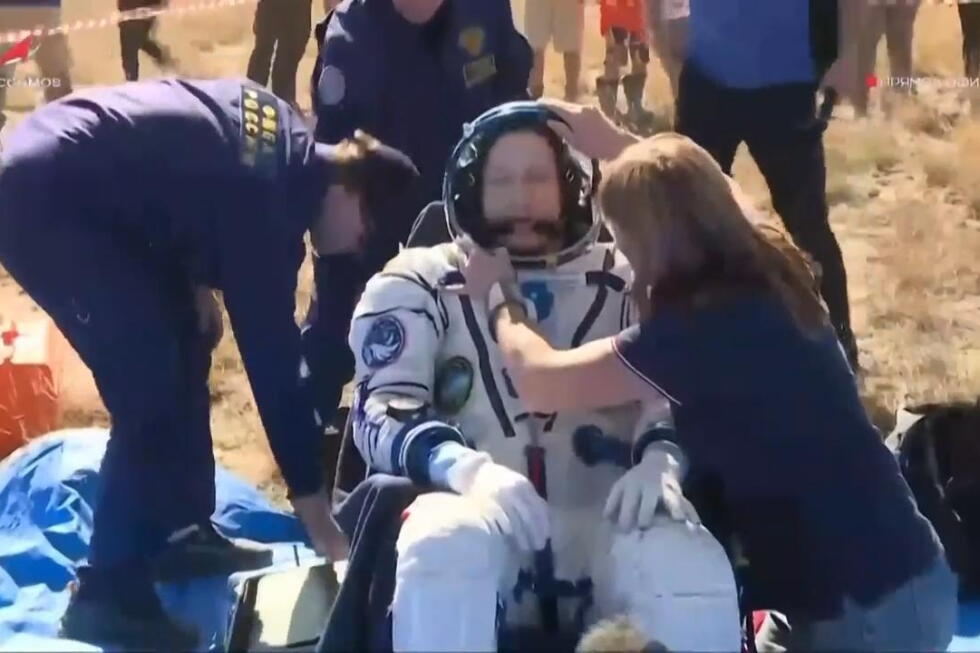
After an eight-month stay aboard the International Space Station (ISS), a joint U.S.-Russian space mission has concluded with a successful, safe landing on the sun-baked steppes of Kazakhstan, marking another milestone in decades of continued orbital cooperation between the two nations. NASA astronaut Chris Williams and Roscosmos cosmonauts Sergei Kud-Sverchkov and Sergei Mikaev touched down aboard their Soyuz MS-28 capsule Sunday, with the craft settling gently into a pre-designated landing zone southeast of the central Kazakh city of Dzhezkazgan, slowed by a large stabilizing parachute.
For two of the three crew members, the 241-day orbital tour marked their first ever venture into space. Williams, the mission’s NASA representative, and Mikaev, one of the two Russian crew members, had never completed a long-duration spaceflight prior to this expedition, while Kud-Sverchkov was making his second visit to the orbiting outpost.
Following the landing, recovery teams will airlift the crew by helicopter to the larger Kazakh city of Karaganda for initial post-landing medical checks and processing. From there, Williams will board a NASA charter flight bound for the Johnson Space Center in Houston, Texas, where he will reunite with family and undergo further post-mission debriefing and observation. The two Russian cosmonauts will return to their training facility at Star City, located just outside Moscow, to complete their own reintegration and post-flight procedures.
The successful landing comes amid a unique geopolitical context for U.S.-Russian space collaboration. Once locked in a high-stakes Cold War space race that defined decades of global technological competition, the two nations have partnered on ISS operations and related space exploration projects for decades. While bilateral diplomatic relations deteriorated sharply following Russia’s 2022 full-scale military incursion into Ukraine, space cooperation has remained one of the few areas where the two powers have maintained consistent, uninterrupted work. To date, U.S. and Russian crews continue to rotate through the ISS, hitching rides on each nation’s crewed spacecraft to reach the orbital laboratory.
The departing crew’s homecoming coincides with the arrival of their replacements, who began their own eight-month ISS mission last month. On July 14, NASA astronaut Anil Menon and Roscosmos cosmonauts Pyotr Dubrov and Anna Kikina launched from the Russia-leased Baikonur Cosmodrome in Kazakhstan, docking successfully with the station shortly after to start their tour. Notably, the launch was attended by NASA Administrator Jared Isaacman, marking the first time a sitting NASA chief has visited the Baikonur launch site in eight years, a move that many observers see as a signal of continued commitment to bilateral space cooperation despite broader geopolitical friction.
Menon, Dubrov and Kikina have now joined the Expedition 75 cadre aboard the ISS, alongside NASA astronauts Jessica Meir and Jack Hathaway, European Space Agency astronaut Sophie Adenot, and Roscosmos cosmonaut Andrei Fedyaev, as the team continues critical scientific research and maintenance operations on the orbiting platform.