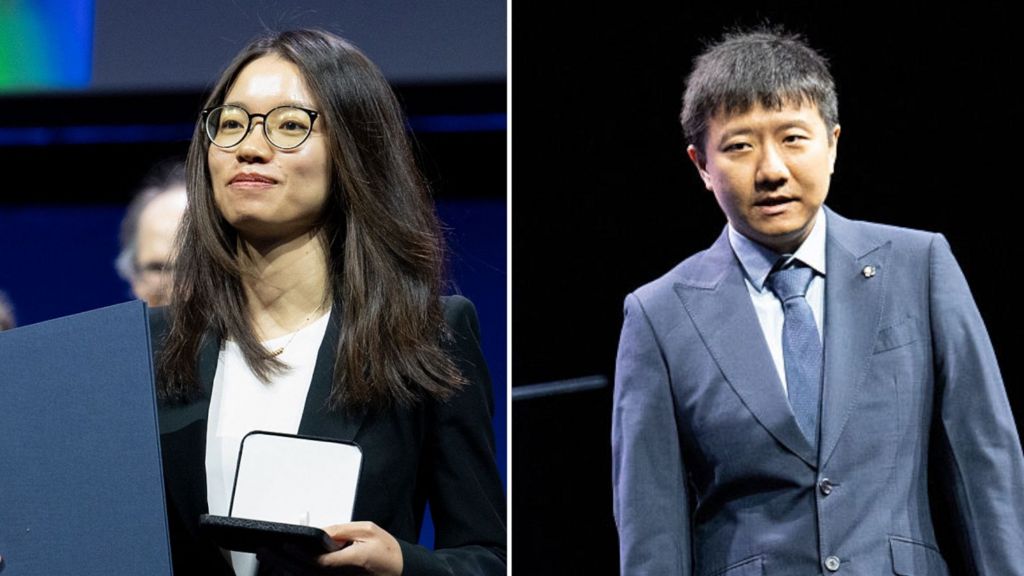
For the first time in the award’s storied history, two Chinese-born mathematicians have claimed the prestigious Fields Medal, widely recognized as the highest honor in the global mathematical community, marking a watershed moment for China’s decades-long push to advance excellence in mathematical research.
Hong Wang, 35, a researcher with academic positions in the United States and France, and Yu Deng, 37, a professor at the University of Chicago, accepted the award alongside two other recipients: John Pardon of the U.S. and Jacon Tsimerman of Canada, during the official awarding ceremony held in the U.S. on Thursday. Each of the four honorees received a prize purse of 15,000 Canadian dollars, equivalent to roughly $10,500 USD.
What makes this year’s wins all the more notable is that both Wang and Deng were recognized for solving open mathematical problems that have stumped leading minds in the field for more than a century. For Wang, the honor carries an extra layer of significance: she is only the third woman ever to receive a Fields Medal, since the award was first established in 1936.
Wang earned her prize for co-solving the century-old Kakeya conjecture, a problem first posed by Japanese mathematician Soichi Kakeya in 1917. The question explores what the minimum possible area is that a line segment — analogized to a rotating pencil — covers when it is rotated through a full 360-degree turn. Working with colleague Josh Zahl, Wang expanded the analysis from the traditional two-dimensional flat plane to three-dimensional space, finally resolving the long-standing open question when the pair published their definitive proof last year.
Wang explained to AFP the enduring appeal of the conjecture, noting that its core concepts naturally appear across a wide range of unrelated mathematical fields, which is why it has remained a central focus of research for more than 100 years. Wang’s research focuses on harmonic analysis, a branch of mathematics centered on the study of wave behavior and signal transformations.
For Deng, the honor came for his breakthrough resolution of Hilbert’s Sixth Problem, another open question first introduced by legendary German mathematician David Hilbert in 1928 as part of his famous list of 23 unsolved mathematical problems. The problem asks how it is possible to derive the collective behavior of a large system from the individual movement of its component particles. Deng approached the problem by modeling and analyzing the behavior of gas particles, producing the first complete solution to the century-old question.
In a statement following the award announcement, Deng called the honor “a really great honor to have my name listed after all those great mathematicians I’ve always been admiring.”
The 2026 award ceremony comes at a time of growing debate over the role of artificial intelligence in advancing mathematical research, as machine learning tools increasingly challenge traditional human-led computation and proof-building. Still, the historic wins for the two Chinese mathematicians have already sparked widespread celebration across China.
On Chinese social media platforms including Weibo and Rednote, hashtags related to the achievement, including “Fields Medal” and “First Chinese mathematicians to win Fields Medals,” racked up millions of views within hours of the announcement, with thousands of public comments pouring in from users expressing national pride. “Pride of all Chinese people,” one widely liked Weibo comment read. Another simply noted, “We are witnessing history.”
Mainstream Chinese media outlets have also dedicated extensive coverage to the two new medalists, publishing deep dives that cover everything from their early educational trajectories and personal research interests to the broader significance of their wins for China’s mathematical community. Shing-Tung Yau, the first ethnic Chinese mathematician to ever receive a Fields Medal, called the achievement a decades-long dream come true for the Chinese mathematics field.
The Fields Medal is awarded only once every four years, and it is restricted exclusively to outstanding mathematicians under the age of 40, a requirement that has kept the award’s prestige high across the global academic community.