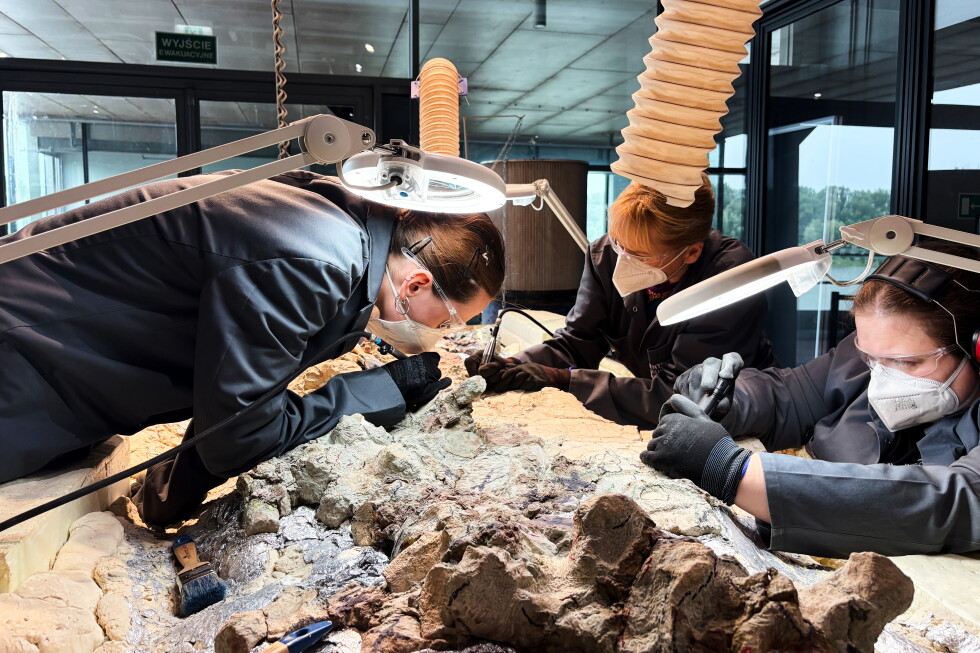
Deep inside a glass-walled laboratory at Warsaw’s iconic Copernicus Science Centre, an extraordinary public science experiment is unfolding. Unlike traditional paleontological digs that happen far from public view, this project invites everyday people to stand shoulder-to-shoulder with scientists and bring a 240-million-year-old giant back into the light.
Armed with pneumatic chisels, soft-bristled brushes, and protective goggles, hundreds of volunteers from across Poland are slowly and carefully chipping away at solid rock that has encased the massive bones of a *Mastodonsaurus* — one of the largest amphibians to ever walk (or swim) the Earth. On the opposite side of the clear glass barrier, crowds of curious visitors watch every step of the painstaking work in real time: wide-eyed children press their palms to the glass to point at the emerging fragments, while adults marvel at the sheer scale of the creature that once dominated Triassic waterways.
What makes this restoration project unprecedented is its reliance on non-professional labor. More than 2,000 volunteers from all walks of life — including office managers, hospital cleaners, professional tattoo artists, and retired teachers — have signed on to help, none requiring prior experience in paleontology or geology. Before they start their two-hour supervised chiseling shifts, every volunteer completes a hands-on training session and receives custom protective gear to keep them safe and ensure the ancient bones remain undamaged.
The work itself requires extraordinary precision. Volunteers separate bone from surrounding rock one millimeter at a time, using a specialized pneumatic chisel with a thin needle tip that gently breaks away rock without damaging the fragile fossil. Ultraviolet lighting is used to clearly mark the boundary between fossilized bone and surrounding stone, eliminating the risk of accidental breaks that could destroy irreplaceable scientific data.
For many volunteers, the experience has been life-changing. “I imagine that those bones were lying underground for 240 million years and I am the first human on earth to touch them,” said Tatyana Kozyk, who coordinates the volunteer teams. “I’m still trying to wrap my head around this experience.” Dorota Serafin, a 51-year-old Warsaw manager who has volunteered multiple times, described the work as both deeply calming and philosophically profound. “Working with the skeleton of an ancient animal is an experience that is at the same time relaxing and philosophical, even mystical,” she said, adding that she plans to bring her entire family to see the finished display when it opens to the public.
The *Mastodonsaurus* itself was a fearsome aquatic ambush predator that ruled freshwater ecosystems during the Middle Triassic period, a time when the first dinosaurs were just beginning to emerge but had not yet become the dominant terrestrial vertebrates on Earth. Growing up to six meters (20 feet) in length, the creature had a broad flat skull, massive elongated jaws lined with sharp conical teeth, and a body shape that vaguely resembles modern crocodiles — though it belongs to an entirely separate branch of the vertebrate evolutionary tree. It fed primarily on fish and smaller amphibians, lying motionless in shallow water before launching surprise attacks on unsuspecting prey.
The massive skeleton was first discovered in southern Poland in 2023 by paleontologist Tomasz Sulej, a professor at the Polish Academy of Sciences’ Institute of Paleobiology, and his colleague Wojciech Pawlak, a geologist from Warsaw University. It was the pair’s idea to open the restoration process to public volunteers, turning a purely scientific project into an unprecedented public outreach opportunity.
When complete, the 1,300-kilogram (2,865-pound) skeleton will be the largest *Mastodonsaurus* specimen ever put on public display anywhere in the world. Sulej notes that while smaller *Mastodonsaurus* skeletons — most measuring between 2 and 3 meters long — have been found in Germany and Russia, this new specimen is far larger than any previously discovered, and promises to rewrite scientific understanding of the species.
“The structure of the body is different from what we knew so far,” Sulej explained. “This is information that is completely new to the scientific world.” The finished skeleton is scheduled to go on public display at the Copernicus Science Centre in late 2024, most likely in October or November.
Beyond its scientific value, the project offers a unique perspective on extinction, resilience, and the future of life on Earth. The *Mastodonsaurus* emerged after the Permian-Triassic extinction event — the most severe mass extinction in our planet’s history, which wiped out roughly 96% of all marine species and 70% of terrestrial vertebrate species — and paved the way for the rise of the dinosaurs millions of years later. As humanity grapples with the accelerating impacts of human-caused climate change, Sulej says the story of the *Mastodonsaurus* offers a message of cautious hope.
“The Mastodonsaurus lived after the great extinction, which shows one thing, that nature always manages,” Sulej said. “It’s not true that humans can destroy life on this planet. Nature and life always find ways to survive.”