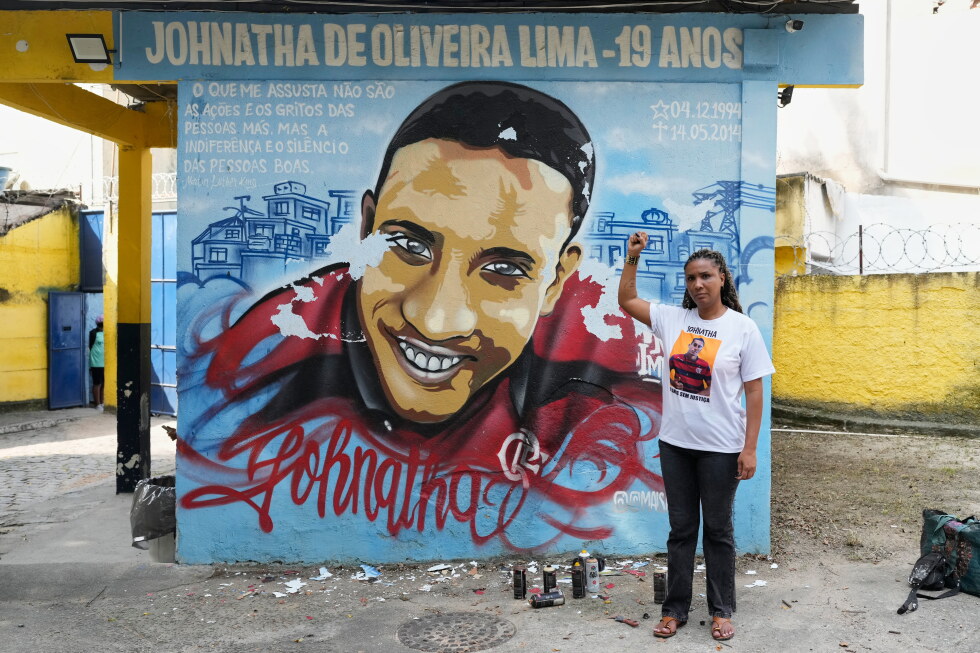
RIO DE JANEIRO — For Ana Paula Oliveira, the 2014 killing of her 19-year-old son Johnatha at the hands of a Rio de Janeiro police officer in the Manguinhos favela felt like an unbearable end. A mother of two, she never imagined she would outlive her child, let alone emerge from crippling grief as a leading activist demanding systemic change. Today, more than a decade later, she credits a collective of other grieving mothers with saving her life — and transforming their shared pain into a nationwide movement for justice.
“Without any doubt, if I had been alone I wouldn’t have made it here, 12 years later,” Oliveira shared at a recent memorial event held at her son’s former school to mark the anniversary of his death. “We need one another to cry together, to smile together and to fight together.”
Oliveira is one of dozens of Brazilian mothers who have turned personal loss into political action, pushing back against a rising tide of lethal police violence that has disproportionately impacted young Black men living in the country’s impoverished favela communities. Following the model of Argentina’s iconic Mothers of Plaza de Mayo — the grassroots human rights group founded by women whose children were disappeared during the country’s 1976–1983 military dictatorship — these women organize collectively to attend judicial hearings, lead public protests, host commemorative events, and provide critical mutual psychological support to one another. Their core mission is to ensure their sons are remembered as people, not just statistics in Brazil’s growing crisis of state violence. Now, they are calling on the federal government to enact a landmark national policy that guarantees support for family members of police violence victims, and to allocate public funding to sustain their grassroots work.
Official and nonprofit data underscores the urgency of their demands. The Brazilian Forum on Public Safety, a leading independent nonprofit, reports that more than 6,000 people have been killed by Brazilian police every year since 2018. In its 2025 annual report on national violence trends, the organization found that 82% of all victims of lethal police violence are Black, and the largest share of victims are young people between the ages of 18 and 24. In Rio de Janeiro alone, the nonprofit Crossfire Institute recorded 460 deaths from police operations last year — the highest annual total since 2016, and a 52% jump from 2023 figures.
Last year, Rio de Janeiro drew global condemnation for the state’s deadliest single police raid in history, when officers carried out an anti-gang operation targeting the Red Command criminal group in two Rio favelas that left 117 people dead, alongside five fallen police officers. Then-Rio Governor Cláudio Castro, an ally of former Brazilian President Jair Bolsonaro, defended the operation, labeling those targeted “narco-terrorists” — language that echoed former U.S. President Donald Trump, who last month formally classified both Red Command and its rival First Command Capital as foreign terrorist organizations. Police reported seizing 118 weapons, more than a ton of drugs, and arresting 113 people during the raid, but the incident renewed widespread international scrutiny of aggressive anti-gang tactics in Rio’s favelas.
The movement for accountability comes ahead of Brazil’s October general election, where crime and public security have emerged as top voting issues for the electorate. Supporters of presidential hopeful Sen. Flávio Bolsonaro, son of former President Jair Bolsonaro, argue that police must be given unrestricted support to combat heavily armed gang activity that has long plagued favela communities. But grieving mothers and allied nonprofits counter that Brazilian law enforcement routinely uses excessive, deadly force that disproportionately kills unarmed young Black residents with no links to gang activity.
Oliveira’s own case illustrates the long, frustrating fight for justice. Johnatha was shot in the back while walking through a Manguinhos street after visiting his grandmother, she says. Police claimed the shooting was carried out to disperse a crowd of protesters, but Oliveira has long pushed for the officer responsible to be convicted of intentional homicide. In 2024, a jury found the officer guilty of manslaughter without intent to kill; prosecutors have since successfully appealed the verdict, but a date for a retrial has not yet been scheduled.
For many mothers, activism has become a permanent calling rooted in personal loss. Monica Cunha, whose 20-year-old son was killed by police in 2006, went on to become a city councilwoman and will formally launch her pre-candidacy for state legislator in October’s upcoming elections. “I fight for memory, truth, justice, reparations and guarantees of nonrepetition — not only for myself, but so that no other family has to endure this pain,” Cunha wrote in an Instagram post marking the 18th anniversary of her son’s death. “The racism that kills our children and loved ones is not an isolated problem, and it must be confronted through state policies. I will keep going, turning grief into struggle.”
The movement has already secured small, hard-won victories that have kept other mothers hopeful. Sisters Nadia dos Santos and Glaucia dos Santos have lost three teenage sons between them to police violence: Nadia lost 18-year-old Cleyton in 2015 and 17-year-old Cleyverson in 2022, while Glaucia’s 17-year-old son Fabricio was killed by police in 2014. A large memorial to the three teenagers covers the front wall of the family’s home in Rio’s Chapadao favela complex. The pair founded their own support group and spent years pushing for accountability in Fabricio’s killing; in 2023, the officers responsible were sentenced to nine years in prison, a ruling that the wider movement celebrated as a rare win.
“We want others to stay alive, so we have to stay upright” despite the crushing weight of grief, Glaucia dos Santos said.
Last year, the movement traveled to Brazil’s capital Brasilia to meet with leaders from the judiciary, legislative, and executive branches to present their policy proposal, which was developed with support from Raave, a Rio-based network of organizations supporting people impacted by police killings. “Raave is negotiating with the federal government to implement a pilot project … developed by the mothers, so that we can provide care and guarantee the rights of this population,” explained Guilherme Pimental, a Raave coordinator.
The mothers are clear about what they want: a binding national public policy that provides financial and psychological reparations to families, alongside systemic changes to prevent future killings. Nadia dos Santos, who traveled to Brasilia to advocate for the policy, says the state bears a clear responsibility to support families whose loved ones are killed by state actors. “The state should have the obligation to give us mothers who lose our sons because of the state’s violence reparations. … We fight, we work, but we become ill. We need solutions,” she said.
Oliveira says reparations can take many forms beyond financial support, including permanent public commemoration of victims by naming schools, hospitals, daycares and other public facilities after them. Most critical, she adds, is policy change that stops the violence from happening to other families. “There are other forms of reparation as well, such as building other public policies of nonrepetition that would help prevent new cases. … Many things need to be done, repaired, so that this barbarity does not continue,” she said.