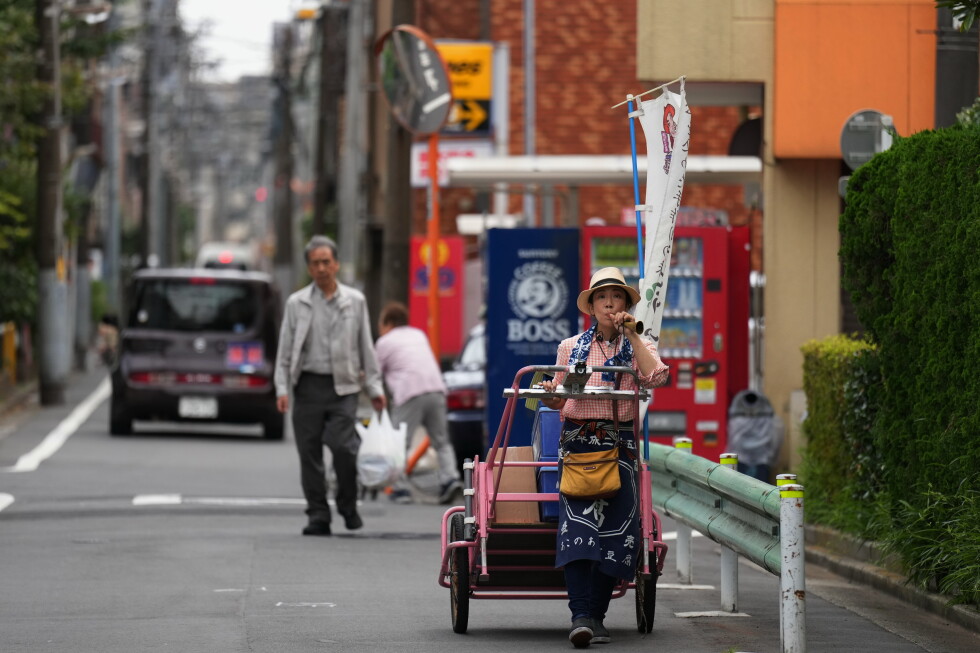
On narrow, winding residential streets in eastern Tokyo, 53-year-old Akiko Sugaya pushes her signature pink cart, straw hat perched on her head and a small brass bugle at the ready. The familiar toot of her horn signals her arrival for locals, who know her not just as a seller of fresh, protein-rich tofu and prepared groceries, but as a trusted guardian and friend in a community grappling with Japan’s growing crisis of aging and social isolation.
For 23 years, Sugaya has filled a role that goes far beyond traditional street vending. Her weekly three-hour routes, which she runs rain or shine three afternoons a week, weave through the Ojima neighborhood, an area dotted with cramped single-family homes and sprawling mid-rise apartment blocks. Where modern convenience has replaced face-to-face interaction with app-based deliveries and contactless checkout, Sugaya has kept the vanishing tradition of neighborhood roaming vendors alive, while quietly stepping in to address a gap that formal social services have not fully filled: checking on isolated elderly residents who live alone.
Sugaya knows her customers’ routines as intimately as if they were her own family. Over decades of rounds, she has spotted the subtle warning signs that something is wrong: piling uncollected newspapers left on porches, laundry that hangs untouched for days, a usually regular shopper who fails to appear when she sounds her bugle. Sadly, she has on multiple occasions been the first person to discover the bodies of elderly customers who died alone — a tragedy that has become increasingly common in Japan, which holds the title of the world’s oldest population, with more than 29 percent of residents aged 65 or older.
“In a neighborhood like this, many long-time residents leave their doors unlocked, and landlords will grant me access if I haven’t seen someone in a few days,” Sugaya explained in an interview at her small brick-and-mortar shop, which operates as a takeout lunch spot by day and a small dine-in restaurant in the evening. “These small, tight-knit streets let me see the signs of trouble easily, but even in large apartment blocks that hide those clues, I know to check in on anyone I haven’t seen in a while.”
What many see as a quiet act of community service has also been a life-changing healing journey for Sugaya herself. Before starting her vending work, she faced years of rejection and trauma: she was bullied relentlessly in school, and was fired from multiple jobs as an adult, leaving her with crippling low self-esteem. It was only when she began pushing her tofu cart through the neighborhood that she found a sense of purpose and belonging that had long eluded her.
“Selling tofu from my cart taught me that it’s okay to just be myself,” she said. “I was put down over and over again for years, but this work let me build my self-esteem back up. I used to be so nervous around people my own age, but when I’m with the elderly, their warm smiles make me feel safe. This job didn’t just give me work — it saved me.”
Long-time regular Shinji Saito, who lives with epilepsy and visits Sugaya’s shop every day, describes her open, accepting nature as “magical.” Another customer, 78-year-old Toshi Niiyama, says she intentionally waits for Sugaya to come through her street even when she could buy tofu at a local supermarket or convenience store. “Cart selling is such a disappearing craft,” Niiyama said. “We used to have a vegetable vendor who came around here too, but he retired years ago and nobody took his place. I wouldn’t buy my tofu from anyone else — waiting for Ako-chan is as much about seeing her and chatting as it is about the food.”
Sugaya has watched firsthand as Japan’s modernization has eroded casual daily social interaction. What were once routine moments of human connection — a newspaper carrier stopping to say hello, a street vendor chatting about the weather — have been replaced by algorithm-driven delivery apps and contactless self-checkout at convenience stores, where customers can complete a purchase without exchanging a single word with another person.
“You can spend an entire day now without having a single verbal conversation with another person,” Sugaya noted. “You go to a convenience store, tap a screen, grab your item, and leave. It’s fast, but it leaves you feeling empty inside. That’s what I see a lot with the elderly who live alone — that emptiness just gets bigger every day.”
Unlike many of the roaming vendors that once defined Japanese neighborhood life, Sugaya has no plans to stop her rounds. She sticks to a fixed weekly schedule: one route on Mondays, a second on Thursdays, and a third on Saturdays, and she never skips a day even when the rain is pouring. For her, it’s not just a business — it’s a promise to the community that gave her back her life. “My customers expect me,” she says simply. “They don’t just want tofu. They want someone to talk to. And I’ll be there.”