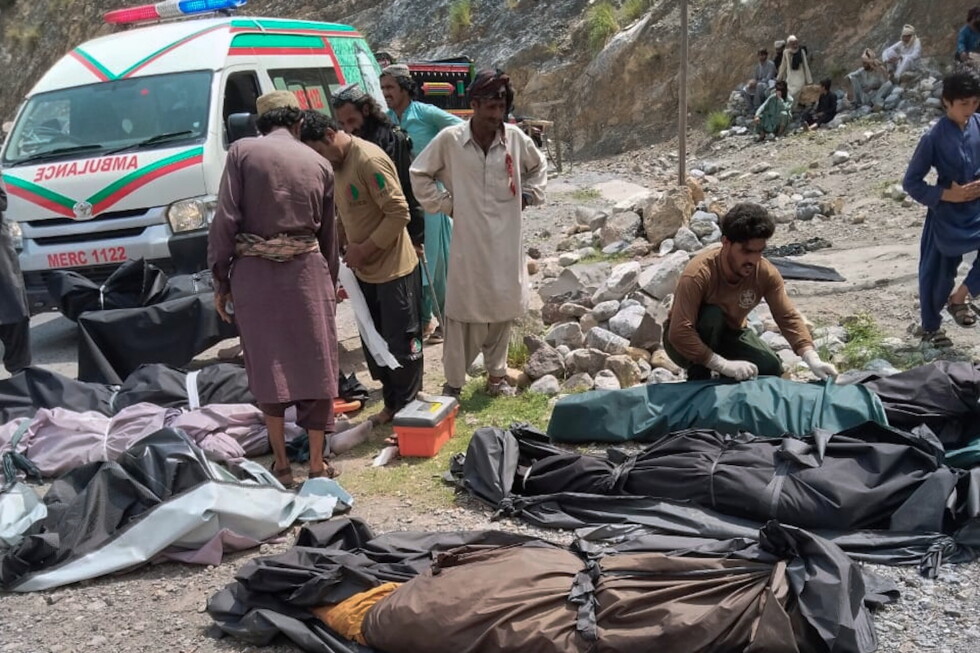
A devastating early-morning road accident in southwestern Pakistan has left at least 40 people dead and 8 others injured after an overcrowded, speeding passenger bus careened off a major highway and fell into a deep rocky ravine, marking one of the deadliest traffic incidents the country has seen in recent years, regional government officials confirmed Friday.
The crash unfolded in Dana Sar, a sparsely populated remote region that sits near the shared border of Pakistan’s Balochistan and Khyber Pakhtunkhwa provinces. According to Shahid Rind, spokesperson for the Balochistan provincial government, the bus lost control before plummeting into the ravine. Rind added that the overcrowding stemmed from the driver picking up additional passengers from a separate bus that had suffered a mechanical breakdown earlier in the trip, meaning the vehicle carried far more people than its authorized capacity. As of Friday, rescuers were still working to complete formal identification of all deceased victims.
One injured survivor, speaking to local Pakistani media from his hospital bed, shared a harrowing account of the moments leading up to the crash. He explained that multiple existing passengers had protested the driver’s decision to pick up extra passengers from the disabled bus, which was also traveling to the city of Peshawar. The protest escalated into a heated argument, during which one angry passenger allegedly grabbed the driver by the neck. Just moments after the altercation, the driver lost control of the vehicle, leading directly to the fatal plunge. Local law enforcement noted that this survivor’s account has not yet been independently verified, and a full official investigation into the cause of the crash is still ongoing.
Regional disaster and emergency management official Hazrat Wali Kakar confirmed that rescue teams from both provinces have completed the initial retrieval of victims and casualties, moving all injured survivors and deceased victims to nearby medical facilities. Rescue officials clarified the final passenger count: the bus was carrying 48 people total at the time of the crash. The eight injured people received stabilizing first aid at the accident site before being transferred to the district headquarters hospital in Zhob, while the 40 victims’ remains were moved to a local district mortuary for identification.
Shah Fahad, director general of emergency rescue services for Khyber Pakhtunkhwa, said his agency has partnered closely with Balochistan’s emergency response teams to coordinate the entire rescue and recovery operation. To ease the burden on grieving families, Fahad added that any victim confirmed to be a resident of Khyber Pakhtunkhwa will have their remains transported via official ambulance back to their home district for burial.
Top Pakistani political leaders have publicly expressed their grief over the tragedy. President Asif Ali Zardari issued an official statement offering his deepest condolences to the families of those killed, extended wishes for a full and speedy recovery for the injured, and ordered relevant government agencies to guarantee that surviving patients receive the highest quality of available medical care. Balochistan Chief Minister Sarfraz Bugti also released a message mourning the loss of life and echoed Zardari’s order to prioritize care for the injured.
Fatal road accidents are an all-too-common occurrence across Pakistan, a trend transportation safety analysts attribute to a combination of poorly maintained infrastructure, weak enforcement of existing traffic regulations, and widespread high-risk driving practices — particularly in rugged, mountainous regions like the area where Friday’s crash occurred. Just two months prior, in May 2024, a separate crash in northwest Pakistan killed 17 people and injured 5 more when a minibus collided with a parked bus on a major motorway.
This report includes additional reporting from Associated Press correspondents Riaz Khan and Rasool Dawar, who contributed on the ground from Peshawar.