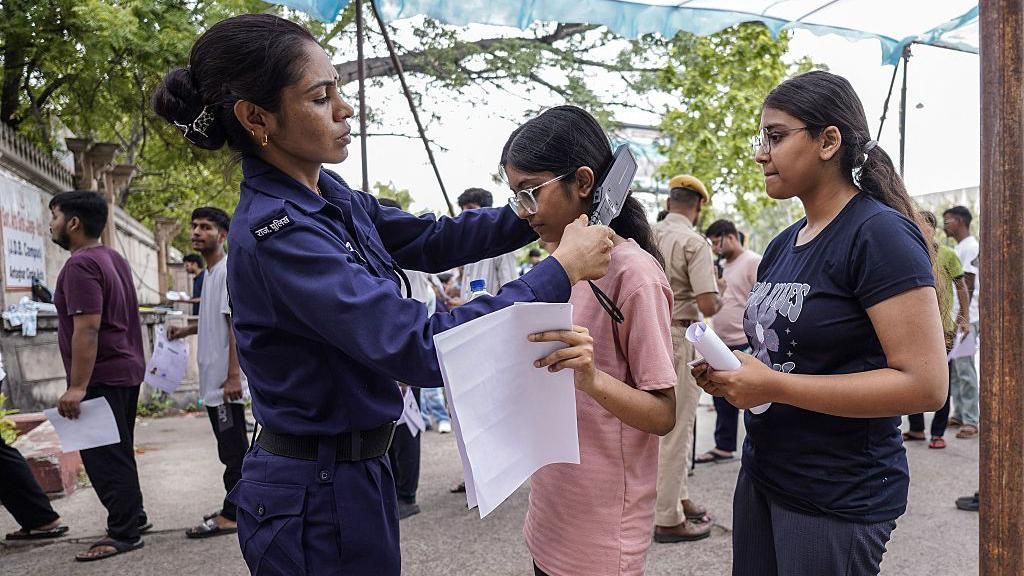
Millions of aspiring medical students across India sat for a high-stakes do-over entrance exam on Sunday, with authorities rolling out sweeping, unprecedented security measures to prevent a repeat of the paper leak scandal that forced the cancellation of the original test in May.
The National Eligibility cum Entrance Test (Undergraduate), better known as NEET-UG, is the mandatory gateway for admission to all government and private medical colleges across India. For the millions of test-takers that compete annually, only a tiny fraction earn one of the extremely coveted spots at top institutions. The notoriously tough exam requires months, and often years, of intensive preparation, making the May cancellation a devastating blow for the 2.28 million candidates who had already sat the initial test.
Allegations that the original exam paper had been illegally leaked and sold to test-takers sparked mass public protests across the country, with widespread calls for Indian Education Minister Dharmendra Pradhan to step down. Pradhan rejected the demands and addressed candidates ahead of Sunday’s retest, urging them: “Sit fearlessly, without worry, and you will definitely do well.”
This time around, authorities left no room for security gaps, deploying a multi-layered defense against cheating across 5,440 test centers nationwide, which contain more than 95,000 individual exam rooms. To eliminate the risk of tampering during transit, the Indian Air Force was tasked with flying new question papers to remote and high-risk regions. Uniformed police and paramilitary personnel were posted at every center, with drone patrols and specialized canine squads scanning perimeters for unauthorized activity.
Upon arrival, every candidate underwent biometric identity verification, full body frisking, and searches by security personnel that included inspections of hair, jewelry, and clothing. In a controversial policy, strict dress codes were enforced: enclosed shoes were banned, and many women candidates were required to remove nose pins, earrings, and traditional sacred wrist threads to avoid any risk of hiding electronic cheating devices. A total of nearly 39,000 screening staff were hired nationwide, with 40 to 50 security personnel stationed at each individual center.
Inside exam rooms, every space was covered by closed-circuit television, adding up to more than 1.3 million security cameras across the country. 51,311 signal jammers were activated at all centers to block mobile phone signals and prevent electronic interference that could aid cheating. As an additional precaution, the popular messaging platform Telegram was temporarily blocked nationwide through Monday, over concerns that the app had been used to coordinate illegal paper sharing in the May leak. Officials also warned candidates to ignore false paper leak rumors circulating on social media, which they said were designed to cause unnecessary stress and mislead test-takers.
Despite the unprecedented security deployment, many candidates remained anxious about the repeat exam, recalling that this is not India’s first high-profile exam cheating scandal. One student, Diksha, told reporters: “There is fear because the exam paper has leaked once already. This is not a one-off thing, it happens every year. This time the authorities got to know about it and are holding the exam again, which is in a way a good thing because the students who worked hard should get fair results. But to study and prepare again in one month… to stay consistent is difficult.”
NEET-UG is a 3-hour-and-15-minute multiple-choice exam covering physics, chemistry, and biology, with intense competition that pushes many candidates to pay for expensive private tutoring to boost their chances. The high stakes have created a profitable black market for organized crime networks that run exam fraud schemes, selling leaked question papers to well-funded candidates for large sums.
The investigation into the May paper leak has been handed over to India’s top federal law enforcement agency, the Central Bureau of Investigation (CBI). This incident also comes amid a string of recent testing controversies in the country: in 2024, NEET-UG was already roiled by allegations of paper leaks, fraud, and irregularities in grace mark awarding that sparked nationwide protests after thousands of candidates received unusually high scores. Earlier this year, thousands of 12th-grade students – the equivalent of UK A-level candidates – raised complaints of widespread marking errors after the rollout of a new digital grading system.