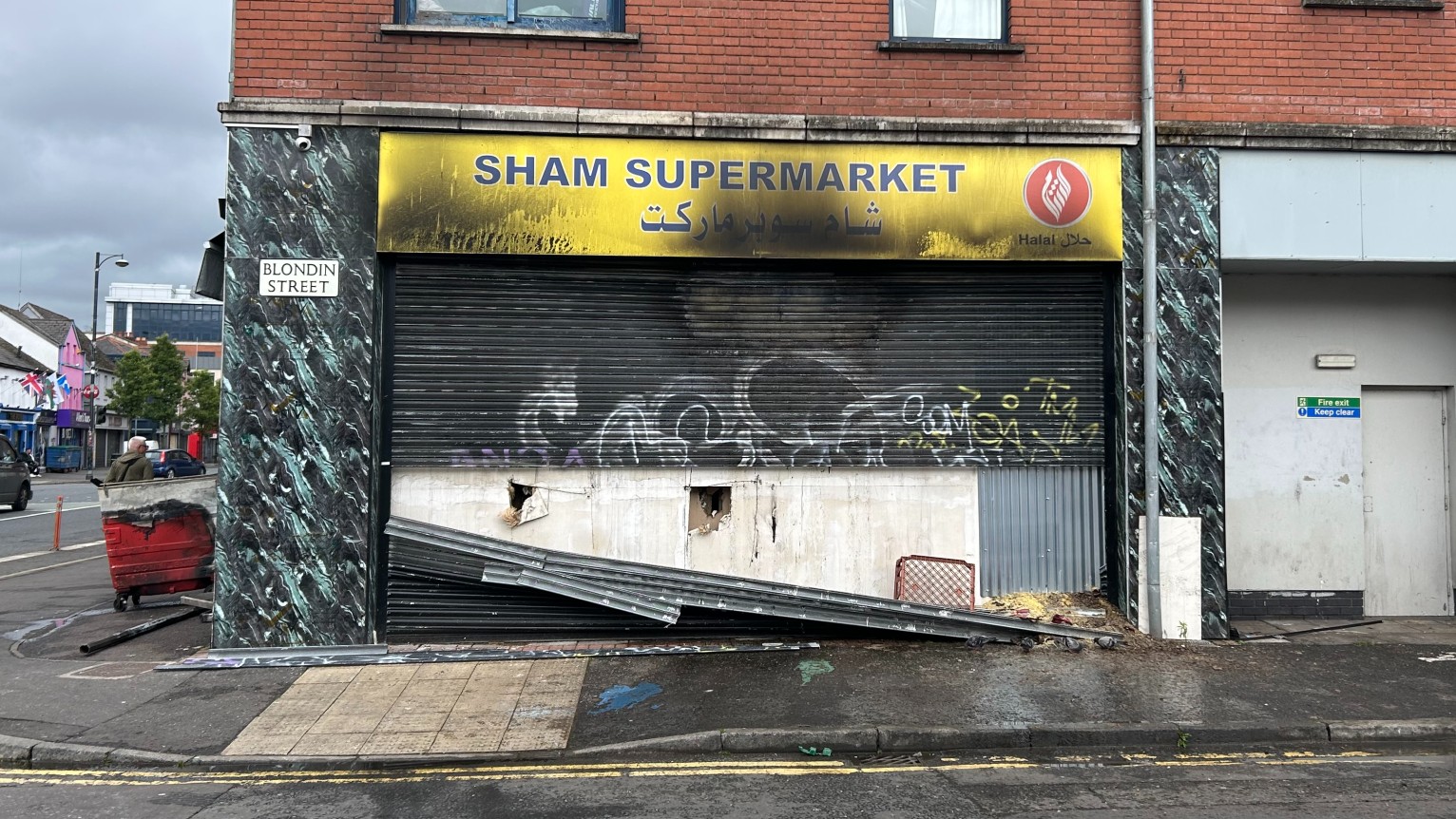
In a strongly loyalist Protestant neighborhood of south Belfast, two Syrian migrants who spent years building a small community business now face the aftermath of destruction for the second time in two years. For managers Mohammed and Sultan, the charred remains of their Sham supermarket on Donegall Road have left them with little choice but to flee the area they have called home for over a decade.
Mohammed, who fled Syria’s conflict in 2014 with a permanent shrapnel wound to his leg and gained British citizenship a year later, says the violence is inevitable. “It’s about to kick off,” he warned before the attack. His younger business partner Sultan, who was just 10 years old when his family escaped war-torn Aleppo to rebuild their lives in Northern Ireland’s capital, echoes the grim realization: “We’ve got to go.”
The pair pack into Mohammed’s car, its interior cluttered with the messy, familiar chaos of a life with six children – half-eaten croissants tucked under seats, discarded clothing piled against the baby seat, one window stuck permanently open. Minutes later, they sit down at a nearby Lebanese cafe to reflect on the total loss of all their hard-won progress.
Mohammed has managed the neighborhood supermarket since 2021, and this latest arson marks the second time masked gangs targeting ethnic minority-owned businesses have destroyed the property. Just three days before the attack, the store stood fully stocked: produce lined the front display, aisles were clean and welcoming, and new refrigeration units – installed to replace equipment destroyed in the 2024 attack – were fully operational. Today, the entire building is gutted by fire, its facade and sections of the residential flats above blackened by soot. The heavy protective security shutters are split clean in two, a discarded wheelie bin sits abandoned outside, and pigeons pick through the charred rubble for scraps of food. “They burned it all,” Mohammed confirms plainly.
The attack came in the wake of a fatal stabbing carried out by a Sudanese man on local resident Stephen Ogilvie, an event the two business owners knew would act as a tinderbox for sectarian and anti-immigrant violence. It would mark the third consecutive summer of racist unrest in Belfast. “We saw some things on Facebook, so we knew it was going to happen,” Mohammed explained. Out of respect for Ogilvie, he voluntarily closed the store on Tuesday, but the gesture did nothing to stop the approaching violence. By 7 p.m., as gangs rampaged through loyalist areas of the city, firebombing homes they identified as belonging to ethnic minority families and setting vehicles alight, Mohammed’s phone flooded with urgent messages alerting him that his shop was ablaze. There was nothing he could do to stop it.
When the pair arrived at dawn the next morning to assess the damage, they found nothing salvageable. Even the new fridges and freezers – replaced after the first attack in August 2024, which followed a wave of anti-immigrant riots that spread across the UK from the English town of Southport – were completely destroyed. The entire stock of produce was lost to the flames.
The Sham supermarket sits directly across from Sandy Row Rangers Supporters Club, a local institution rooted in the area’s staunch loyalist identity, which supports Northern Ireland remaining part of the United Kingdom. The neighborhood is dotted with iconic markers of that identity: a wall mural marking Queen Elizabeth II’s 2012 Diamond Jubilee inscribed “From Sandy Row to the House of Windsor”, a tribute to the Northern Irish national football team labeled “Our wee country”, and murals honoring loyalist paramilitary fighters killed during the Troubles, emblazoned with the crests of the Ulster Defence Association and Ulster Freedom Fighters. Flags fly from every building: the Union Jack, Saint George’s Cross, and the Israeli flag, raised in counterpoint to the Palestinian and occasional Hezbollah flags common in Catholic west Belfast.
Outside the supporters club, local opinion splits on the violence. While many long-term residents reject attempts to paint the entire loyalist community as racist, hostility toward the Syrian-owned supermarket persists, repeating unsubstantiated talking points spread by far-right figures including Elon Musk and Tommy Robinson. One local man in his 60s repeated false claims that the shop’s owners are drug dealers, alleging repeated tax raids on the property. Sultan dismisses these allegations as baseless excuses to justify years of harassment and ultimately the destruction of the business. Graffiti scrawled on a nearby apartment building across the street labels the property “Drug dealer flat”, echoing the smears.
Other local residents openly condemn the rioting. Jackie, 69, and John, a former British soldier who settled in Belfast 50 years ago, both describe the attackers as thugs. “These people are thugs,” Jackie says, while John adds “Personally, I think they’re doing the wrong thing.” Even so, both parrot anti-migrant rhetoric common in far-right circles, claiming migrants housed in local hotels are responsible for violent crime and that the UK government “emptied their prisons” to allow mass migration. Jackie insists the unrest “isn’t about race”, pointing to her concern for a Black local family trapped in their home during the violence, but acknowledges the fear and suffering the unrest has inflicted on innocent people.
Few residents are willing to speak openly about long-running rumors that loyalist paramilitary groups are involved in organizing the violence. Amid widespread poverty across the Sandy Row area, many locals acknowledge that organized crime groups profit from the instability and hold back community development. “Some of these areas have suffered from the baleful interests of loyalist paramilitaries and protection rackets,” explained Patrick Corrigan, head of nations and regions for Amnesty International. “Some of the investment has come from migrants because they set up little businesses and no one is competing with them.”
While Belfast remains a deeply segregated city, split largely between Irish Catholic and Protestant communities, the past three years of summer violence have targeted a new group: Black and Brown migrant residents, not Catholic communities. For many long-term residents, the chaos echoes the worst violence of the Troubles. “History is repeating itself,” says John. Jackie recalls experiencing similar unrest as a child: “I got a flashback to when I was 11 years old, living up the road, when the soldiers were coming over, the petrol bombs were flying, and the fear of God was in me.”
For Mohammed and Sultan, the violence in Belfast echoes the trauma they fled from Syria. Mohammed first became caught up in the 2011 Syrian uprising, and survived an airstrike in his hometown of Latakia in 2014 that left him with a permanent leg injury when he went out to buy food for his family. He claimed asylum in the UK, settled in Belfast, and gained citizenship in 2015; his wife joined him in 2018, and all six of his children were born in Northern Ireland. “I came here and I felt like I’m happy,” he says. Despite his injury qualifying him for disability benefits, he chose to work, holding a three-year position as a cook at KFC before opening his own shop. “I told myself it’s easy to open businesses here because there are no Arabic shops and rent is cheap.” He said he liked Belfast, liked the people, and understood the city’s complex history.
Even so, the pair say there was not a single day operating the supermarket that did not bring some form of harassment. After the first attack in 2024, they rebuilt anyway, only to lose everything again. “The racist attacks are getting worse,” Sultan says. Official data from December 2025 confirms his observation: race hate crimes in Northern Ireland have reached their highest level since record-keeping began 20 years ago.
Sultan, who grew up in Aleppo before the city was reduced to rubble by regime and Russian bombing, says local rioters have no understanding of the trauma he and Mohammed have already survived. “They have no idea what happened in Syria,” he says. Even so, his life is now rooted in Northern Ireland: he attended local schools, and has a Northern Irish girlfriend from a mixed Protestant-Catholic family who supports him. “My life is here now,” he says. “There are a lot of locals who look out for me. My girlfriend is amazing. Her family take care of me.”
Despite the repeated destruction and rising danger, the two men have not given up entirely. They plan to make one more attempt to rebuild the Sham supermarket. “Life is not going to stop because some people burned a shop,” Sultan says.