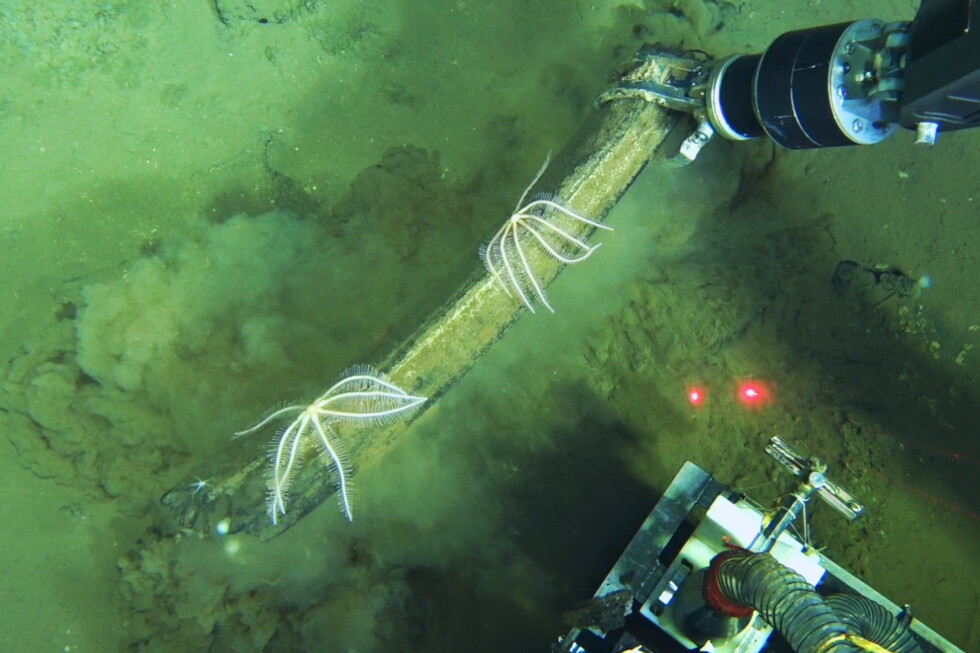
Beneath more than 22,000 feet of frigid, pitch-black water in the southeastern Indian Ocean, researchers have made a landmark deep-sea discovery: the largest, deepest, and oldest whale necropolis ever documented, where diverse marine communities have thrived for millions of years feeding on the sunken remains of massive cetaceans.
Whale falls, as these sites are informally called, form naturally when the bodies of dead whales sink to the abyssal sea floor. What would be a grim end for the massive mammals becomes a life-sustaining oasis for deep-sea organisms, which rely on the concentrated energy and unique chemical composition of whale bones to survive in an environment where food is extremely scarce.
Lead researcher Xikun Song, a deep-sea biologist with the Chinese Academy of Sciences’ Institute of Deep-sea Science and Engineering, explained that the size of whale carcasses and the unique chemical makeup of their bones are what allow these complex underwater ecosystems to develop. Song, who participated in the expedition that uncovered the site, also noted that the extreme inaccessibility of the deep ocean makes locating these rare graveyards an extraordinary challenge for marine scientists.
Over the course of multiple research dives conducted by deep-sea submersibles in 2023, the international research team mapped the full extent of the site, collected biological and fossil samples, and documented the scope of the discovery. The team identified five distinct whale carcass sites and fossils, including well-preserved whale skulls from beaked whales and baleen whales. Radiocarbon and geological dating confirmed the oldest of these remains date back more than 5.3 million years, making this the oldest confirmed whale graveyard ever found.
When the team examined the remains, they found a thriving, diverse community of marine organisms calling the whale bones home. Countless species, from brittle stars and jellyfish to tubeworms, sea cucumbers, squat lobsters, and saltwater clams, have made these sunken carcasses their feeding and breeding grounds. According to the team’s findings, published Wednesday in the peer-reviewed journal *Nature*, many of these organisms may represent entirely new species that have never been formally documented by science.
Outside experts not involved in the research say the find reshapes what we know about deep-sea ecosystem development. Stephen Godfrey, a paleontologist at the Calvert Marine Museum in Maryland, called the volume of specimens uncovered at the site “astounding.”
Study authors have outlined multiple factors that allowed the whale bones to remain preserved for millions of years in the deep ocean. The dense structure of large whale bones allows them to withstand degradation from bone-eating worms, while the site’s deep location protects remains from being completely buried by sediment and loose particulate matter. A thin, naturally occurring mineral coating from surrounding seawater also sealed the bones, slowing decomposition significantly over millennia.
The team has also put forward multiple hypotheses to explain why so many whale remains accumulated in this specific location. It is possible the whales were native to the region and died of natural causes, while some may have succumbed to exhaustion or illness related to deep diving. The site’s natural V-shaped geography may also have acted as a natural funnel, guiding sunken whale carcasses to this concentrated resting area over millions of years.
Researchers emphasize that discoveries like this are critical to expanding our understanding of life in Earth’s most extreme environments. Study co-author Giovanni Bianucci, a paleontologist at the University of Pisa in Italy, explained that studying these deep-sea whale graveyards helps scientists unpack how life adapts to extreme conditions: perpetual darkness, extremely low oxygen levels, and crushing water pressure thousands of times greater than what is experienced at the ocean surface.
The Associated Press’ Health and Science Department receives funding support from the Howard Hughes Medical Institute’s Department of Science Education and the Robert Wood Johnson Foundation. AP retains sole editorial responsibility for all content.