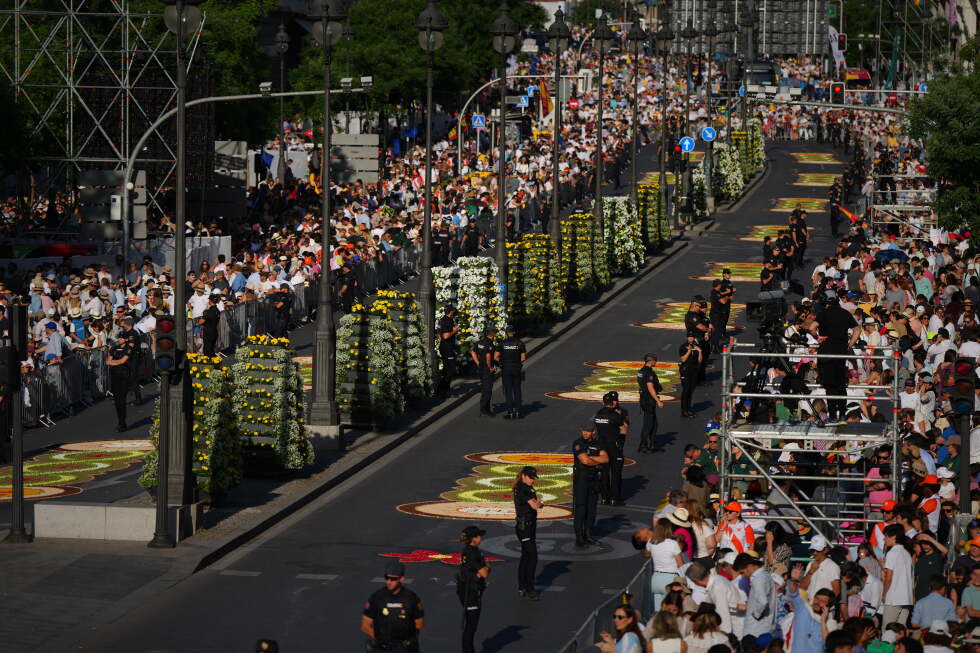
On a bright spring Sunday in central Madrid, more than 1.2 million worshippers and onlookers flooded Plaza Cibeles and the surrounding city streets to join Pope Leo XIV for a celebratory Mass marking the Catholic feast of Corpus Domini, the centerpiece of his week-long pastoral visit to Spain. The gathering highlighted one of the country’s most beloved expressions of popular Catholic devotion: the elaborate, hand-laid flower carpets that line the route of traditional Corpus Domini processions.
When Pope Leo arrived at the plaza, navigating the perimeter in his popemobile past crowds stacked several rows deep behind security barricades, the throng erupted in cheers, shouting out “This is the pope’s youth!” in a warm display of support. The pope, who touched down in Madrid Saturday to kick off his first visit to the country in 15 years, has centered his trip on reviving Spain’s deep-rooted Catholic heritage and drawing younger generations back to faith, at a time when the country is increasingly marked by secularization.
A day before the public Mass, an estimated 600,000 young Catholics gathered for a vigil with the pontiff, where attendees knelt in shared silent prayer for several minutes. The turnout served as a striking counterpoint to narratives of declining religious engagement among Spanish youth. During the event, Irati Valda and Javier Hormazal, a young couple who shared that they would marry on June 13, were escorted close to the pope to receive a personal blessing. “To see so many young people together, it’s incredible. Half a million people in silence, this is something you will only live once,” Valda shared with reporters after the encounter. In an address to the gathered crowd, Pope Leo encouraged young attendees to explore religious callings: “Let me take the opportunity to tell all of you: Don’t ever be afraid of thinking about a vocation to the priesthood or religious life, or other services in the church!”
Sunday’s procession route, stretching half a kilometer through central Madrid, was lined with 16 handcrafted flower carpets prepared by a team of florists from Spain’s Galicia region. Organizers confirmed the displays used more than 30,000 blooms, most in the yellow and white of the Holy See flag, and featured iconic symbols including the keys of the Holy See.
The tradition of laying flower carpets for Corpus Domini processions — which are intentionally trampled by the procession as an act of offering to the Eucharist — dates back more than 200 years in Spain, and similar practices have spread to Latin America, where artisans often pair floral designs with intricate sand artwork. Poland’s Corpus Domini flower carpet tradition already holds UNESCO intangible cultural heritage status, and Galicia is currently working to secure the same designation for Spain’s variation as part of a multinational nomination.
Public religious celebrations remain a deeply embedded part of cultural life across most of Spain, drawing practicing Catholics, non-believers, and international tourists alike. Beyond Corpus Domini, the country’s most famous religious events include the dramatic Holy Week processions held in the final week of Lent, where robed penitents and brotherhoods parade ornate sacred statues through city streets accompanied by marching bands. Many regions also host annual fiestas honoring local patron saints, and popular pilgrimages like the Pentecost El Rocío pilgrimage in Andalusia draw more than a million attendees each year, who travel on horseback and in decorated wagons to venerate a revered icon of the Virgin Mary.
Shortly after his arrival Saturday, Pope Leo opened his visit by urging the Spanish people to bridge growing political and social divides and work toward national unity. Following Sunday’s Mass and procession, the pontiff is scheduled to hold a private meeting with members of his Augustinian religious order and deliver an address to leading Spanish cultural figures.
This coverage from the Associated Press was contributed to by visual journalist Helena Alves, with support for AP’s religion reporting provided through a collaboration with The Conversation US, funded by Lilly Endowment Inc. The AP retains full editorial responsibility for all content.