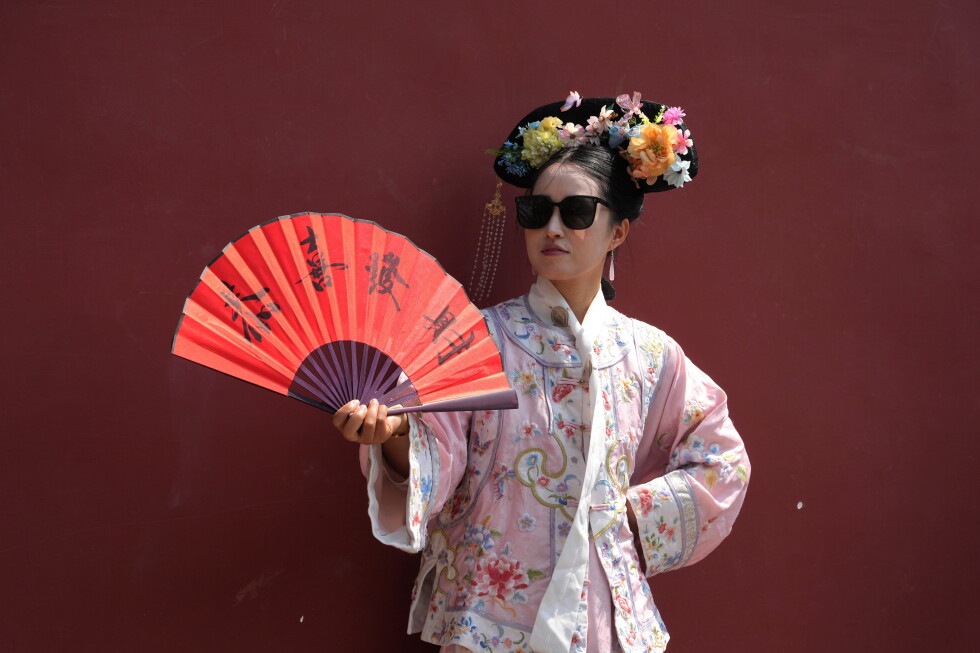
Nestled in the blocks surrounding Beijing’s Forbidden City — the centuries-old imperial residence that housed China’s final two imperial dynasties, the Ming and Qing — a fast-growing niche creative industry is thriving, driven by young Chinese people’s surging enthusiasm for reviving and experiencing traditional Chinese culture. At the heart of this trend are makeup artists like Chen Jiao, whose daily work involves turning ordinary visitors into elegant imperial figures straight out of ancient Chinese history.
Every day, streams of tourists flood into these nearby costume studios, eager to step into the ornate robes embroidered with intricate phoenix patterns, adorn themselves with jade pendants, pearl accessories and gilded fingernail guards that once were exclusive to noblewomen in imperial courts. After artists carefully apply traditional-style makeup and sculpt elaborate hairstyles decorated with flowing tassels and delicate hairpins, visitors head out to the historic walls and moat encircling the Forbidden City to capture photos and short videos for their social media feeds. Blending the charm of imperial-era aesthetics with modern lifestyle touches, many even pair their historic costumes with casual sneakers and trendy sunglasses while sipping popular bubble tea, creating a unique fusion of old and new.
The immersive experience comes at an average price of 300 yuan, equivalent to roughly $45, though high-end customized packages can cost more than 1,000 yuan, or over $150. For makeup artists like Chen, business rarely slows down. She notes that peak seasons — public holidays and weekends — bring nonstop crowds, and on a recent busy working day, she started her shift as early as 6 a.m. and completed styling for more than 20 young women in a single day. “There is no real off-season for us, only a short break when the Forbidden City itself is closed,” Chen explained.
This booming trend of immersive traditional costume experience has taken hold among young Chinese people over recent years, with Beijing’s scene centered heavily on Ming and Qing dynasty aesthetics, drawn directly from the adjacent Forbidden City that anchors the experience. To understand the historical context: the Ming Dynasty, which ruled China for more than 270 years until 1644, oversaw the construction of the Forbidden City and the reinforcement of the Great Wall. The Qing Dynasty, established by China’s Manchu ethnic group, collapsed in 1912, bringing an end to more than 2,000 years of imperial rule across the country.
For young travelers, the experience is more than just a photoshoot — it is a personal way to connect with Chinese history and cultural heritage. Chen Xiao, a college student from China’s eastern Shandong Province, traveled through the night to Beijing during this year’s Qingming Festival holiday to participate, wearing a soft pink costume matching that of a *Gege*, or Qing dynasty princess. “If you are standing on the grounds where history actually happened, you should wear clothing that fits the setting,” she said, adding that her interest in the trend grew out of her love for popular Chinese historical costume dramas that have dominated streaming platforms in recent years. “I’ve watched so many of these shows, they’ve definitely shaped my interest. Lately, I’ve been really fascinated by Qing dynasty history,” she added.
Another visitor, Liu Ruitong, a college student from neighboring Hebei Province, chose a solemn black Ming-style imperial outfit for her experience. “This whole styling feels so elegant and dignified, especially the color palette,” she explained. “I picked black because it complements the architecture of the Forbidden City and all the traditional Chinese scenery here so well.”
The explosive growth of the industry is visible in the neighborhood where Chen Jiao’s studio is located. Local media reports show that back around 2020, only a handful of these costume styling studios operated in the area. Today, that number has surged to more than 100.
Industry observers and cultural enthusiasts say the trend reflects a broader shift among young Chinese people. Cai Zehong, founder of Hanfu Beijing — one of China’s earliest non-profit groups established by enthusiasts to promote traditional culture and clothing of the majority Han ethnicity — notes that young generations have increasingly recognized the unique aesthetic value of traditional clothing while deepening their understanding of China’s extensive cultural heritage. Beyond that, the sustained popularity of historical television dramas and online series across Chinese streaming platforms has also served as a major catalyst, bringing imperial-era aesthetics to mainstream young audiences and sparking their desire to experience the culture firsthand.