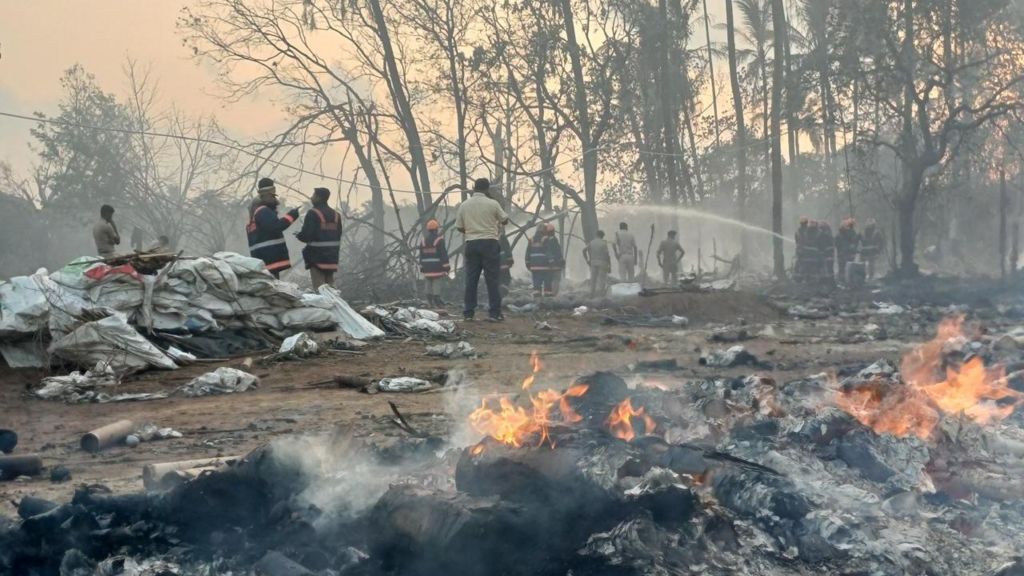
A devastating explosion at an illegal makeshift firecracker assembly site in India’s southern Kerala state has left at least 13 people dead and multiple others critically injured, marking the second fatal industrial disaster in the country’s fireworks sector within seven days.
The blast struck shortly after 3 p.m. local time on Tuesday in the city of Thrissur, where roughly 40 workers were gathering to assemble fireworks ahead of the upcoming Thrissur Pooram, one of India’s most prominent annual Hindu temple festivals. Local authorities confirmed that five of the injured are in life-threatening condition, and damage from the explosion extended to nearby residential structures, with the shockwave felt as far as several kilometers away — so powerful that many local residents initially misidentified it as an earthquake.
Witnesses reported chaotic scenes in the immediate aftermath of the blast, with local residents rushing to the site to pull survivors and deceased victims out of the rubble before official emergency teams arrived. The response effort was significantly hampered by the location of the temporary assembly sheds: the structures were built alongside rural paddy fields with narrow, unpaved access roads that slowed the arrival of fire trucks and ambulances. The initial blast also triggered a series of secondary smaller explosions from stored firework materials, forcing rescuers to pause operations while hazards were neutralized.
Officials confirmed the workers were contracted to produce fireworks for the Thiruvambady Temple, one of the two main temple groups that host the iconic competitive fireworks display that is the centerpiece of the 7-day Thrissur Pooram festival. Kerala’s Revenue Minister K Rajan told reporters that the organizing committee held official permission to produce and store fireworks in designated, regulated areas, but it remains unclear why assembly was taking place at the unauthorized rural makeshift site. Food preparations for roughly 40 workers were found at the site, confirming that a large workforce was present when the explosion occurred, though an exact headcount remained incomplete in the hours after the disaster.
While the exact cause of the blast has not been confirmed, Thrissur’s municipal chairman PN Surendran told reporters that high mid-afternoon temperatures may have been a contributing factor. “There is still no clarity on how many workers were in the shed or the full extent of injuries,” Surendran said. “It is suspected that extreme heat may have triggered this tragedy.”
This explosion comes just three days after a separate blast at a firecracker factory in neighboring Tamil Nadu state killed 25 people, bringing the total death toll from fireworks sector accidents in south India this week to 38. Deadly explosions are an endemic, recurring crisis in India’s $1 billion fireworks industry, which supplies pyrotechnics for religious festivals, weddings, and cultural celebrations across the country. The sector is dominated by informal, unregulated small-scale operations that handle highly explosive raw chemicals in cramped, low-cost facilities, where even a tiny stray spark can trigger a catastrophic blast.
India’s largest fireworks production hub is Sivakasi in Tamil Nadu, which produces more than 90% of the country’s domestic firecracker supply. A 2010 study documented nearly 10,000 fireworks-related accidents in Sivakasi between 2003 and 2010 alone, including almost 400 fatal incidents. Weak regulatory enforcement and surging consumer demand ahead of major festivals like Diwali routinely push safety protocols to the background, with factory owners often cutting corners to meet deadlines and keep costs low.
Kerala has already seen one of the deadliest fireworks disasters in Indian history: a 2016 explosion at an unauthorized fireworks display at the Puttingal Temple in Kollam killed more than 100 people and injured 400 others. Investigations later found that basic safety rules were completely ignored, with explosives stored in unregulated makeshift sheds, and community competitive pressure overriding existing safety regulations.
In response to Tuesday’s disaster, Kerala authorities have ordered a full magisterial inquiry to determine the cause of the blast and assign responsibility for any safety violations. Kerala Chief Minister Pinarayi Vijayan has announced that the state government will bring in specialized burn care experts from other regions of India if needed to treat injured victims. Indian Prime Minister Narendra Modi also released a statement offering condolences and announcing official financial assistance: 200,000 Indian rupees (roughly $2,140) for each victim’s family, and 50,000 rupees for each injured survivor.