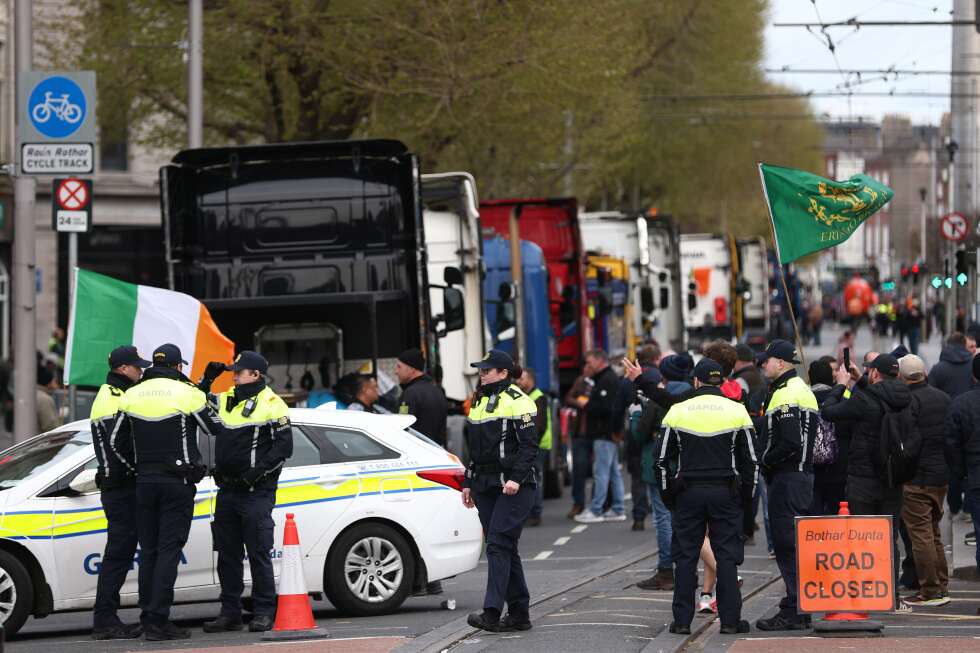
DUBLIN, Ireland – A week of widespread national disruption sparked by fuel price protests has reached a critical turning point, with Irish law enforcement clearing a major demonstration blockade in central Dublin Sunday, just hours before the Irish government planned to vote on new cost-reduction measures aimed at ending six days of unrest driven by skyrocketing pump prices.
By Sunday morning, the tractors and heavy trucks that had occupied O’Connell Street, Dublin’s busiest central thoroughfare, were already being withdrawn from the capital. However, demonstrations persisted across other regions of the country. On the opposite coast in Galway, clashes broke out between police and protesters at the city’s docks, where authorities deployed a military vehicle to tear down a makeshift barrier erected by demonstrators.
Over the past six days, the protests have upended daily life across Ireland. Blockades at the country’s only commercial oil refinery and multiple key fuel depots have halted tanker deliveries to service stations, leaving more than one-third of all gas pumps dry across the nation. Slow-moving convoys of protest vehicles have also caused crippling traffic congestion on major intercity highways, disrupting travel and commerce.
Law enforcement launched a coordinated crackdown on the blockades starting Saturday. At the Whitegate refinery in County Cork, officers used pepper spray to disperse protesters blocking access, and officials pledged to clear all demonstrations that threaten critical infrastructure and public safety. Authorities warn that widespread fuel shortages could disable emergency response vehicles, putting ordinary residents at direct risk.
Irish Police Commissioner Justin Kelly emphasized Saturday that the blockades are not a protected, legitimate form of protest. “We gave the blockaders fair warning that we were moving to enforcement, and they chose to ignore it and continue to hold the country to ransom,” Kelly said.
But Christopher Duffy, a farmer who serves as a spokesperson for the Dublin protest bloc, accused police of ambushing what he called a peaceful demonstration overnight. Duffy said officers gave protesters an ultimatum: move their heavy vehicles or have them towed. He added that protesters had no choice but to comply, because towing the expensive specialized vehicles with their engines off could cause severe mechanical damage that would leave farmers facing crippling repair bills.
“These vehicles are very expensive with automatic transmissions and everything, and if they drag them with the engine not on they could wreck them,” Duffy said. “So we have no choice, financially we have to move the vehicles.”
The protest movement first emerged last Tuesday, spreading rapidly across social media to draw participation from truckers, small-scale farmers, taxi drivers, and bus operators. Demonstrators are calling for urgent government intervention — including fuel price caps and cuts to fuel taxes — to bring down costs that many small business owners and independent operators say will force them to shut down.
Irish government officials note they already introduced a package of relief measures for rising energy costs two weeks ago, and have expressed confusion over the continued protests, pointing out that the current global fuel price surge stems from the Middle East conflict that has disrupted global oil exports, a factor outside the Irish government’s control.
Irish Prime Minister Micheál Martin has called the ongoing blockades “illogical,” warning that the disruption has left the country on the cusp of being unable to accept incoming oil tankers at ports, which could lead to a total collapse of domestic fuel supplies.
While the government was widely expected to approve a new set of targeted relief measures for gas and diesel costs Sunday, it remained unclear whether the proposed concessions would be large enough to end the protest movement entirely.