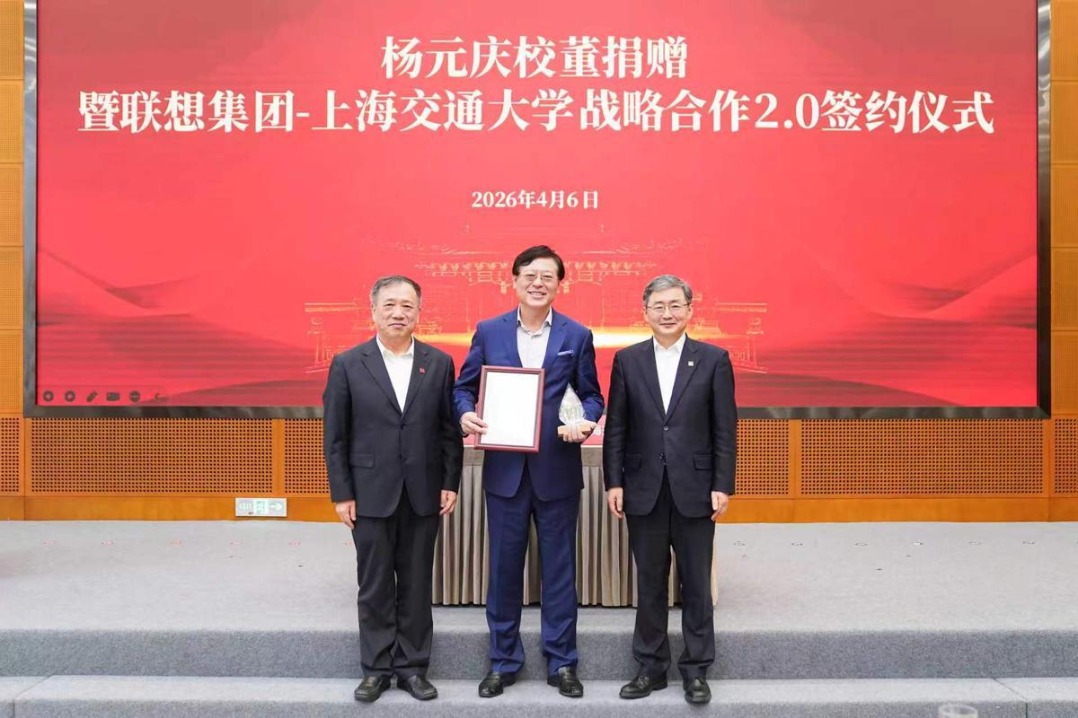
Ahead of Shanghai Jiao Tong University’s upcoming 130th founding anniversary, one of its most prominent graduates has made a landmark personal contribution to advance the institution’s work in cutting-edge technology education. On Monday, Yang Yuanqing, chairman and chief executive officer of global tech giant Lenovo, formally presented a 200 million yuan ($29 million) personal donation to his alma mater at a campus ceremony, alongside the launch of a broad new five-year strategic partnership between Lenovo and the university that will see the company commit an additional 300 million yuan to collaborative initiatives.
Yang, who earned his undergraduate degree in computer science from Shanghai Jiao Tong University in 1982, outlined that his personal gift will be directed specifically at supporting research innovation and talent development within the university’s artificial intelligence programs. The core goal of the investment, he noted, is to help the institution cultivate a new generation of world-class AI professionals that can drive global progress in the fast-evolving field.
This donation marks the third major personal contribution Yang has made to support his alma mater’s long-term growth. His most recent prior gift came in 2021, when he donated 100 million yuan to build what was at the time the most powerful university-based scientific computing center in all of China. In the years since its launch, that cutting-edge facility has emerged as a leading domestic and international research computing platform, providing critical infrastructure support for more than 1,200 individual research projects and enabling the publication of over 1,100 high-impact academic papers across a wide range of scientific and technical disciplines.
The new strategic partnership between Lenovo and Shanghai Jiao Tong University will expand on this legacy of collaboration over the next five years, with three core focus areas: joint scientific research initiatives, industry-aligned talent development programs, and investment incubation for early-stage technology innovations emerging from the campus. The collaboration is expected to bridge academic research and real-world industry application, creating new pathways for technological innovation and talent growth at the intersection of academia and global tech development.