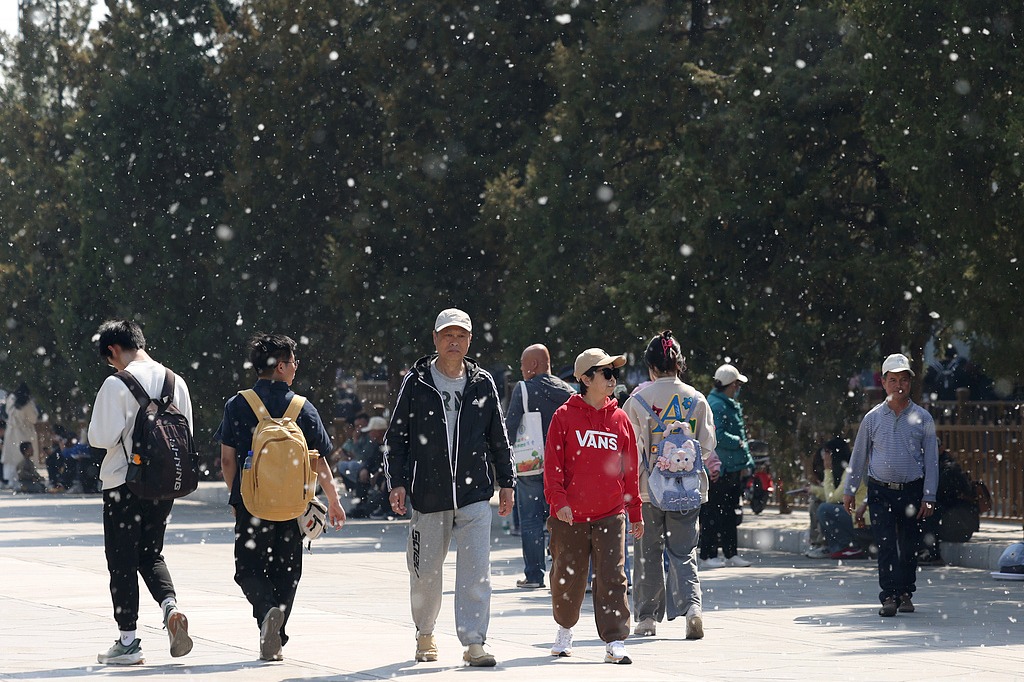
Across northern China and the Yellow-Huaihe River Valley, the annual spring phenomenon of poplar and willow catkin dispersal has kicked off earlier than the historical average this year, bringing extended periods of floating white fluff that is set to last through most of April and elevating dual risks of allergic reactions and wildfire outbreaks.
According to Weather China, the official meteorological platform operated by the China Meteorological Administration, unseasonably early warming that pushed regional temperatures to around 20 degrees Celsius triggered catkin release one to two days ahead of the 2025 timeline. In major northern urban centers Beijing and Tianjin, the catkin season is scheduled to commence between Monday and Thursday this week, with warm, arid, and windy conditions forecast to push catkin concentrations to their peak in mid-April. Unlike regions further south, this area will see catkins remain in the air well into May, creating a months-long period of elevated risk for residents.
Many people mistake the floating white fluff for flower blossoms, but it is actually the fibrous seed dispersal structure of mature poplar and willow trees, designed to carry tiny seeds on wind currents. While the fibers themselves are not the main trigger of seasonal allergies, they act as a mobile carrier for common irritants including pollen, fine dust, and airborne fungi. For residents with sensitivities, this often leads to uncomfortable allergic reactions ranging from persistent sneezing and runny noses to itchy, inflamed eyes.
Li Yuan, deputy chief physician at the China Meteorological Administration Hospital, has outlined clear precautionary guidance for the public to minimize exposure during high-catkin periods. She advises residents to use tightly fitted face masks and protective eyewear such as goggles or oversized sunglasses when outside, to block irritants from entering the respiratory tract and eyes. After returning indoors, she recommends rinsing nasal passages with saline solution and thoroughly washing the face and eye area to remove any trapped irritants and reduce irritation.
To further cut down on exposure, Weather China recommends avoiding unnecessary outdoor activities between 10 a.m. and 4 p.m., the window when catkin concentrations are highest in the air. Individuals with asthma or severe seasonal allergies are specifically advised to stay away from low-lying areas where catkins accumulate in dense drifting drifts.
Beyond health risks, catkins also present a major underrecognized fire hazard, due to their oily fiber composition and large surface-to-volume ratio that makes them extremely flammable. Even a tiny open flame can ignite catkins, leading to extraordinarily rapid combustion. Meteorological researchers note that experiments confirm a 1-square-meter patch of accumulated catkins can be fully engulfed in flames in less than two seconds, and fire can spread quickly from catkins to nearby dry grass, parked vehicles, and even building exteriors, posing a major threat to urban and suburban fire safety.