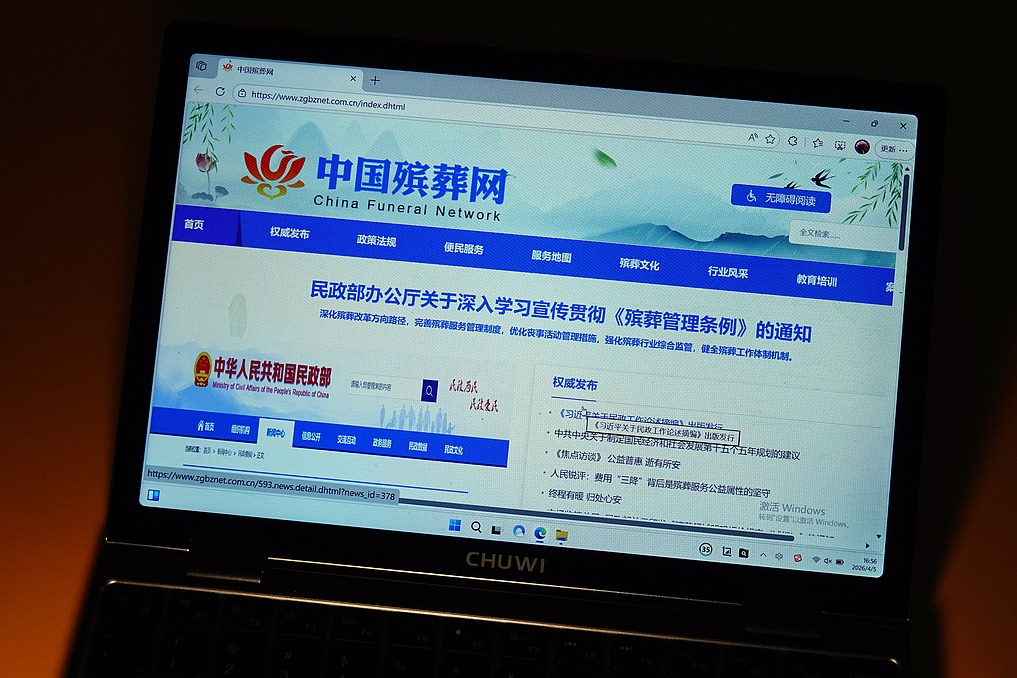
To mark the 2026 Tomb Sweeping Day, China launched its first centralized national online platform for funeral and interment services on Sunday, a development crafted to tackle longstanding public concerns over opaque pricing and fragmented information in the country’s funeral sector.
Developed under the official guidance of China’s Ministry of Civil Affairs, the new platform — named China Funeral Network and accessible at https://www.zgbznet.com.cn — is designed to streamline end-of-life planning for grieving families by aggregating authoritative, up-to-date information across every core stage of funeral arrangements, from initial mourning services to final burial and ongoing memorial activities.
At the heart of the platform is its “one-stop” service model, which integrates national access to official government portals for handling all post-death administrative affairs. A key interactive feature is its map-based interface, which pinpoints the exact locations of funeral homes, columbaria, and cemeteries across every region of China, alongside full details on service offerings, required application procedures, and transparent pricing breakdowns. Users can filter search results by geographic region, proximity to their location, and type of service institution to find resources that match their specific needs.
Officials confirmed that civil affairs departments from all 31 provincial-level administrative regions across mainland China, plus the Xinjiang Production and Construction Corps, contributed to the platform’s development and national rollout.
“The platform will help bereaved families quickly locate nearby funeral service resources and gain a clear understanding of service pricing, which effectively addresses the information asymmetry that often creates additional stress for families during an already difficult time of funeral arrangements,” explained Xu Zesheng, a senior official with the Ministry of Civil Affairs’ national funeral services task force.
Beyond core service information, the website also hosts dedicated sections covering national and local funeral policies and regulations, updates on industry-wide developments, and public case alerts about unregulated or problematic service providers. These additional resources are designed to serve both the general public and funeral industry professionals seeking authoritative regulatory updates, cultural guidance, and professional training materials.
Moving forward, authorities plan to expand the platform’s existing functions to further promote the adoption of environmentally friendly burial practices and encourage more civilized, cost-effective forms of memorialization that align with modern public needs.
In a coordinated move aligned with the platform’s launch, six newly revised or formulated industry standards for funeral services also went into effect on the same day, with a focus on advancing digital transformation and raising overall service quality across the sector.
One of the new standards outlines technical requirements for communication architecture and interface protocols for funeral internet of things (IoT) systems, establishing clear technical guidelines for digital infrastructure to support more innovative governance and service delivery in the funeral space.
A second standard formalizes rules for secure data sharing and exchange between civil affairs regulatory bodies and service institutions including funeral homes, cemeteries, and columbaria, strengthening the sector’s overall capacity for secure data transmission and practical data application.
A revised public satisfaction evaluation standard formalizes core principles, performance indicators, and assessment procedures for measuring funeral service quality, creating a clear framework for service providers to implement targeted improvements to their offerings.
Additionally, a new set of standards for electronic certification across core funeral services — covering cremation, ash storage, and burial — is designed to streamline digital documentation across key end-of-life processes and build a stronger foundation for data-driven sector management.
The Ministry of Civil Affairs noted that it will continue refining the national funeral industry standards system and strengthening regulatory oversight to support the healthy, well-regulated development of the sector for all Chinese families.