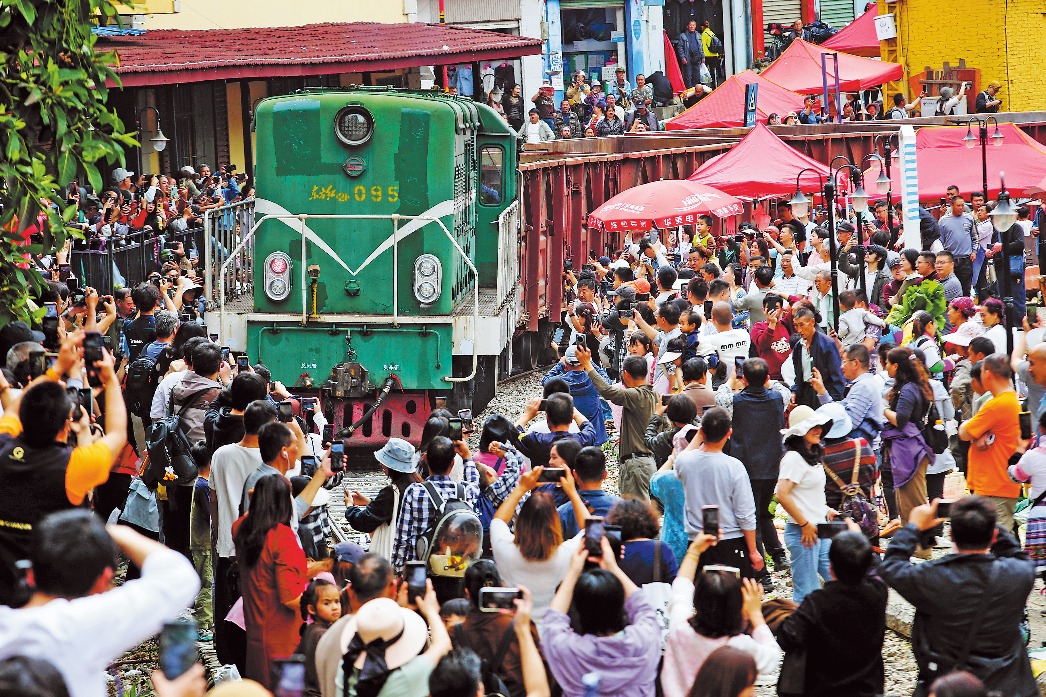
Tucked away in the mountainous terrain of Southwest China’s Yunnan Province, in the rural town of Baihe, Pingbian Miao Autonomous County, a unique century-old way of life continues to unfold every Monday along the tracks of the historic Yunnan-Vietnam Railway. This is the famous ‘Train Market’ of Baiheqiao Station, a living relic of industrial and cultural history that has now earned the title of China’s ‘last train market’, drawing curious visitors and keeping generations-old trading traditions alive.
The market’s origins stretch back to the construction of the narrow-gauge Yunnan-Vietnam Railway more than 100 years ago, a line that once connected inland China to global trade routes through Vietnam. Long before modern highways and large commercial hubs transformed regional commerce, local communities leaned on the railway as both a transportation link and a natural gathering place for trade. Every week, villagers from surrounding mountain valleys would travel to the station, where access was easiest for communities spread across the rugged landscape, to buy and sell goods.
Today, the centuries-old line has undergone massive changes. It no longer functions as a primary transport artery for passenger travel, but the Kaiyuan-Hekou section still maintains limited freight operations, with one or two cargo trains rolling through Baiheqiao Station on an average day. The rhythm of the market has adapted perfectly to this schedule: when the train’s whistle echoes through the valley and the locomotive rumbles into view, vendors step back from their stall spaces that line both sides of the tracks, pausing their haggling and transactions. As soon as the train passes and the tracks clear, trade resumes just as quickly as it paused.
Every week, vendors arrive before dawn, carrying handwoven baskets stacked high with homegrown produce, free-range poultry, foraged mountain delicacies, and seasonal vegetables. What once was a weekly gathering exclusively for nearby local residents has grown into a popular cultural and tourism attraction in recent years. Each Monday, tourists from across Yunnan and other provinces across China travel to the remote station to experience this one-of-a-kind market. They come not just to purchase authentic local farm products, but to walk in the footsteps of history, exploring a living industrial heritage that has adapted rather than disappeared in the face of modernization.
As nearby communities have gradually shifted toward more developed urban centers further from the railway line, the Baiheqiao Train Market stands as a persistent anchor for tradition. Unlike many historic market sites that have been relocated or turned into sterile tourist attractions, this market retains its original character, continuing to serve both local traders and modern visitors who seek a connection to China’s rural and industrial past.