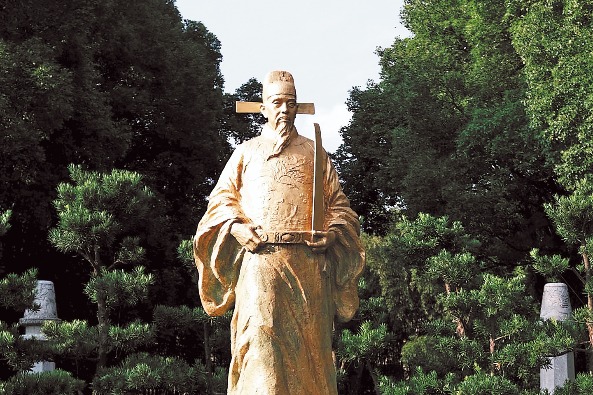
As the Qingming Festival, China’s traditional occasion for honoring ancestors and departed heroes, approaches in 2026, a growing trend of spontaneous tribute-paying by young people at the graves of historical figures has emerged, bridging the gap between centuries and bringing centuries-old revolutionary spirits to life for modern generations.
Twenty-one-year-old Wu Yutong, a university student hailing from Dalian, Liaoning province, stumbled upon an unexpected connection during a recent trip to Hangzhou, Zhejiang. While checking her location in her hotel room, she discovered she was staying just hundreds of meters away from the final resting place of Qiu Jin — a pioneering 20th-century Chinese revolutionary and feminist who was executed by Qing Dynasty (1644–1911) authorities in 1907 at just 31 years old, a heroine Wu has admired since her middle school years.
The following morning, on a clear January day, Wu set off across Gushan Hill, which sits along the scenic shoreline of Hangzhou’s iconic West Lake. Winding past crowds of casual tourists and street vendors selling local handicrafts and souvenirs, she followed a quiet path to a secluded clearing ringed with tall pine and camphor trees. There, a white marble statue of Qiu Jin, holding a sword in hand, stands in quiet tribute to her legacy.
Wu came prepared with two carefully chosen offerings: a bouquet of chrysanthemums, selected to honor a poem Qiu wrote about the resilient flower, and a bright red silk scarf, placed to symbolize the blood Qiu shed fighting for her radical beliefs of gender equality and national liberation. “The fire in her heart never went out,” Wu shared reflecting on the moment. She spent an entire hour standing quietly before the statue, and when passing tourists mistakenly identified Qiu as other famous figures from Chinese history or folklore — such as the legendary snake spirit Bai Suzhen, or 20th-century Communist martyr Jiang Zhujun — Wu took the time to share Qiu Jin’s true story with them.
For Wu, the visit marked the end of a long journey to connect with the heroine she had first encountered as a one-dimensional name in middle school textbooks, where Qiu was reduced to just a few lines describing her as a revolutionary patriot and martyr. It was only after Wu sought out Qiu’s own writing — including the poetry and essays Qiu published in *Chinese Women’s Journal*, the groundbreaking feminist periodical she founded in 1907 — that she came to see Qiu as a fully realized person, not just a historical footnote.
“I no longer saw just a name but a girl trapped by her era, one who fought desperately to break free,” Wu explained. When she shared the story of her visit to the grave on Xiaohongshu (RedNote), China’s popular lifestyle and social sharing platform, the overwhelming public response took her by surprise. To date, her post has earned more than 35,000 likes, and in the comment section, she found a thriving community of other young people who share this quiet hobby of paying respects to historical heroes.
Commenters asked for directions to the site, while one young artist even shared an original New Year portrait of Qiu Jin, painted with mountains and rivers across her robes — a visual tribute to the nation Qiu gave her life to improve. For Wu, this trend of visiting historical graves is far from the modern celebrity culture many young people engage in; it is a deeply personal practice that allows her and other young Chinese to draw strength from the past to navigate modern challenges.
Qiu Jin has become a mirror for Wu’s own life choices: “I remind myself to stand tall like her, to be the master of my own fate,” she said. “I don’t see it as chasing celebrities, but rather drawing strength from history. When we face challenges or feel lost in our own lives, thinking about the spirit of historical figures gives us courage to move forward. In the quiet of an ancient tomb, we can find in history the direction and confidence to keep going.”
This grassroots movement of tribute-paying ahead of the 2026 Qingming Festival highlights a growing desire among young people in China to connect with their history beyond formal education, building intimate, cross-temporal bonds with the figures who shaped modern China.