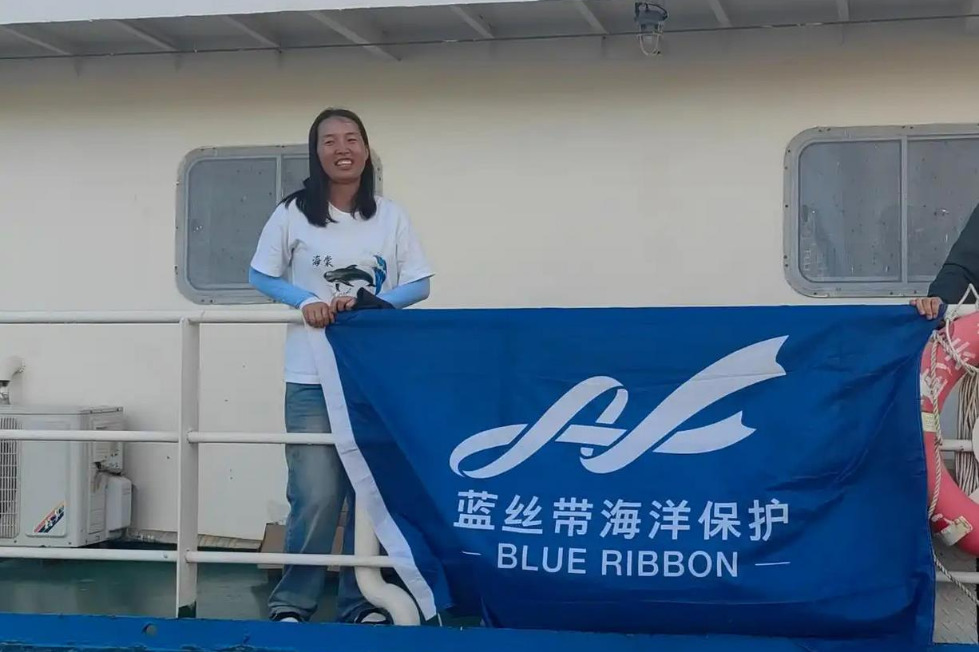
What began as a college student’s fascination with the sea has evolved into a transformative marine conservation movement spanning nearly two decades. Pu Bingmei, who grew up in China’s arid northwest, discovered her life’s purpose upon encountering the ocean for the first time in Sanya, Hainan province in 2007.
The stark contrast between the pristine waters she initially witnessed and the deteriorating coastal conditions she observed subsequently compelled her to action. Beginning with weekly beach cleanups during her college years, Pu has now dedicated 16 years to full-time conservation work with the Blue Ribbon Ocean Conservation Association.
The association’s journey demonstrates the evolution of environmental activism from basic cleanup operations to sophisticated ecosystem management. Starting with fewer than 10 members who operated on the simple principle that collecting beach garbage prevented ocean pollution, the organization gradually developed scientific monitoring systems. Through systematic beach litter analysis, they identified infrastructure deficiencies including insufficient trash bins and inadequate collection frequencies, providing data-driven solutions to local government.
In 2013, the association launched a groundbreaking project in Meilian, a traditional fishing village. Recognizing the unsustainability of fishing practices, Pu leveraged her tourism management background to orchestrate an economic transformation. She persuaded villagers to abandon destructive fine-mesh nets and repurpose fishing boats, while introducing health and wellness tourism initiatives that established over 200 homestays. This created local employment opportunities that reversed youth migration patterns.
Beyond pollution control, Pu’s team developed specialized expertise in marine mammal rescue. They established trained response teams after recognizing that stranded animals—particularly cetaceans—face critical internal injuries from their own body weight on land. The December 2017 attempted rescue of a 300-kilogram sperm whale proved educational despite its tragic outcome, leading to improved protocols.
The association’s dedication culminated in a landmark 2024 success: the rehabilitation and release of a male short-finned pilot whale, a national second-class protected animal. This 145-day rescue operation required around-the-clock care from more than 100 volunteers who took turns holding the whale upright in a rescue pool—China’s first successful rescue of this species.
Pu notes the profound shift in public consciousness: ‘What struck me most was the growing environmental awareness. Initially, people joined for small gifts, but now they participate out of genuine initiative.’ Her expertise has gained international recognition, with Gulf region countries seeking her consultation.
‘The oceans are connected,’ Pu emphasizes. ‘From picking up a piece of trash to inspiring global cooperation, it is actual actions that truly make a difference.’