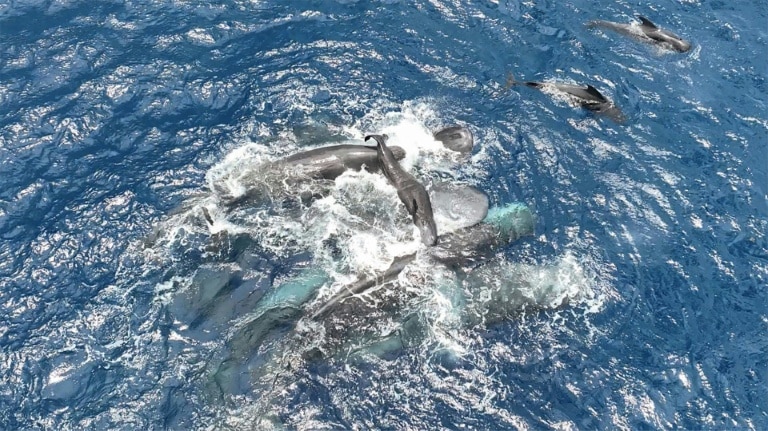
In a groundbreaking scientific observation, researchers have documented the first known instance of non-primate birth assistance among marine mammals. The extraordinary event occurred on July 8, 2023, when an international team from Project CETI witnessed a 19-year-old sperm whale named Rounder giving birth off the coast of Dominica while receiving active support from both related and unrelated pod members.
During the 34-minute birthing process, multiple adult females demonstrated remarkable cooperative behavior. They positioned themselves beneath Rounder’s dorsal fin, often swimming on their backs with their heads oriented toward her genital slit. Immediately following the birth, the entire pod of 11 whales underwent a dramatic behavioral shift, with all adults actively engaging with the newborn through physical contact and coordinated pushing motions.
The research team, which published its findings in both Scientific Reports and Science journals, captured the event using drone footage, boat observations, and underwater audio recordings over nearly five and a half hours. This documentation represents an exceptional rarity in marine biology, as only nine of 93 cetacean species have been observed giving birth in wild conditions.
Notably, the assisting whales included both family members and unrelated individuals—the first documented evidence of such behavior outside primate species. Researchers noted that the whales’ evolutionary history as land mammals that returned to the ocean approximately 36 million years ago necessitated specialized birthing adaptations. Unlike terrestrial mammals, whale calves emerge tail-first and require immediate assistance to prevent drowning before developing swimming capabilities.
The team also recorded significant vocalization changes during key moments, suggesting sophisticated communication coordination among pod members. The newborn calf, measuring approximately four meters at birth, was spotted over a year later with other young pod members, indicating successful survival through the critical first year—a positive indicator for reaching adulthood.