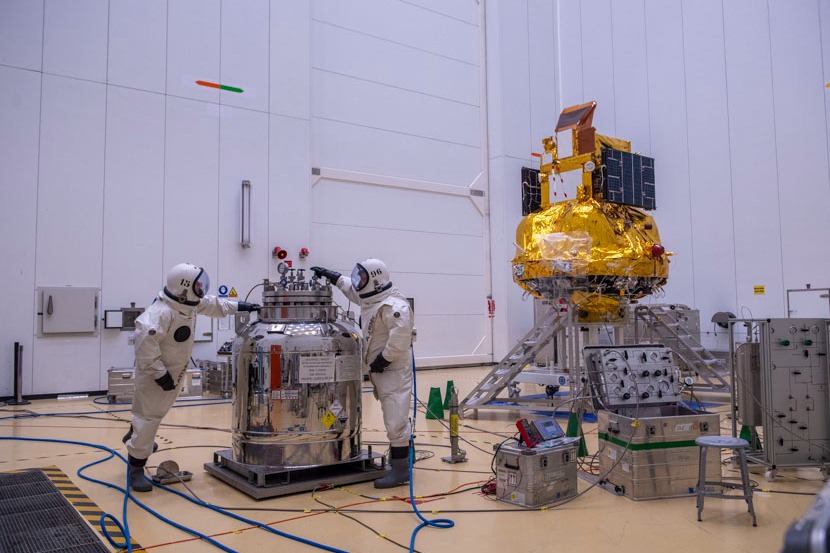
The groundbreaking Solar wind Magnetosphere Ionosphere Link Explorer (SMILE) mission, a collaborative endeavor between the Chinese Academy of Sciences and the European Space Agency, has completed all preparatory phases and is scheduled for launch on April 9 from Europe’s Spaceport in French Guiana. This announcement was made by China’s National Space Science Center on March 26, 2026.
The sophisticated spacecraft has been successfully integrated onto the Vega-C rocket, marking the mission’s transition into its final countdown sequence. The SMILE mission represents a significant milestone in international space cooperation, particularly between Chinese and European scientific communities.
This ambitious project aims to study the interaction between solar winds and Earth’s magnetosphere through advanced imaging technology. Unlike previous missions that primarily relied on in-situ measurements, SMILE will utilize cutting-edge ultraviolet and X-ray imaging equipment to provide unprecedented visual data of how solar particles interact with our planet’s protective magnetic field.
The mission’s launch from South America signifies the global nature of space exploration, with equipment having been previously shipped from the port of Amsterdam. This joint venture demonstrates how international partnerships can advance our understanding of space weather phenomena that potentially affect satellite communications, navigation systems, and power grids on Earth.