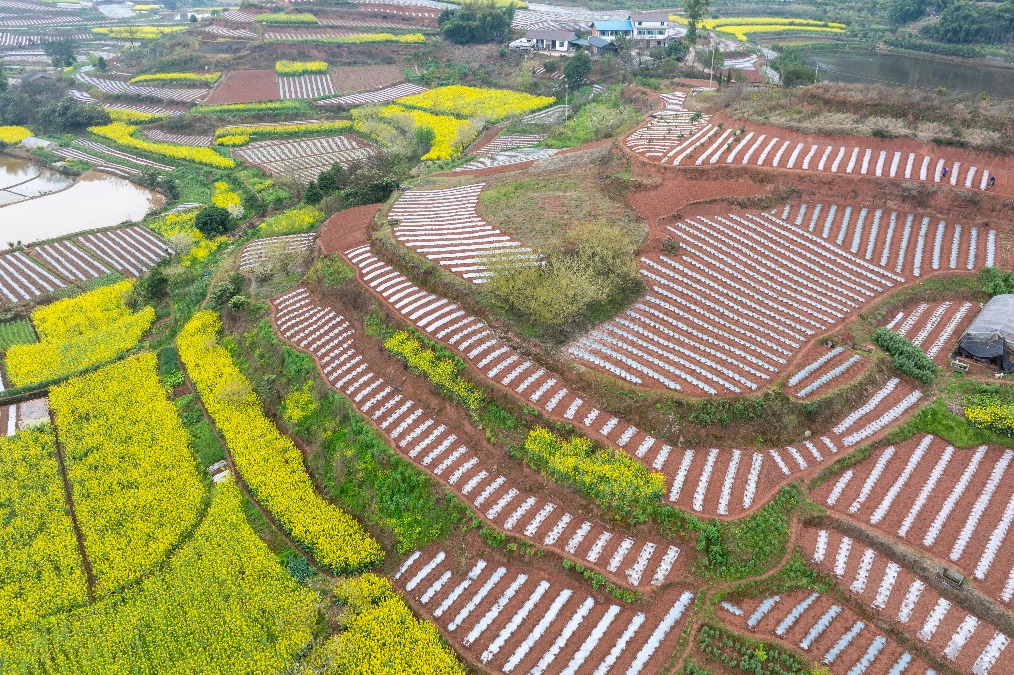
A comprehensive national assessment reveals significant improvements in China’s land geochemical composition over the past three decades, signaling enhanced soil productivity and ecological functionality across the country. The China Geological Survey, operating under the Ministry of Natural Resources, released these findings in its landmark National Land Geochemical Monitoring Report 2025, which analyzed over 500,000 data points collected from nationwide monitoring conducted in 1995, 2016, and 2023.
The report demonstrates that 92.6% of China’s land area now qualifies as medium grade or higher in quality—a notable increase of 0.4 percentage points since baseline measurements began in 1995. According to lead researcher Peng Min, this evaluation framework assesses critical chemical elements directly linked to soil nutrient content and ecological health.
Scientific analysis indicates that essential mineral components—including silicon, aluminum, iron, calcium, sodium, and magnesium—have maintained remarkable stability throughout the 28-year observation period. Researchers characterize these elements as the fundamental ‘skeletal structure’ of soil, whose balance prevents degradation phenomena such as acidification, salinization, and desertification.
More significantly, monitoring data confirms measurable increases in both macronutrients vital for plant development (nitrogen, phosphorus, and potassium) and micronutrients essential for human health (manganese, selenium, and iodine). These elevated nutrient levels suggest positive implications for agricultural productivity and food security.
The study further documents a substantial 16.4% rise in organic carbon content, with concentrations increasing from 6.7 grams to 7.8 grams per kilogram of soil between 1995 and 2023. This enhancement strengthens soil water retention capabilities and nutrient preservation while establishing a virtuous cycle of carbon sequestration through plant photosynthesis.
Regionally, the Qinghai-Xizang Plateau exhibited extraordinary progress with organic carbon levels surging by 141.4%. Researcher Cheng Hangxin attributes this dramatic improvement to climate change effects—specifically warmer and wetter conditions—coupled with conservation initiatives including modified grazing protocols. As one of Earth’s critical carbon sinks, the plateau’s enhanced capacity for atmospheric carbon dioxide absorption strengthens its role in mitigating global greenhouse effects.
Looking forward, the China Geological Survey plans intensified monitoring during the 15th Five-Year Plan period (2026-2030), with 6,000 additional monitoring sites scheduled for establishment this year alone. The agency commits to continuing decadal national surveys and quinquennial regional assessments to track environmental progress and inform future conservation strategies.