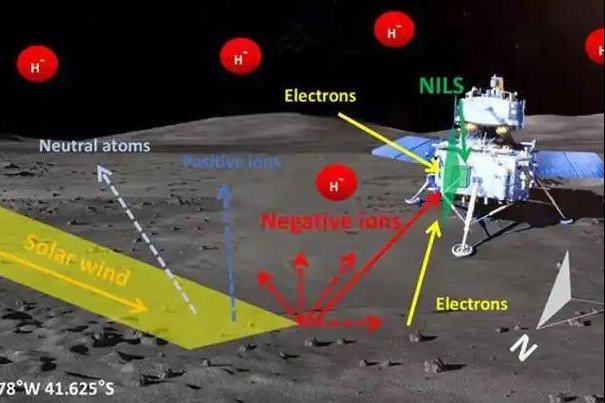
A groundbreaking discovery by a Chinese-led international research team has unraveled a long-standing cosmic mystery through the first direct detection of negative hydrogen ions on the lunar surface. The findings, captured by specialized instrumentation aboard China’s Chang’e 6 lunar lander, reveal how solar wind interactions generate these elusive particles on airless celestial bodies.
The research team employed the Negative Ions at the Lunar Surface (NILS) detector, a pioneering instrument co-developed by the Swedish Institute of Space Physics and the Chinese Academy of Sciences. During its operational window, the instrument recorded six distinct energy signatures of negative hydrogen ions over a 48-hour period, marking the first direct measurement of such particles on another planetary body.
Negative ions—atoms or molecules that have gained extra electrons—represent a crucial component of universal plasma but have remained notoriously difficult to study due to their fragility. Solar radiation typically strips away their additional electrons almost immediately, making remote detection virtually impossible.
The investigation confirmed these ions form through a scattering process where solar wind particles collide with lunar regolith and rebound, capturing electrons from the soil in the process. By cross-referencing data with the European Space Agency’s Artemis satellites, researchers established a direct correlation between solar wind intensity and negative ion production rates.
Simulations revealed dramatically different behaviors between the moon’s illuminated and dark sides. On the sunlit surface, ions survive mere moments within an extremely thin surface layer, while on the night side, they persist significantly longer, being carried by electromagnetic fields to form a massive tail extending thousands of kilometers behind the moon.
This discovery provides critical insights into space weathering—the gradual physical and chemical alteration of celestial surfaces by the space environment. The researchers suggest these ions may contribute to lunar water formation and help maintain the moon’s tenuous exosphere, with ion density surging over 1,000% during periods of intense solar activity.
The findings establish a new framework for studying similar phenomena on other airless solar system bodies, including asteroids and planetary moons, advancing our understanding of universal plasma behavior and celestial evolution.