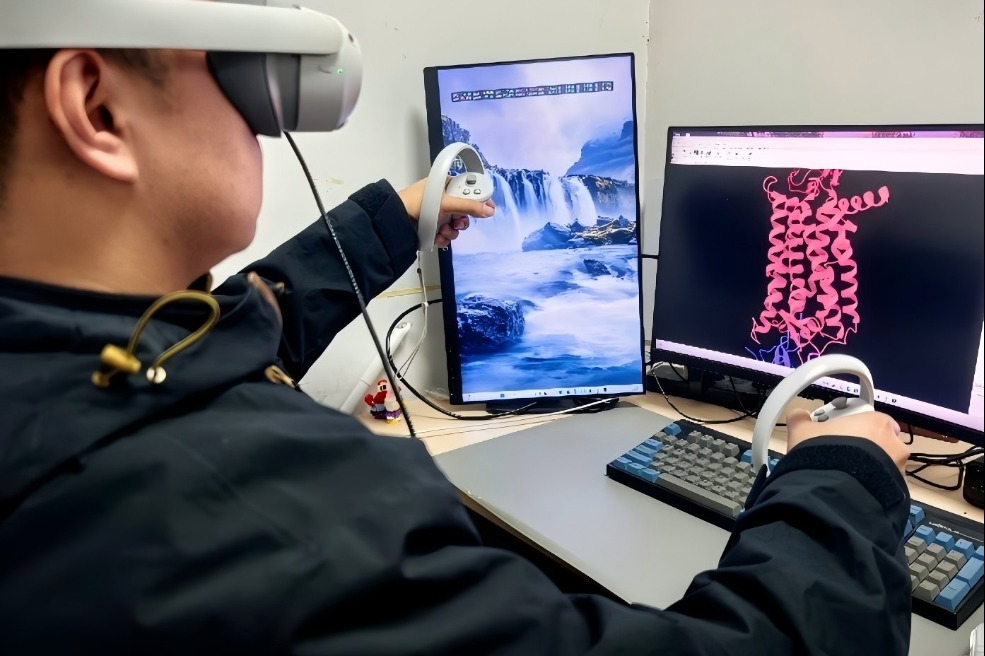
In a landmark study with profound implications for treating genetic disorders, scientists from Zhejiang University have developed a novel method to engineer artificial proteins capable of rectifying malfunctions in critical cellular receptors. The research, recently published in the prestigious journal Nature, represents a significant departure from conventional drug design paradigms.
The multidisciplinary team focused on G protein-coupled receptors (GPCRs), a large family of membrane proteins that facilitate cellular communication by transmitting external signals into cells. These receptors are targeted by approximately 30% of all approved pharmaceuticals worldwide, typically through interaction with their primary binding pocket, known as the orthosteric site.
According to Professor Zhang Yan, Vice-Dean of Zhejiang University’s School of Medicine and a lead researcher on the project, genetic mutations in these receptors can impair their signaling functions, leading to hundreds of clinical conditions including Parkinson’s disease, obesity, and hypercalcemia. Traditional drugs designed to target the receptors’ ‘switches’ generally cannot repair these structural dysfunctions, often leaving patients with long-term chronic burdens.
The innovative approach developed by the Zhejiang team involves creating artificial transmembrane proteins that function as customizable molecular ‘armor’ or exoskeletons. These modulators attach to malfunctioning receptors, enabling precise regulation of their functions. Professor Zhang likened the technology to ‘installing prosthetic limbs for persons with disabilities, or implanting medical devices supported by brain-computer interface technologies, only at the molecular level.’
The research team selected the dopamine D1 receptor (D1R) as their prototype model, successfully engineering four modulators that could bind to the receptor and restore activities in various loss-of-function mutants. The complexity of this endeavor was immense—designing a modulator composed of 60 amino acids from 20 available types presents approximately 20^60 possible combinations.
Critical to overcoming this challenge was the implementation of artificial intelligence. As explained by Professor Zhang Min from the University’s College of Computer Science and Technology, AI-driven protein design, particularly generative models for de novo design, provided tools to create entirely novel proteins with unprecedented speed and accuracy. The team developed an AI-guided probe to thoroughly profile targeted receptor structures and identify potential binding sites, using ‘structural prompts’ analogous to inputs for language models like ChatGPT but specifically for protein structures.
The resulting technology not only enables precise switching of receptor functions but also offers programmability to a certain degree. More significantly, the team’s findings establish a platform for similar research, potentially revolutionizing treatment approaches for disorders stemming from genetic mutations in cellular receptors.