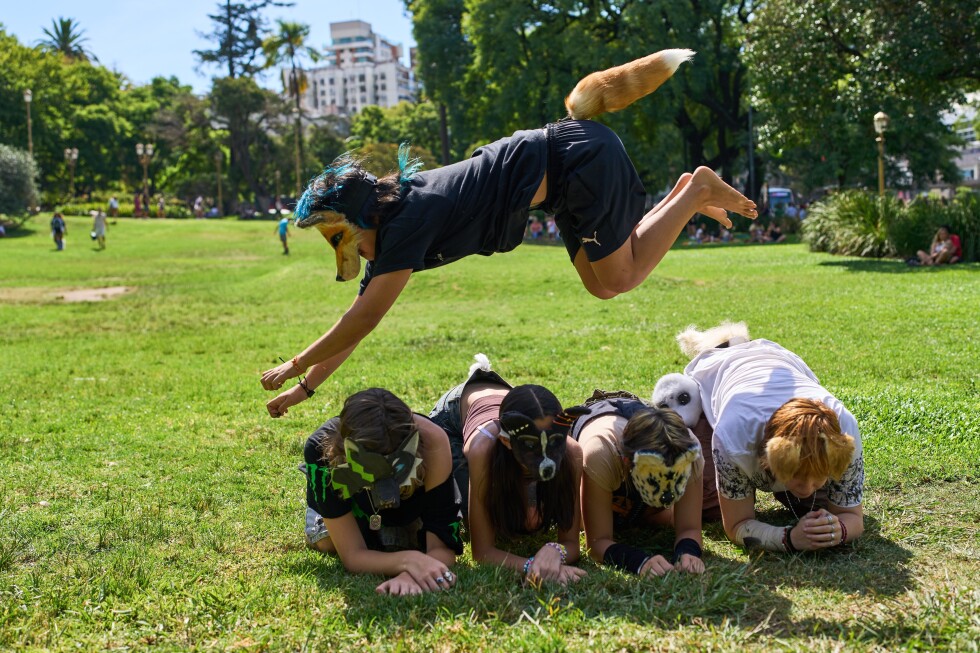
BUENOS AIRES — The sprawling plazas of Argentina’s capital have become unconventional gathering spaces for a burgeoning youth subculture that identifies with animal spirits. On a typical weekend, these urban spaces transform into surreal landscapes where teenagers don elaborate animal masks and move with uncanny animal-like grace.
This phenomenon, known as therianthropy, has exploded across Argentine social media platforms, particularly TikTok, where the hashtag #therian has amassed over 2 million posts. Argentina currently leads Latin American engagement with this trend, which involves individuals who assert mental, spiritual or psychological identification with non-human animals.
At a recent gathering, participants demonstrated remarkable commitment to their chosen animal personas. Sofía, wearing a meticulously crafted beagle mask, navigated the grassy terrain on all fours with surprising agility. Nearby, 15-year-old Aguara—identifying as a Belgian Malinois—executed precise movements through an improvised obstacle course. Other participants resembling cats and foxes observed from tree branches, maintaining cautious distance from curious pedestrians.
The movement has developed distinct internal classifications. Some participants, like 16-year-old Aru who wore a seal mask, identify as “otherpaw” therians—those who engage in animal-like behavior and attire primarily for recreational purposes rather than deep psychological identification.
Psychologists have begun examining this social phenomenon through clinical lenses. Débora Pedace, director of Buenos Aires’ Integral Therapeutic Center, characterizes therianthropy as “symbolic identification with an animal” that typically remains harmless unless evolving into deeply entrenched beliefs that could potentially lead to self-harm or endanger others.
Many participants emphasize the community aspect of the movement, describing it as a sanctuary where unconventional self-expression finds acceptance. Aguara, who leads a “pack” of over 125,000 TikTok followers, coordinates regular meetups throughout the capital while maintaining what she describes as an otherwise normal teenage existence.
The trend’s particular resonance in Argentina may stem from the country’s historically progressive attitudes toward social experimentation and identity exploration. As the movement gains visibility, it continues to provoke reactions ranging from bemused curiosity to outright criticism, reflecting broader societal conversations about identity, belonging, and the boundaries of self-expression in the digital age.