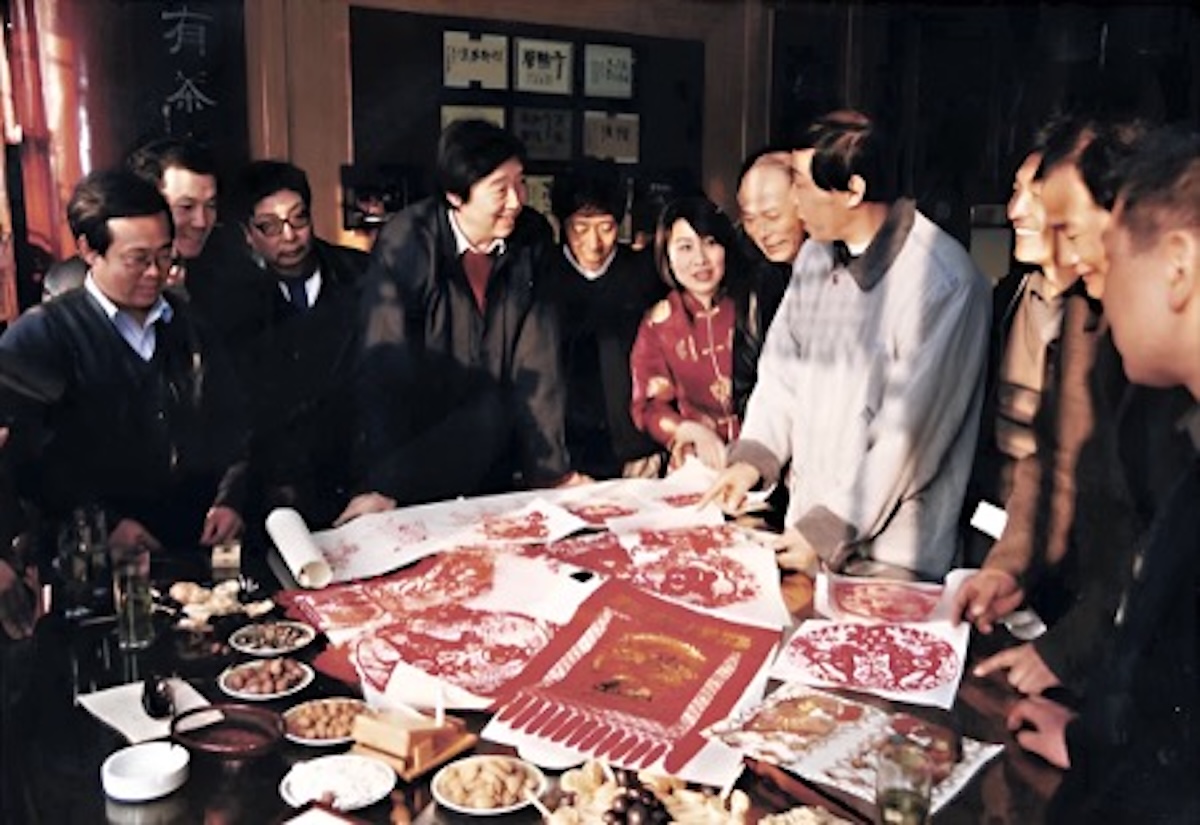
While Western observers often perceive Chinese Spring Festival through superficial symbols like red lanterns and fireworks, this ancient tradition represents something far more profound—a continuous cultural river flowing through millennia. At the forefront of interpreting this rich heritage stands Feng Jicai, an octogenarian cultural preservationist whose lifelong work bridges China’s past and present.
Originally emerging as an accomplished writer and painter from Tianjin’s established financial circles, Feng gradually transformed into China’s preeminent cultural guardian. His evolution from artist to preservationist reflects a deep commitment to safeguarding traditions threatened by modernization’s relentless advance. Through the Feng Jicai Institute of Literature and Arts at Tianjin University, where he serves as professor and doctoral supervisor, he has institutionalized cultural protection while maintaining field research well into his eighties.
Feng’s vision materialized physically with the 2025 opening of the Tianjin University Feng Jicai Museum, occupying 12,000 square meters across two restored heritage buildings. As mainland China’s first museum named after a living polymath—recognized simultaneously as writer, painter, and cultural protector—it houses extraordinary collections including international treasures: Victor Hugo’s correspondence, Leo Tolstoy’s signed works, and Franz Liszt’s handwritten scores. This institution transcends personal archive status, embodying Feng’s philosophy that literature and folk memory constitute society’s shared historical consciousness.
Feng’s cultural perspective draws from deep historical roots. His wife’s family established Chung Foo Bank in 1916 during global financial restructuring, while ancestor Sun Jianai (1827–1909) served as Qing dynasty imperial tutor and educational reformer. Sun helped establish Peking University’s predecessor, advocating Sino-Western knowledge integration during Europe’s industrialization and America’s Gilded Age.
This intellectual legacy informs Feng’s focus on ordinary people’s living traditions rather than elite culture. The Spring Festival represents the apex of these traditions—a 3,000-year-old celebration comparable to Western New Year and Christmas combined. Its rituals evolved through dynastic eras: taking shape during the Han period (contemporaneous with Rome), structuring during Tang-Song eras (parallel to medieval Europe), and crystallizing during Ming-Qing periods (alongside Renaissance and Enlightenment).
Modern celebrations involve intricate customs: spring couplets bearing auspicious phrases, reunion dinners featuring dumplings (symbolizing unity), chicken (homophone for fortune), and fish (representing surplus). Fireworks drive away misfortune, while red envelopes convey protection and goodwill. For Feng, these traditions represent life’s idealization—where “food, color, and ritual are never merely decorative” but elevate ordinary existence into meaningful experience.
Feng’s decades-long advocacy achieved a milestone in 2024 when UNESCO inscribed Spring Festival on its Intangible Cultural Heritage list. He emphasizes that participation alone conveys core values: family emphasis, elder respect, and harmony pursuit—universal ideals transcending cultural boundaries. Today, global celebrations from London to Sydney form one of humanity’s largest cultural migrations, representing shared aspirations for renewal.
In an increasingly commercialized world, Feng protects the essential thread connecting culture to lived experience rather than mere display. The Spring Festival’s true power lies not in spectacle but in its timeless reminder to return to family, memory, and hope—a legacy guarded by cultural stewards like Feng Jicai along time’s endless river.