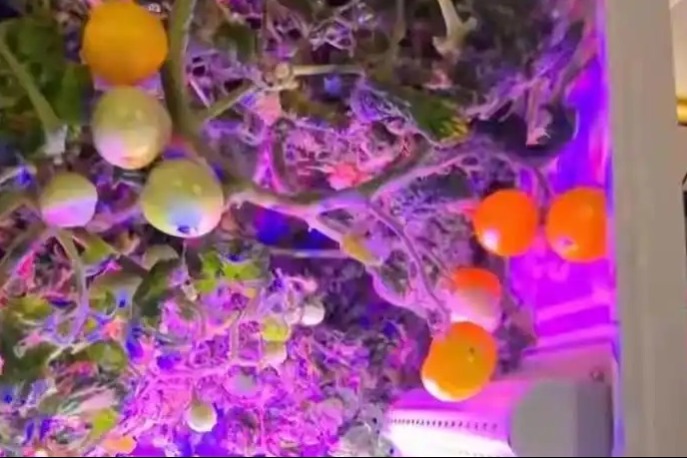
In a landmark achievement for space agriculture, Chinese astronauts aboard the Tiangong space station have successfully harvested fresh tomatoes during their Spring Festival celebrations, marking a significant advancement in bioregenerative life support systems. The Shenzhou XXI mission crew, led by astronauts Zhang Hongzhang, Wu Fei, and Zhang Lu, celebrated the orbital harvest using an innovative aeroponic cultivation system developed by the China Astronaut Research and Training Center.
The cutting-edge system, delivered to the station by the Tianzhou-9 cargo spacecraft in July 2025, utilizes vaporized water mist and specialized LED lighting to optimize plant growth in microgravity conditions. Astronaut Zhang Hongzhang described the thriving tomato plants as a ‘healing corner’ within the space station, noting that the sight and scent of ripening tomatoes provide psychological benefits during long-duration missions.
‘These tomatoes are incredibly enticing with their fresh scent,’ remarked astronaut Wu Fei. ‘Every time I pass by this area, I want to take a deep breath and enjoy the fragrance.’ The crew meticulously tends to the plants daily, collecting valuable growth data that will inform future space crop cultivation protocols.
The research extends beyond mere horticultural observation, with scientists systematically investigating multiple aspects of space agriculture including atmospheric regeneration capabilities, fruit productivity, and optimized crew maintenance procedures. Future experiments planned for the Tiangong ‘space garden’ include aeroponic trials with wheat, carrots, and medicinal plant species, progressively expanding the diversity of sustainable orbital crops.
According to the China Manned Space Agency, the Shenzhou XXI mission has now exceeded 100 days in orbit since its October 2025 launch, with all scientific experiments, equipment maintenance, and health management tasks progressing smoothly. The successful tomato harvest represents a crucial step toward developing self-sustaining life support systems for future deep space exploration and long-duration missions beyond Earth’s orbit.