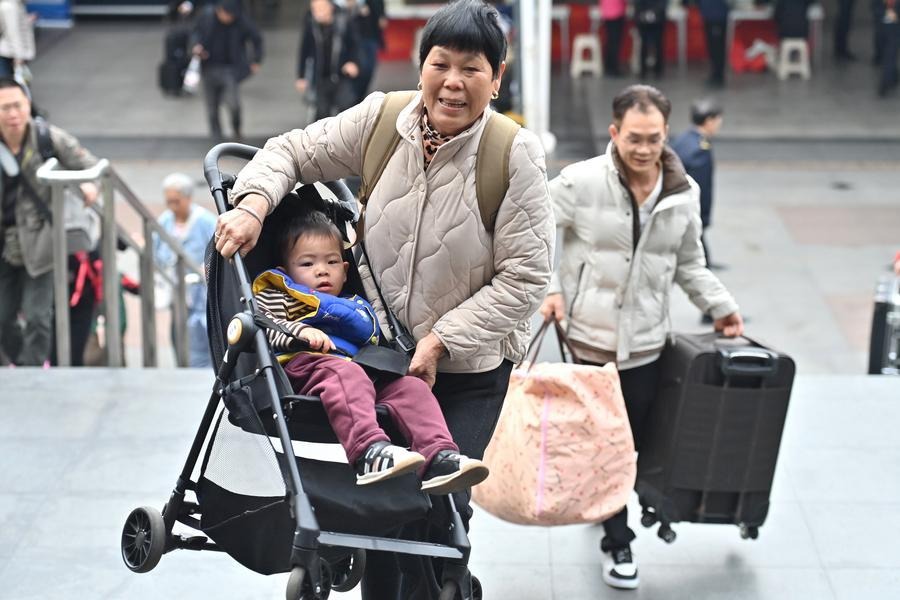
The annual Spring Festival travel rush in China, historically characterized by arduous journeys, has undergone a remarkable transformation, evolving into a diverse and efficient transportation phenomenon. This year’s chunyun period, running from February 2 to March 13, is projected to generate an unprecedented 9.5 billion passenger trips, showcasing China’s rapidly modernizing transport infrastructure.
The personal journey of Wei Shouyi, a 44-year-old migrant worker, exemplifies this dramatic shift. Two decades ago, Wei endured an 18-hour motorbike trek from Foshan to his Guangxi village through challenging conditions. Today, his 700-kilometer journey has been reduced to a comfortable six-hour drive in his private vehicle. “Since I bought a van in 2010, and later a car, the motorcycle has become a memory,” Wei reflects. “In my village, no one rides back from Guangdong anymore.”
This personal transformation mirrors national trends. The once dominant sight of massive motorbike caravans has dramatically diminished. Police officer Zou Dan, stationed at a key highway checkpoint in Wuzhou, confirms: “You only see a few scattered motorcycles now. Our focus has shifted entirely to managing the massive flow of private cars on the expressways.”
Multiple factors drive this evolution. Surging private vehicle ownership, particularly new energy vehicles (NEVs), has revolutionized road travel. According to Huang Guoxun of Guangxi’s transport department, NEV travel during this Spring Festival is expected to jump by 72.2 percent, comprising one-fifth of all highway traffic.
Rail infrastructure has simultaneously undergone massive expansion. China’s total operating railway mileage increased by 12.8 percent during the 14th Five-Year Plan period (2021-2025), reaching 165,000 kilometers. The high-speed rail network specifically grew by 32.98 percent to 50,400 kilometers, maintaining China’s position as home to the world’s largest high-speed rail system. This expansion supports the expected 540 million rail passengers during the travel period.
Notably, traditional “green trains” continue to operate alongside modern high-speed networks, providing affordable options for passengers traveling to smaller stations.
The aviation sector has similarly transformed from a luxury service to a practical transportation alternative. Migrant workers like Ma Changwei now consider air travel a viable option when high-speed rail tickets are unavailable. “It’s expensive compared to the train, but it only takes two or three hours,” Ma explains. “Many of my coworkers are doing the same.”
Industry data confirms this trend, with China’s civil aviation authorities anticipating approximately 95 million passengers during the holiday season—a historic high. China Southern Airlines’ Guangxi branch reported an 85 percent seat occupancy rate on the first day of chunyun alone, describing demand as “explosive.”
This comprehensive transportation evolution has fundamentally reshaped the Chinese cultural tradition of returning home for the Lunar New Year, making journeys safer, faster, and more comfortable for millions of travelers.