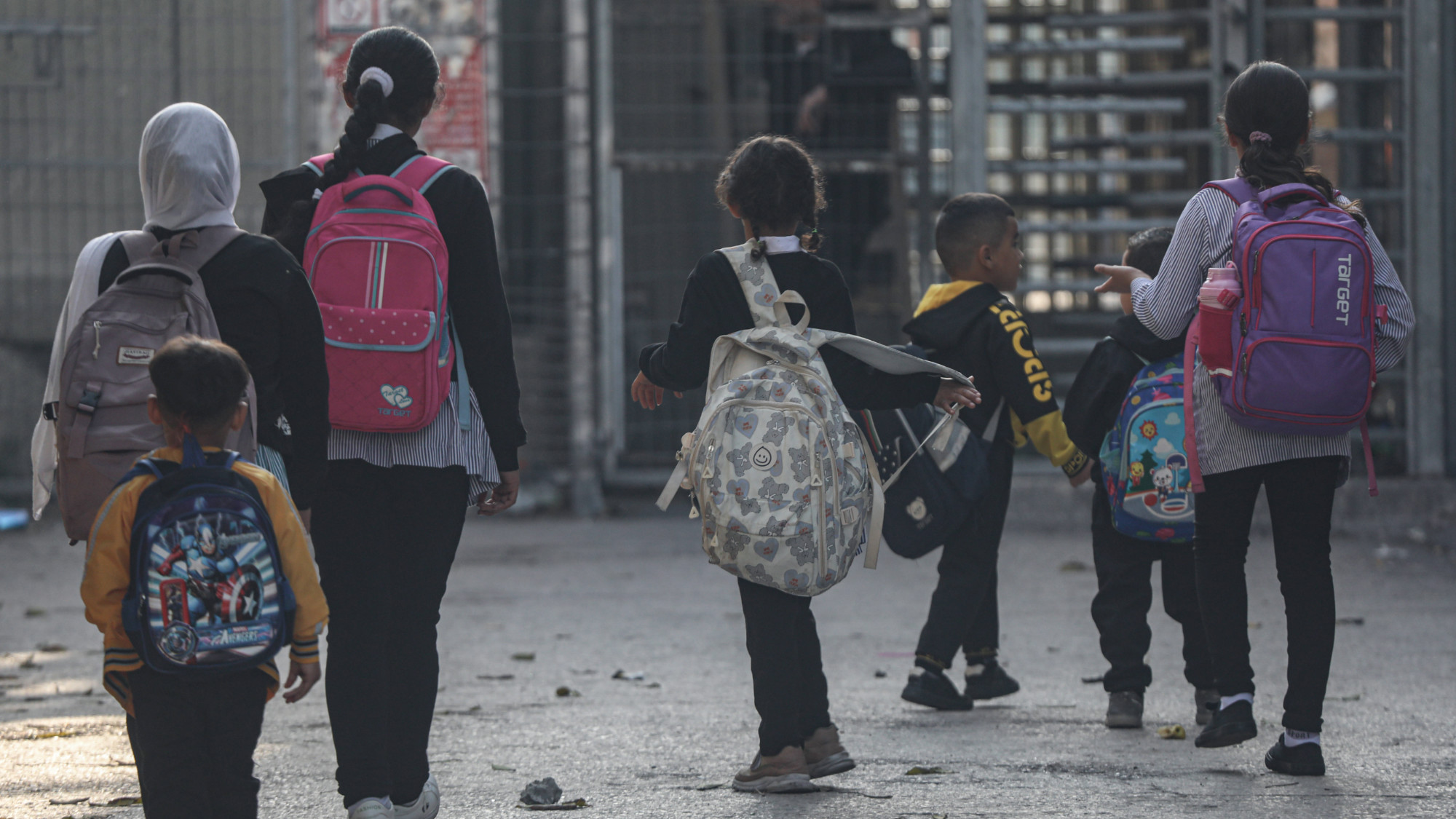
The Palestinian education system is experiencing a severe deterioration as a result of a protracted financial crisis within the Palestinian Authority (PA), compounded by the challenges of Israeli occupation. This has led to significant reductions in teaching hours, irregular salary payments for educators, and a dramatic decline in student performance.
Nevine Hamad, a resident of Ramallah in the occupied West Bank, has witnessed her son Jalal al-Din’s academic abilities weaken considerably. Once ranked among the top three in his class, his skills have regressed since Year Seven. He attends a government school that was initially established as a model institution with modern facilities and advanced teaching programs, but the educational environment has deteriorated over the past three years.
The crisis originated in 2021 when the PA began paying public sector employees partial salaries, sometimes as low as 60% of their full pay, and often irregularly. Education staff, who constitute more than half of all public sector workers, responded with prolonged strikes, further disrupting a system already struggling to recover from the COVID-19 pandemic.
At the start of the 2025/2026 academic year, the Ministry of Education reduced the school week to just three days after delaying the term by a week. This marked the second reduction in two years, following a previous cut from five to four days. Consequently, students have effectively lost half of their classroom time and curriculum coverage.
The impact on educational outcomes is now evident. Performance has dropped significantly, particularly in reading and writing. Parents and educators warn of ‘slow illiteracy’ in a society where education was historically a defining strength. Despite attempts to compensate with online lessons, parents acknowledge they cannot replace formal schooling, especially for complex subjects.
According to retired education supervisor Majed Abu Dawood, the Palestinian curriculum adopted in 2017 was designed for 182 school days. The compressed schedule has forced teachers to shorten explanations and deliver dense information in 40-minute lessons, overwhelming students. The ministry has attempted to address this through summarized ‘teaching packets,’ but completing the curriculum remains practically impossible.
Naseem Kabha, a member of the Palestinian Education Coalition, reports that government school students in the West Bank attended no more than 50 days in the first term of the current academic year—a learning loss of nearly half the curriculum. This has resulted in what Kabha describes as ‘educational alienation,’ with deficits accumulating as students move up grades without mastering foundational skills.
The crisis has fragmented education across the occupied Palestinian territories. While most government schools in the West Bank operate three days weekly, public schools in occupied East Jerusalem and private schools continue full-time schedules. In Gaza, the Israeli genocide since 2023 has left hundreds of thousands of students without access to education altogether.
In some areas of the West Bank, schooling has been completely halted due to prolonged military raids and settler violence. Seven-year-old Ghouson Yousef Kaabneh, displaced with her family due to settler attacks, exemplifies this reality. Despite bringing her Year Two textbooks during displacement, she has been unable to enroll in school due to safety concerns and distance.
Officials acknowledge the decline but offer limited solutions. Ayoub Alian, assistant undersecretary for educational affairs at the Ministry of Education, admits student performance is falling but attributes the crisis to circumstances beyond the ministry’s control, citing the challenges of operating ‘under occupation and without funding.’
Saed Erziqat, head of the Teachers’ Union, emphasizes that restoring full salaries would resolve the immediate issue, while Rifat al-Sabbagh of the Palestinian Education Coalition calls for a nationwide study to assess learning loss. The Central Parents’ Council has proposed solutions to secure funding outside the budget, but these have been rejected by the PA.
The situation echoes historical educational crises in Palestine, such as during the First Intifada in 1987 when popular education emerged as an alternative through community-organized secret classes. However, sociologist Wissam al-Rafidi believes such solutions are unlikely to work today without a supportive political framework. He advocates for developing alternatives that engage the new generation through cultural and educational activities outside schools, while cautioning against foreign funding that might undermine Palestinian national identity.