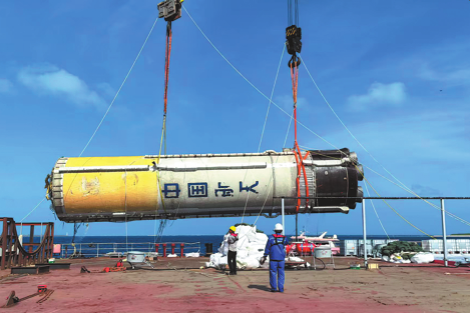
In a landmark achievement for its space program, China has successfully completed its first-ever maritime recovery operation of a rocket booster from the ocean. The China Manned Space Agency confirmed that the first-stage booster of the Long March 10 heavy-lift carrier rocket was retrieved from the South China Sea on Friday morning following a critical test flight conducted earlier this week.
The recovery mission represents a significant technological milestone, marking China’s inaugural successful retrieval of rocket components from maritime environments. Official imagery released by the space agency depicts a specialized vessel employing crane operations to lift the massive booster from the water, demonstrating the sophisticated recovery capabilities developed by Chinese aerospace engineers.
This achievement follows Wednesday’s comprehensive flight test of the Long March 10 first-stage booster combined with the Mengzhou crewed spacecraft, a configuration specifically designed for China’s ambitious manned lunar mission targeted for approximately 2030. During the experimental flight, the booster executed a controlled return to Earth utilizing its engine system and guidance fins, achieving a precise splashdown within a predetermined maritime zone.
The successful recovery operation positions China among an elite group of nations capable of rocket stage retrieval, a critical capability for developing reusable launch systems. Currently, only the United States maintains operational reusable rocket technology, making China’s accomplishment particularly significant in the global space race.
Developed by the China Academy of Launch Vehicle Technology, the Long March 10 represents a new generation of launch vehicles featuring a modular design with a central core booster and multiple side boosters. The rocket stands at an impressive 92.5 meters with a 5-meter diameter, generating 2,678 tons of thrust at launch with a total weight of 2,189 metric tons. This configuration enables the transportation of payloads exceeding 27 tons to Earth-moon transfer trajectories.
Spacecraft designers have revealed that the Long March 10 system will include a shorter variant without side boosters, measuring 67 meters tall with a 740-ton launch weight. This adaptation will serve China’s Tiangong space station operations, capable of delivering 14-ton payloads to low-Earth orbit for both crewed and cargo missions.
A key design feature across both configurations is the reusable first-stage booster, with the lunar mission variant incorporating an additional third-stage component. While the space agency has not disclosed specific plans for the recovered booster, this successful retrieval demonstrates substantial progress toward China’s goals of developing fully reusable launch systems and advancing its lunar exploration capabilities.