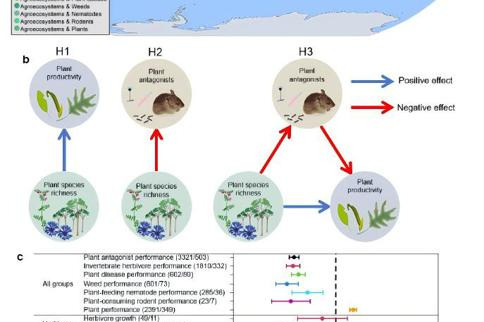
A groundbreaking international study spearheaded by Shanghai’s East China University of Science and Technology has demonstrated that cultivating multiple plant species simultaneously significantly enhances agricultural yields through natural pest and disease suppression mechanisms. The research, conducted in partnership with 18 institutions across nine nations, analyzed over 5,700 datasets from more than 600 global experiments spanning farmland, grassland, and forest ecosystems in both tropical and temperate regions.
The research team discovered that diverse plant communities employ sophisticated natural defense systems that are absent in monoculture plantations. These include the creation of a complex ‘scent maze’ from mixed plant odors that disorients specialized pests attempting to locate their host plants. Additionally, varied vegetation structures help regulate microclimates, effectively inhibiting the spread of disease spores and impeding pest migration patterns.
Professor Wan Nianfeng, the project’s lead researcher, emphasized that these synergistic effects collectively transform diversified planting systems into biologically resilient and highly productive ecosystems. The findings, recently published in the prestigious journal Nature Ecology & Evolution, provide scientifically innovative and practically feasible pathways for developing efficient ecological agriculture, forestry, and grassland management practices.
Building upon these discoveries, the research team has developed customized technical solutions adapted to different climate zones and crop varieties throughout China. Professor Wan highlighted that promoting these tailored planting techniques can substantially reduce dependency on chemical pesticides while simultaneously enhancing land productivity. This approach directly supports national food security objectives and facilitates the transition toward sustainable green agricultural practices.