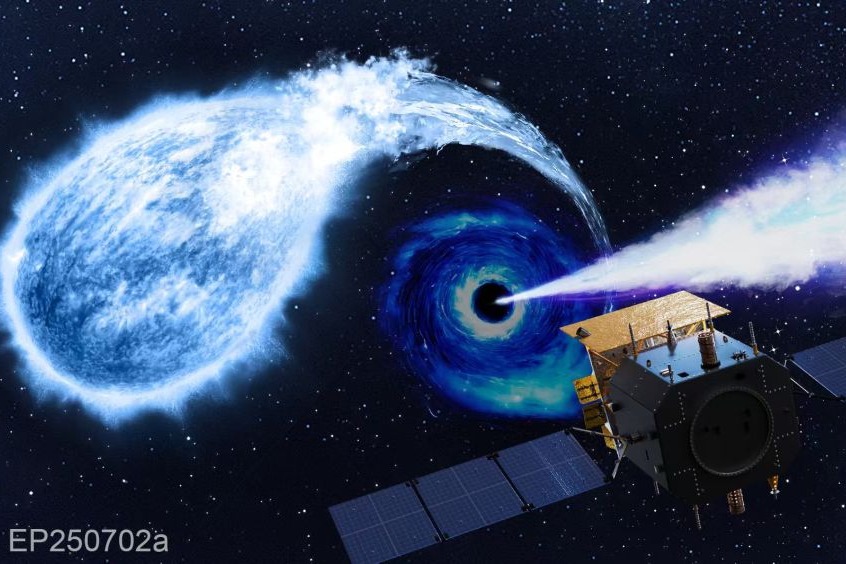
China’s astronomical research has achieved a groundbreaking milestone with the Tianguan satellite, internationally known as the Einstein Probe, potentially recording the first-ever observation of an intermediate-mass black hole violently consuming a white dwarf star. The National Astronomical Observatories of the Chinese Academy of Sciences (NAOC) announced this extraordinary discovery, marking a significant advancement in cosmic phenomenon documentation.
The pivotal detection occurred on July 2, 2025, when the satellite’s Wide-field X-ray Telescope (WXT) identified an exceptionally luminous and rapidly evolving X-ray source during standard sky surveillance. Designated EP250702a, this event prompted immediate international collaboration among astronomers worldwide, triggering multi-wavelength observations across the global scientific community.
Research published in Science Bulletin’s cover article presents compelling evidence that the observed phenomenon represents a tidal disruption event of unprecedented nature. The scientific team notes that the burst’s distinctive characteristics—including its brightness evolution, radiation pattern, and spectral features—differ markedly from any previously documented cosmic explosion.
Associate Researcher Zhang Wenda of NAOC explained that the event closely resembles theoretical predictions of jetted tidal disruption occurrences, where celestial bodies are torn apart by immense gravitational forces. White dwarfs, the ultra-dense remnants of deceased stars, possess densities approximately one million times greater than our Sun. Theoretical models indicate that only intermediate-mass black holes—ranging from hundreds to hundreds of thousands of solar masses—generate sufficient tidal forces to dismantle such compact objects rather than consuming them intact.
Researcher Jin Chichuan emphasized that the observed ultra-short timescale, extreme peak luminosity, and subsequent emergence of a soft X-ray ‘afterglow’ provide strong evidence supporting the white dwarf disruption scenario. This process theoretically produces brief, intense energy bursts typically accompanied by luminous, high-velocity jets consistent with EP250702a’s observed properties.
Principal Investigator Yuan Weimin highlighted that this discovery demonstrates Tianguan satellite’s unique capability to capture unpredictable transient cosmic events. The mission’s sophisticated monitoring technology has not only enabled the first documentation of this extreme astrophysical phenomenon but also signifies China’s substantial contribution to international astronomical exploration and understanding of the universe’s most violent processes.