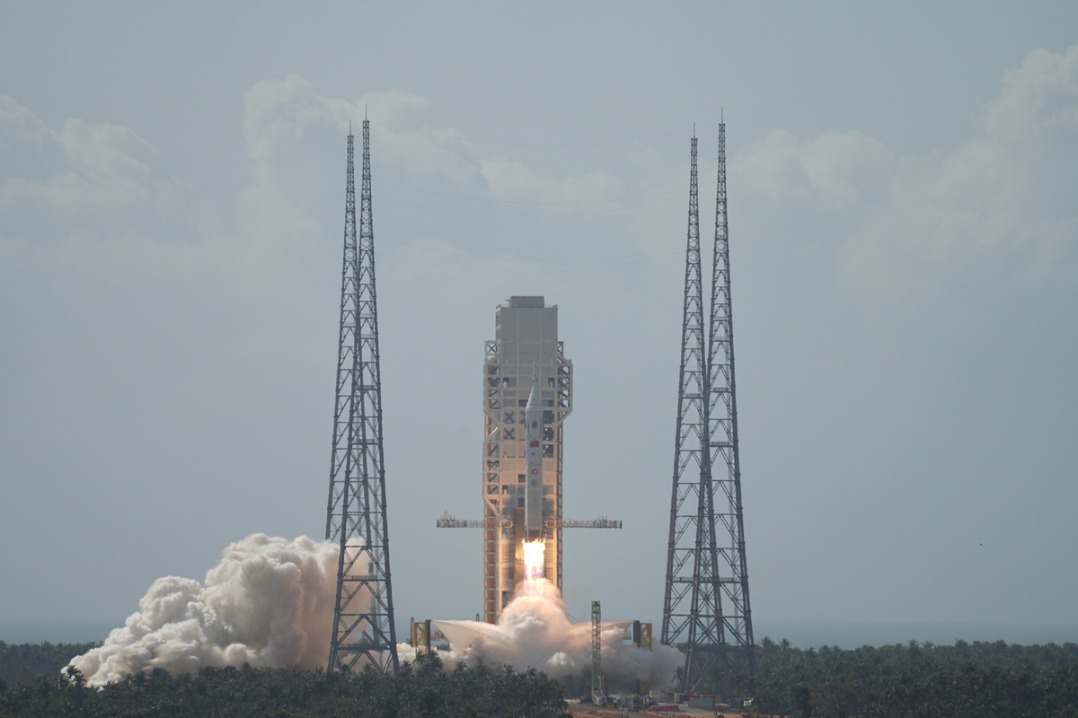
China has successfully executed a groundbreaking flight test that marks a significant advancement in its ambitious lunar exploration program. On February 11, 2026, at the Wenchang Spacecraft Launch Site in Hainan province, Chinese aerospace engineers conducted simultaneous tests of both the Long March 10 carrier rocket and the next-generation Mengzhou crewed spaceship system.
The comprehensive demonstration involved a low-altitude verification flight for the heavy-lift rocket alongside a maximum dynamic pressure (Max Q) abort test for the Mengzhou spacecraft. This dual-purpose mission represented multiple firsts in China’s space exploration history: the inaugural flight test of the Long March 10 prototype, the country’s first Max Q escape operation for a spacecraft, the maiden sea splashdown of both a crew capsule and rocket booster, and the initial operational use of Wenchang’s newly constructed heavy rocket launch infrastructure.
The meticulously orchestrated sequence began with the Long March 10 prototype booster launching from the coastal spaceport, carrying the Mengzhou spacecraft prototype. At the critical Max Q phase—where aerodynamic forces peak during ascent—the spacecraft’s return capsule successfully separated using its rocket-powered escape tower. After achieving predetermined altitude, the capsule deployed parachutes and was successfully recovered from the South China Sea.
Concurrently, the rocket booster continued its trajectory, crossing the Kármán line into space before executing a controlled return. Through sophisticated maneuvers involving grid fin deployment, reaction control system activation, and precisely timed engine reignitions, the massive vehicle achieved a stable hover before making a controlled splashdown—marking China’s first successful recovery of a rocket booster and demonstrating reusable rocket capabilities previously mastered only by the United States.
Technical experts highlighted the extraordinary challenges overcome during the test. Zhu Pingping, chief engineer at China Aerospace Science and Technology Corporation, emphasized that the booster endured unprecedented thermal fluxes and aerodynamic loads during reentry, pushing the limits of structural integrity, thermal protection, and altitude control systems.
The Mengzhou program’s deputy project manager, Deng Kaiwen, explained that the Max Q escape test validated the spacecraft’s ability to safeguard astronauts during the most aerodynamically demanding ascent phase, requiring exceptional reliability from the escape tower and computer systems.
Both the Long March 10 rocket and Mengzhou spacecraft, currently in final development phases, represent critical components of China’s strategy to land astronauts on the moon before 2030. The rocket’s configuration includes a 92.5-meter tall moon mission variant capable of delivering 27-ton payloads to lunar transfer orbit, plus a shorter version for space station missions. The Mengzhou spacecraft, measuring 9 meters long with 4.5-meter diameter, will eventually replace the veteran Shenzhou capsules that have served China’s crewed space program for nearly three decades.