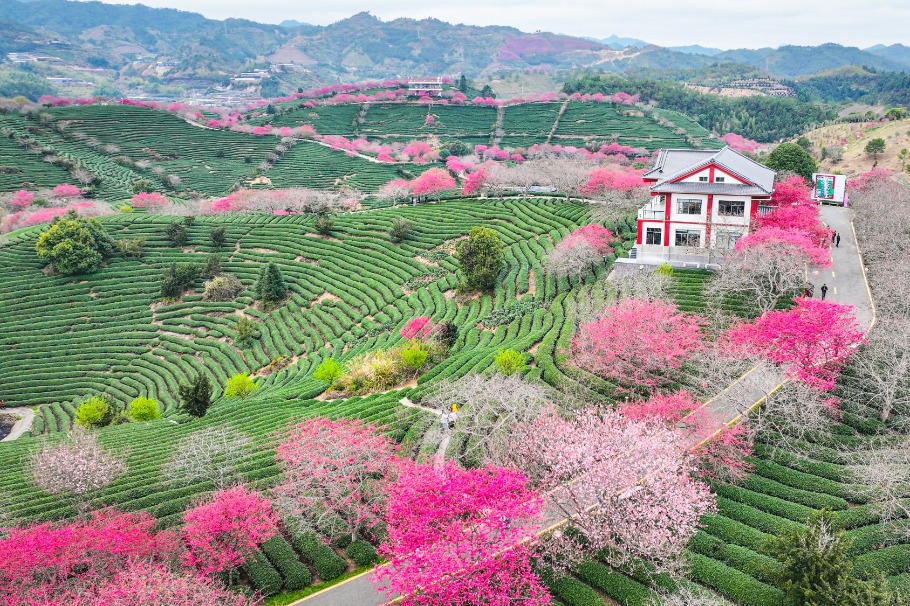
The picturesque hills of Yongfu town in Zhangping, Fujian province, have erupted in a spectacular display of color as the annual Cherry Blossom Cultural Tourism Festival opens to the public. This year’s event, running through February 28, showcases what has become known as China’s mainland equivalent to Taiwan’s famed Alishan Mountain scenery.
The transformation of Yongfu represents a remarkable case study in agricultural innovation and cross-strait cooperation. The story begins in 1997 when Hsieh Tung-ching, a pioneering tea farmer from Taiwan, recognized the region’s geographical and climatic similarities to Taiwan’s premier oolong tea growing regions. What followed was decades of dedicated cultivation that turned previously barren hills into thriving tea terraces.
The agricultural landscape gained its distinctive character when Taiwanese farmers introduced cherry trees to create a strategic ‘tea-cherry symbiosis’ system. This innovative approach has produced stunning visual ribbons of pink blossoms weaving through emerald green tea fields, creating what locals call the ‘tea-green and cherry-red’ phenomenon that now attracts visitors nationwide.
This year’s festival features 42 varieties of cherry blossoms alongside cultural activities including traditional Hanfu fashion shows, tea ceremony demonstrations, and photography exhibitions that highlight the shared cultural heritage across the Taiwan Strait. Visitors can wander through pink-canopied pathways or enjoy scenic train rides through the sprawling terraces.
The economic impact has been substantial. Yongfu has developed into mainland China’s primary production center for Taiwan high-mountain oolong tea, hosting 86 Taiwan-funded enterprises that collectively produce 1,600 metric tons of tea annually. The industry generates over 1.5 billion yuan ($216 million) in output value while providing employment for more than 10,000 local residents.
The Taiwan Farmers’ Entrepreneurial Park in Yongfu, established in 2008, has achieved top national performance evaluations for eight consecutive years. The festival continues to evolve with immersive light shows and educational exhibitions that tell the story of cross-strait collaboration, while agricultural experts work jointly to develop national standards for Taiwan-style oolong tea production.