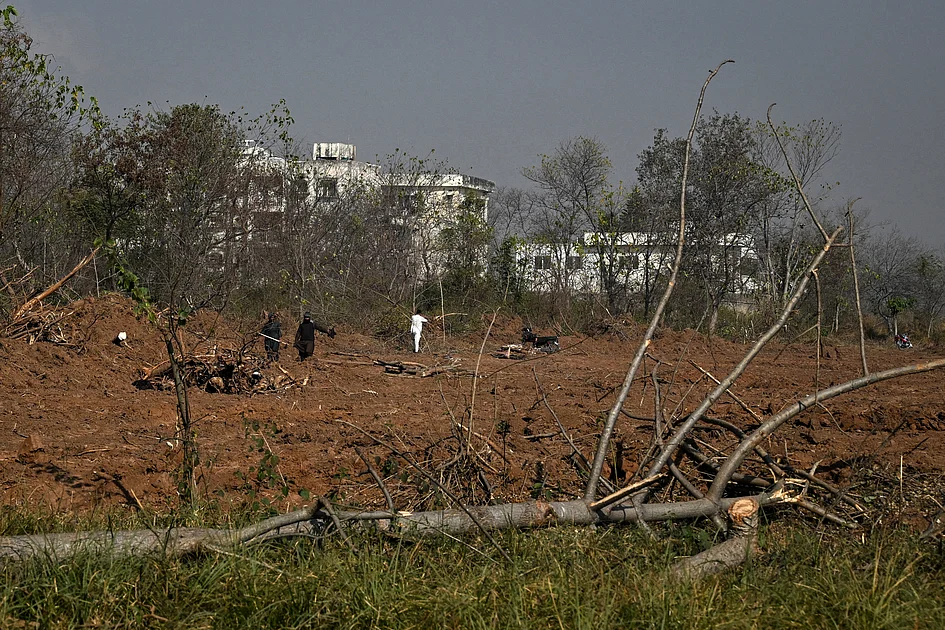
Islamabad—once celebrated as Pakistan’s meticulously planned green capital—now faces an environmental crisis as widespread tree removal sparks public outrage and legal challenges. The city, originally designed in the 1960s with expansive parks and tree-lined sectors, has witnessed accelerated deforestation linked to infrastructure expansion and military monuments.
According to Global Forest Watch, Islamabad lost approximately 14 hectares of tree cover between 2001 and 2024—equivalent to 20 football pitches—though net changes accounting for replanting remain unspecified. Residents like Muhammad Naveed have initiated lawsuits against authorities, citing “large-scale tree cutting” that leaves land “barren.” The World Wide Fund for Nature attributes this ecological degradation to rampant development projects.
The deforestation coincides with deteriorating air quality. Last month, Islamabad recorded zero days with healthy air quality, with most days classified as “unhealthy” or “very unhealthy” by IQAir. Forests traditionally serve as natural air filters, absorbing pollutants and mitigating urban heat, but their rapid disappearance exacerbates environmental health risks.
Officials from the Capital Development Authority justify partial tree removal by citing pollen allergies primarily caused by paper mulberry trees—a species planted extensively during the city’s early development. The government plans to remove 29,000 pollen-producing trees, though critics argue this rationale masks broader militarized urbanization.
Anonymous government sources acknowledge military-linked land clearance for monuments commemorating recent conflicts with India. At one express highway site, over six hectares were cleared without subsequent replanting, indicating infrastructure-driven motives. Pakistan’s influential military, historically engaged in politics and economy, faces allegations of unchecked development practices.
Environmental advocates emphasize that solutions require strategic replanting with non-allergenic species and transparent urban planning—not indiscriminate removal. As court cases proceed and bulldozers continue reshaping the capital, Islamabad’s identity hangs in the balance between modernization and ecological preservation.